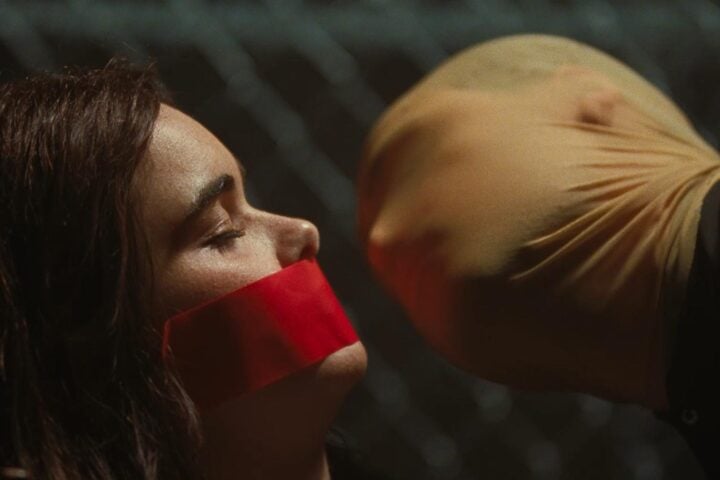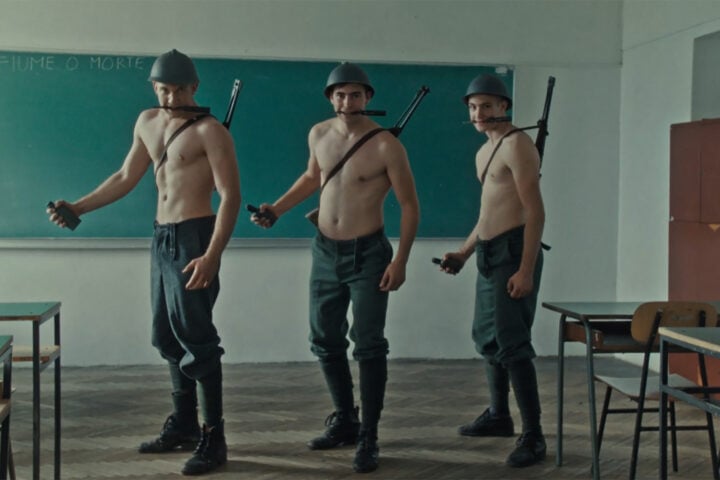
“She says…I say,” filmmaker Sophy Romvari clarifies after catching that she’s mistaken herself for Sasha, the protagonist of her debut feature, Blue Heron. It would be tempting to deem such moments in our chat as Freudian slips, were her work not so consciously mining the subconscious associations between cinema and memory-making.
In her short films, Romvari often blurred the boundaries between fiction and documentary, as well as between reality and re-enactment. Her approach to the fluidity between forms and styles dovetails movingly with her open-hearted emotional exploration of the devastating interplay between love and loss. These artistic expressions coincided with her academic pursuits at York University, all culminating in her master’s thesis project, “Still Processing.”
That short, in which Romvari documents the digitization of archival family photographs from her childhood, functions like a companion piece to Blue Heron. Through a fictionalized proxy, Sasha (Eylul Guven as a child and Amy Zimmer as an adult) allows Romvari the opportunity to work through many autobiographical elements with some critical distance. Much of Sasha’s experience mirrors Romvari’s as the youngest daughter in a large Canadian-Hungarian family observes the strain put on the household—especially her unnamed parents (Iringó Réti and Ádám Tompa)—by the behavioral troubles of her teenage brother, Jeremy (Edik Beddoes).
Blue Heron uses cinematic tools to excavate Romvari’s childhood memories. What starts as a tenderly recreated family album soon takes a self-reflexive turn, calling into question the value of replaying and rethinking such episodes. In her adult years as a filmmaker, Sasha contemplates both the aesthetic and therapeutic value of turning life into art to an enriching effect for Romvari as well as any viewer who engages with the character’s journey.
I spoke with Romvari in New York ahead of Blue Heron’s theatrical release about how her feature builds on her short work, why she doesn’t shy away from cinema’s cathartic power, and how making the film has changed her relationship with her parents.
You quote Joe Lambert in the intro of your thesis defense for “Still Processing”: “If we can keep our stories at the right distance, it’s much easier for us to drop into this moment, into the people we are right now, and let ourselves become a bit freer to dance into our lives.” How do you think about this in relation to Blue Heron?
Wow, you’ve done your research! [laughs] I think that’s a really great reference point, because what I’ve always been trying to do is find the right distance. I spent a long time with my shorts navigating that distance from variations of right in my face, and then a variety of modes of telling this story or these themes from different perspectives. But Blue Heron is the first time where I feel like I locked in on that distance. This was the distance I was aiming for all along. That’s not to say the other films don’t have their place, but I feel like now I’ve found a way to communicate what I’ve been trying to communicate because I found the right distance.
How were you expanding on the simplicity of your short film work in Blue Heron, making it a choice rather than something done out of necessity?
Intentionality costs money! Being able to fulfill your intentions can take more resources. This is still a very small budget movie, let’s be real. I think a big part of what I tried to focus on, which was free, was working on the script: making it as cohesive as possible, making sure that the structure was already there. The script and the final product are quite similar. That [focus] can really save a lot of time, because you can spend so much money and time shooting things that you don’t need. Then, you’re trying to find your film in the edit, which is a very valid process. But I really wanted to make sure that I wasn’t falling into that hole because I knew I had a very tight budget and a set of limitations that were just going to be enough to pull it off.
I’m fascinated by the way your film, as it goes along, collapses time in a way that I felt made such an intuitive, emotional sense. How were you sorting it out from a logical sense as well, if that was a consideration?
You can look at it in two different ways. One is that it’s half and half, because you have this child character, and then we shift into the adult character. They’re pretty 50/50, in terms of perspective. But you can also look at it as these three parts, which are past, present, and past/present, and that was structurally in the script. I wanted to have it be very jarring, the fact that we’re pulled out of childhood and into this adulthood with the context, trying to extract this fallible sense of memory. And ultimately, by the end, [we have] the acknowledgement that it’s quite fallible, and you’re not going to be able to recreate these things or reanimate a person.
Even so, I also wanted to use the structure to think about the possibilities and also the limitations of filmmaking, especially fiction filmmaking. I’ve spent a long time working in hybrid forms, and this was my way of really taking everything I had learned with my short films and putting them into this [feature] film. Everything from how to direct actors from a naturalistic perspective, how to quickly establish emotional beats, how to use non-actors and make them feel like actors on screen…it took everything I had!

On the practical level of directing actors, how did you get contemporary children to understand the pace of millennial childhood? There’s such a sense of playfulness and boredom from that era that’s uncommon now.
I think that they were aware that they had knowledge of the present day that they weren’t supposed to have. It was funny to take away all the digital resources and then have them be bored and wanting to capture what it was like to be a child without an iPad or an iPhone. And the thing is, you do play with throwing a hot dog and trying to catch it in your mouth, play on the trampoline, or play with water balloons. I was trying juxtapose childhood boredom with the chaos and dysfunction, and how those two things comingle and become the norm for this family. Because I wanted to show that this is a normal family. There’s just this member of the family that’s a disruption to the norm, but he’s also part of the norm of this family.
Filmmaking is about controlling something that feels so uncontrollable, especially the flow of time. Were there any particular instances where you had to surrender and let your inability to control guide the project?
That was a big acknowledgement for me, making this movie, how much of my filmmaking and my desire to be a filmmaker is my desire to control time, and this existential acknowledgement of not being able to. Because I did so much prep, I feel like I was able to pivot and move more seamlessly as a director on set when things would happen that were not planned, or just take advantage of things that were presented to me as well.
There’s a bizarre coincidence that every day we were on set at the house, this cat would show up. It was just, I assume, the neighborhood cat. He was very friendly, and he would present himself to the crew to be petted. And it was funny, though, because my production designer, Victoria [Furuya], had studied a lot of my home video footage and my parents’ photography. She said, “Is that not the cat that you had at the age that we are now depicting?” And I’m like, “It actually is.” It was a tabby cat that looked exactly like the cat that I had. Instead of ignoring that ridiculous coincidence, we put it in the movie. It’s a very small thing, but I’m just trying to utilize what the universe is throwing at [me]. If it’s there and you’re being nudged, you might as well.
Sasha’s father often documents events with his camera from the periphery of events, while she’s often recording from the center of them. How do you see this intergenerational connection and disparity in how to capture reality unfolding?
I was trying to show a character who’s a product of her environment, as we all are. I tried to find little ways to subtly integrate what she learns from her parents and how that reflects now in her adulthood. Her becoming a filmmaker, to me, now feels—her, and me, as well—very obvious. The circumstances that this character is growing up in and learning to see the world through a lens and a camera, as it’s quite literally, at one point, handed to her by her dad, the way that things are handed to you from your parents, I was trying to find all the ways I could imply that.
As well as with the mother, like where she records the conversation that she has with the psychiatrist, I tried to imply that it wasn’t necessarily with permission granted. And then you see Sasha, when she comes back to the house, that she’s pressing record on her iPhone. She’s going to do the same thing: record that conversation. These little things that you pick up and you learn subtly from your parents, they create who you are as a person. I was trying to do a lot of different things, like the acknowledgement of memory and grief, but then also [show] what makes her into who she is. By doing that, I did ultimately acknowledge or learn that the outcome of how my life turned out was already predetermined, in a way.
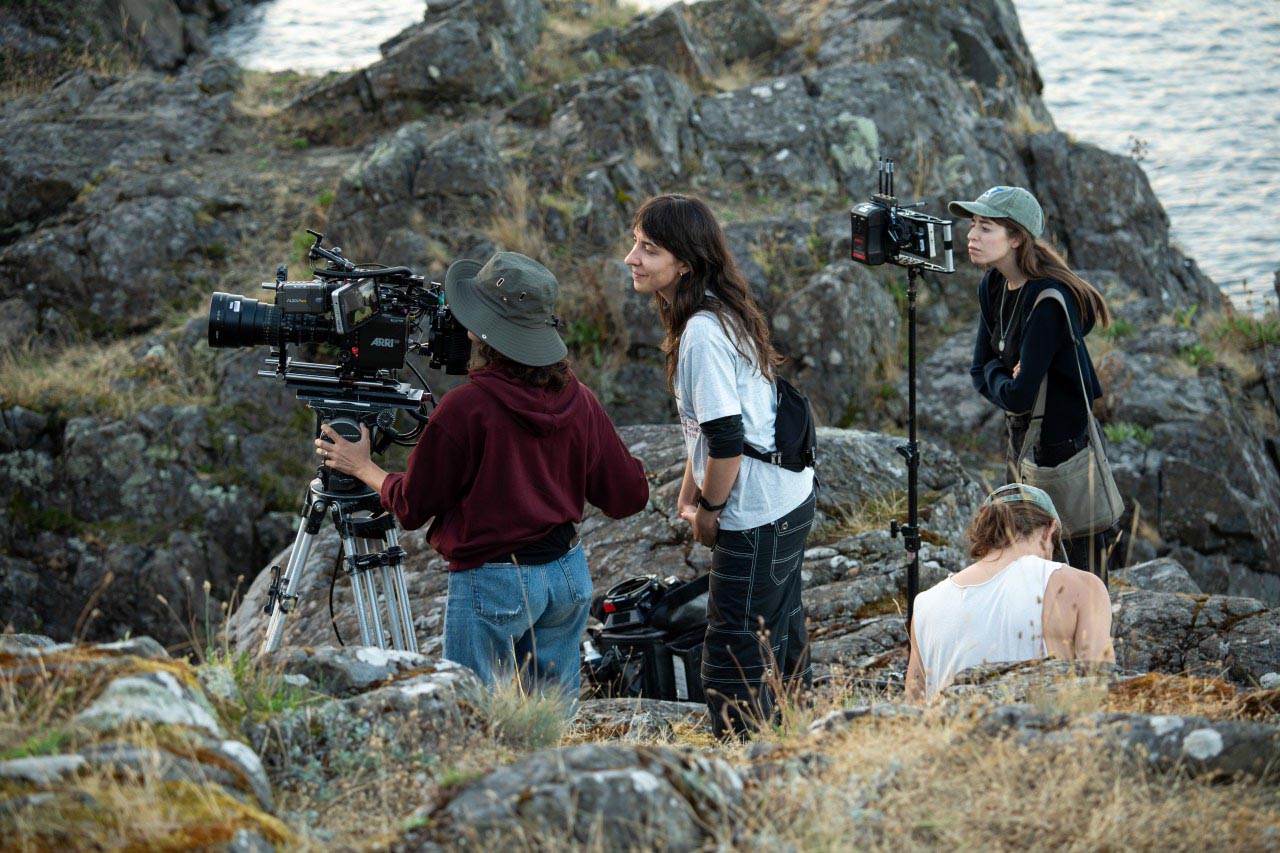
You mentioned in your Letterboxd list of inspirations that the zooms in Robert Altman’s Short Cuts influenced Blue Heron’s camera language. Since your short film work is so heavily based on static tableaus, how were you and your DP, Maya Bankovic, expanding your visual vocabulary?
Once you start zooming, it’s quite hard to stop. It’s inherently evocative because you’re bringing someone closer in to something. From a budget and limitations [perspective], it was also very intentional. If you bring a dolly into a filmmaking process, you’re cutting your day in half because of the time it takes to set up a dolly, hit the mark, light for a dolly, and all these different aspects. You need more crew! We were able to accomplish a sense of movement and dynamic blocking without ever having to move the camera, so that was a big part of that decision. And also, we watched a lot of my dad’s home videos again, and Maya felt very moved by the way he was using the camera. That was a big part of the inspiration as well, mimicking this loving gaze through the zoom lens and trying to find moments that are mundane but elevated by the zoom.
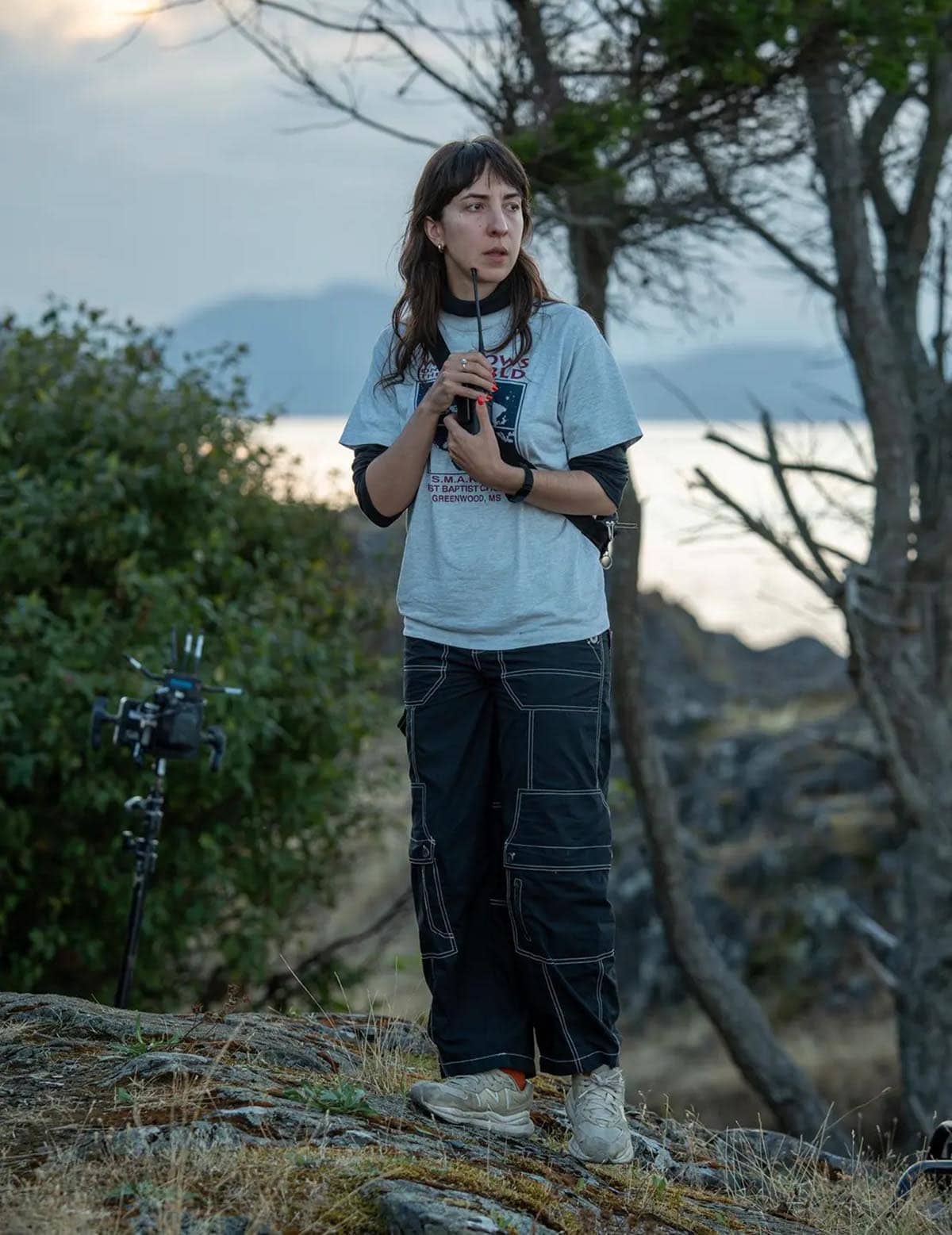
I find that many filmmakers swear off any connection between cinema and therapy or social work, but you embrace looking for those connections. What motivates you to find those points of overlap?
It’s my worldview! Movies are such a big part of my worldview, growing up with parents who were also very cinephilic, watched a lot of movies, and were very art-forward, it’s just the way that I have always seen the world. I did my master’s on this, so the topic of using filmmaking as a mode of processing is inherent to the way that I understand the world.
What I would agree with in those other filmmakers is that it can’t be a substitute for therapy in and of itself. But I would be lying if I said that this film didn’t benefit me greatly emotionally, because I think making this film allowed me to accept the limitations of what I’m able to do for my parents. The film, because I’ve spent so long trying to fill a hole for my parents, is my attempt to acknowledge what that experience has been like from my point of view.
Now I am, in a way, able to move on from that. It’s a massive privilege to get to make a film that allows you that process. I spent years developing the script and making the movie, so now I’m steeped in that understanding. There’s no way that’s not having an impact on my process and on my evolution as an artist—but also as a human being.
Among many things that Blue Heron represents, you’ve said it’s a gift for your parents. I can tell that you’re fluent in cinema as a love language, but do you find they’re equipped to receive this gift?
Again, because I didn’t have to fight to become an artist or a filmmaker, it wasn’t like my parents were sitting around expecting me to become a doctor. They wanted their kids to be artists, actually. When I started to make films that were personal and also about my family, there was a tension, and it’s obvious. It’s in “Still Processing.” But after I made “Still Processing,” and after they saw it, they were so moved. There was such a greater understanding of what it was I wanted to do with my work, and then that trust built into me making this film.
When they saw this film, they were moved very much, but also really impressed with the craft of the filmmaking, honestly. That was very validating. Any kid wants their parents to acknowledge the work that they’re doing in their life, but mine was very direct. I made this work to acknowledge what I saw my parents go through from an adult perspective. As a child, you don’t understand. As an adult, you’re able to put those pieces together. But it was important to me that the characters in the film were also fallible, real people.
You’ve said “Still Processing” was more about catharsis and Blue Heron was about acceptance. How do you think about how to undergo these journeys for yourself while also “cheating out” to make them valuable to an audience?
By putting the specificity of my own experiences first, it allows that second part to occur. It’s like the quote you mentioned at the beginning to find the right distance. I studied a lot of work before “Still Processing,” but also Blue Heron, and I found that the distance in certain films wasn’t there for me. It doesn’t allow you in, and I think I really do want to make work that allows people to enter into the story, but also to feel reflected. That’s the gift that you can provide as an artist: a space for people to feel acknowledged. When it becomes a communal experience, it’s also beneficial to me. It allows me to feel less alone in the experience, and then they feel less alone. So it works really in tandem that way.
I love the moment in the film where there’s a whispered secret between the younger and the older Sasha. Is that at all emblematic of these tandem journeys?
There’s a line in “Still Processing”: “There are some things that can’t be said out loud.” I do also really like it in films when things are being withheld from the audience purposefully. I knew I wanted there to be an acknowledgement between the two characters. It’s funny because most people focus on Sasha seeing her younger self. But for me, that scene is much more about her seeing her brother. At that point in her life, her brother had passed away, so she’s seeing her brother and trying not to react as though she’s seeing her brother alive for the first time in years in front of her childhood self. There are many layers for it to me.
I think the whisper itself was partially inspired by Citizen Kane, to have this whisper and the meaning behind it be a big part of the thesis of what you’re trying to uncover through childhood memory as well. Another film that does it is Lost in Translation. There are so many tiny little inspirations that weasel their way into the work without always being conscious. The whisper, I know what they said to each other, but I’ll never say.
Since 2001, we've brought you uncompromising, candid takes on the world of film, music, television, video games, theater, and more. Independently owned and operated publications like Slant have been hit hard in recent years, but we’re committed to keeping our content free and accessible—meaning no paywalls or fees.
If you like what we do, please consider subscribing to our Patreon or making a donation.