Writer-director Igor Bezinović plays up the farcical side of history in Fiume o Morte!, his innovative docudrama retelling of Italian fascist poet Gabriele D’Annunzio’s short-lived occupation of Rijeka, Croatia, in 1920. With shades of Radu Jude’s I Don’t Care if We Go Down in History as Barbarians, Josua Oppenheimer’s The Act of Killing, Peter Watkins’s La Commune (Paris, 1871), and even Christian Petzold’s Transit, the film juggles archival material and reenactment to transpose history onto the streets of modern-day Rijeka.
In the film’s introductory shots, Bezinović’s voiceover informs the audience that Rijeka was once two cities: Fiume and Sušak. If that weren’t enough, he adds, “Throughout the 20th century, our city was located in eight or nine different countries.” That statement alone should give a sense of just how arbitrary borders and nationalisms can get in the wake of an imperial collapse, Austro-Hungarian in this case. Opposed by the Italian state yet financed by Italian bankers and industrialists, not to mention applauded by Mussolini, D’Annunzio’s occupation of Rijeka stands out as an episode of preposterous adventurism.
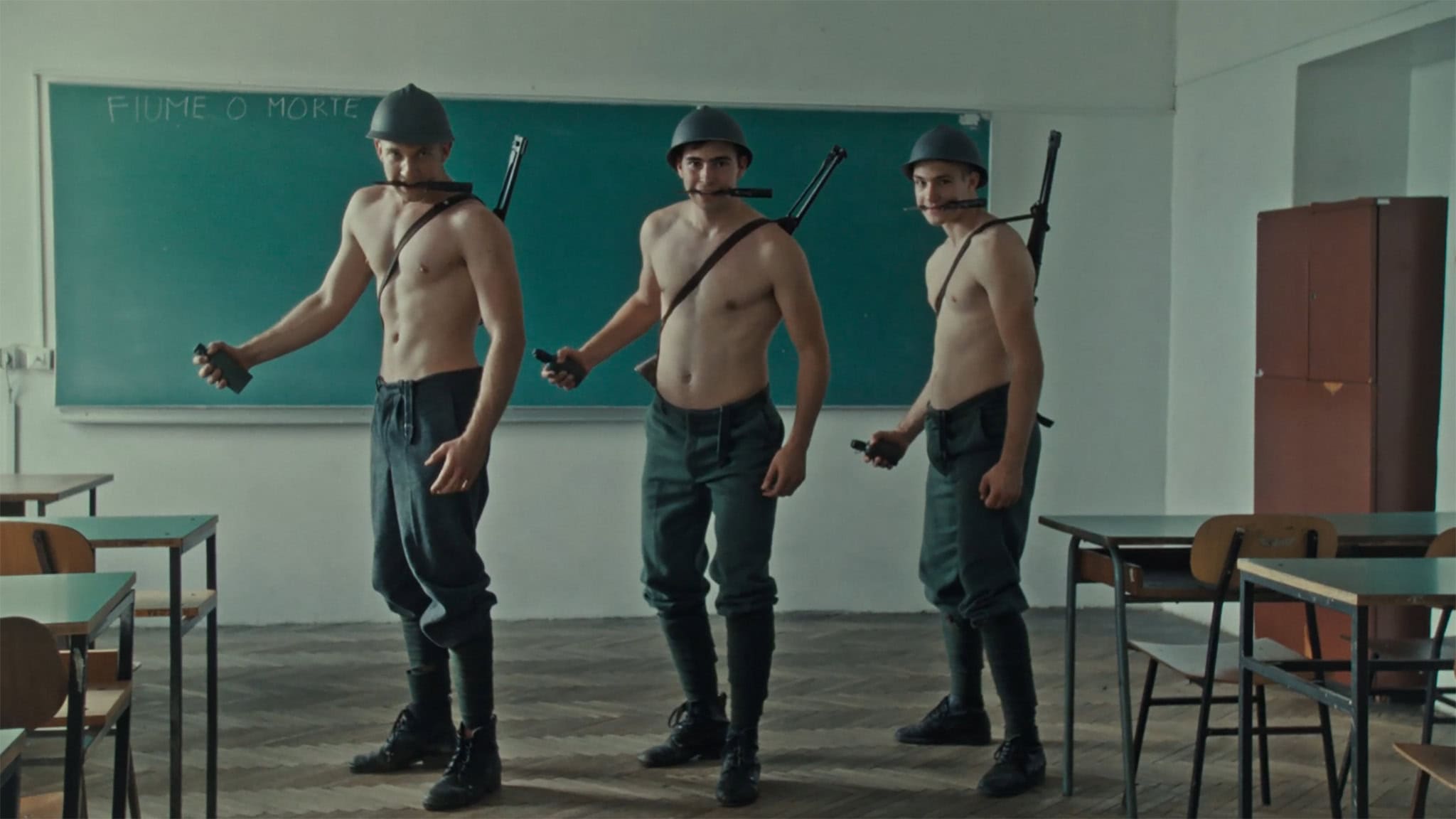
The role of D’Annunzio is played by no fewer than eight nonprofessional actors (Ćenan Beljulji, Tihomir Buterin, Andrea Marsanich, Izet Medošević, Massimo Ronzani, Milovan Večerina Cico, and Albano Vučetić), chosen largely for their baldness and ability to speak the Fiuman dialect. In one patently ridiculous shot, several of them appear together, all striking the same heroic pose on the Karst Plateau overlooking Rijeka. The poet comes across as a parody of Mussolini—said to have compared D’Annunzio with a rotten tooth, to either be pulled out or covered with gold. But the multiplication of actors also reflects a conflicted history, as the same figure may be viewed in as many ways as there are perspectives. If D’Annunzio wanted nothing more than to be remembered, Bezinović will remember him, not as a hero but as a clown.
Bezinović’s principle tool in this reframing is the graphic match. For some shots, he holds an archival photograph of Fiume before the camera, then lowers it to reveal the same location in modern-day Rijeka, replacing any pictured figures with actors holding the same poses. For others, he cuts from archival to contemporary footage. It may be a gag, but it’s a strangely inexhaustible source of visual fascination.
Graphic mismatch might be a more apt descriptor, as Bezinović plays in the gaps separating archive from recreation. Besides the tension between stillness and movement, black and white and color, he intentionally alters other elements. One shot, for example, recreates a photograph of D’Annunzio’s friend Guglielmo Marconi (Nikola Tutek) dressed as an admiral and surrounded by Legionnaires—except that in the recreation, the soldiers are staring at their cellphones. This tweak ends up being a great innovation. In a film like La Commune, reenactment against the artificial backdrop of a warehouse leads to unexpected verisimilitude, but here, taking place on historical location, it has the opposite effect. The reenactors look ridiculous, sometimes breaking out into laughter.
For the most part, Fiume o Morte! is all in good fun. As a resident of Rijeka himself, Bezinović has the right to a certain flippancy, and for all that, he has a serious, as well as timely, lesson to impart. Fascism tends to start as a publicity stunt. It’s only when people start taking it too seriously, on its own terms, that it gains a toehold in reality. Fascists demand that we accept their grandiose reframing of history in terms of lost glory—as opposed to the farce, at once corny and abhorrent, that we, the playthings of history, more often experience it as.
Bezinović takes a different approach, never allowing us to forget the provisional, ramshackle frivolity of his storytelling. What attitude to take when fascism does establish that toehold, and starts annulling elections or kidnapping scapegoats, isn’t a question that Fiume o Morte! seems equipped to answer. That may be a byproduct of that fact that it tells this story from the perspective—no matter how fragmented, ventriloquized, or satirized—of D’Annunzio, and not the citizens who lived through his occupation.
Since 2001, we've brought you uncompromising, candid takes on the world of film, music, television, video games, theater, and more. Independently owned and operated publications like Slant have been hit hard in recent years, but we’re committed to keeping our content free and accessible—meaning no paywalls or fees.
If you like what we do, please consider subscribing to our Patreon or making a donation.