The juxtaposition at the core of director James Hawes’s frustratingly staid One Life is between the gravity and urgency of Nicholas Winton’s Kindertransport rescue movement, which began almost a year before the start of World War II, and the man’s relative obscurity in 1987 living in Maidenhead, England. Winton helped to save 669 children in Prague from the horrors of the Holocaust, so Hawes’s film constitutes an attempt at immortalizing an unsung hero. But given the profound lack of risk that it takes in depicting Winton’s heroic efforts, One Life seems ironically destined to also fade into obscurity.
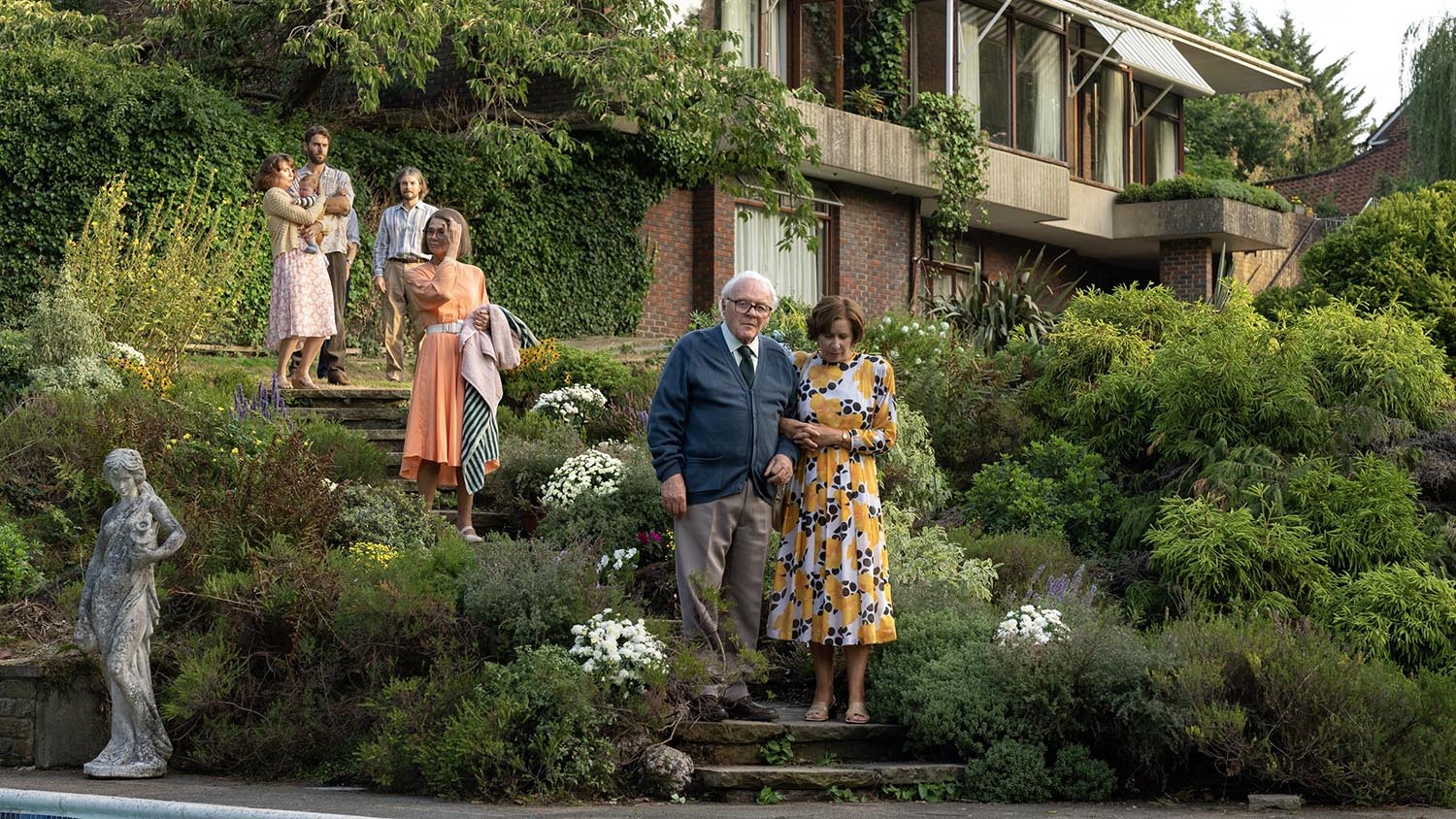
Throughout, One Life toggles between two time periods. In one, the young Winton (Johnny Flynn) conceptualizes and then carries out his humanitarian mission to move as many refugee (and mainly Jewish) children as he could out of Czechoslovakia, and in the other, the seventysomething Winton (Antony Hopkins) lives a quiet life in Maidenhead with his wife, Grete (Lena Olin). The film opens with the stockbroker turned human rights activist counting coins from charity tins and pocketing a button that someone dropped into one of them. Without context, someone unfamiliar with Winton would think that he’s your run-of-the-mill senior citizen, a meticulous man, sure, but one who seems to hoard because he has nothing else to do.
Winton’s office overflows with stacks of files, and when Grete goes out of town one day, the man sets out to clean house, at times trailing off in remembrance, and it’s here that you vaguely sense that this cleansing is a means for him to grapple with something about his past. Really, though, it becomes a handy springboard into the past, when his life was no less cluttered by officialese.
Cut to the seeds of the Kindertransport being planted, with young Winton communing with refugees in Prague and butting heads with bureaucratic figures in London. When setting the operation into motion through proper channels proves difficult, he enlists the help of his mother, Bobi (Helena Bonham-Carter), whose resourcefulness can be traced to her son, in the present timeline, successfully getting a parking meter to accept the aforementioned button.

Hawes and co-writer Lucinda Coxon emphasize just how herculean an effort it was for Winton to pull off his mission in scene after scene of the man chafing against a maze of red tape. In quickly edited montages, Winton and his colleagues, most notably Alex Sharp (Trevor Chadwick) and Doreen Warriner (Romola Garai), beg for resources, including visas, from tight-fisted immigration authorities. These sequences offer a clear-eyed look at the nuts and bolts of Winton’s operation, but they don’t do nearly enough to communicate just who Winton is, and this indifference to the niceties of characterization leaves the audience wanting more.
Perhaps that lack of clarity is purposeful. In one scene, a colleague and close friend of Winton’s, Martin Blake (Jonathan Pryce), tells our protagonist over lunch that he should be proud of his life’s work. It’s a moment that communicates clearly, perhaps too clearly, that Winton’s humility explains why his deeds were kept out of the public eye for so long. But what’s at the root of that humility? In what ways does he think about his family, not to mention the people he saved? In an effort to present the ins and outs of the Kindertransport in as formally neat and tidy a way as possible, the film keeps its main character at a frustrating remove. We learn that, yes, he was “compelled” to action, but One Life doesn’t do the difficult work of telling us why.
Given the extent to which the Kindertransport was made possible by Winton’s ability to disrupt the public’s nonchalance via photographs of those he sought to save, it’s a shame that the film can’t similarly make that purposeful disruption more cinematically interesting. Zac Nicholson’s cinematography is prosaic without feeling as if it’s conveying a prosaic truthfulness, while Volker Bertelmann’s score predictably swells in intensity when required, as in the scene that depicts the cruel end to the Kindertransport just before WWII erupted.
The film movingly climaxes with a recreation of an episode of the BBC consumer affairs TV show That’s Life that brought Winton to the attention of the public at large. During the episode, it was revealed that the man was sitting in the audience with many of the children whose lives he saved. It’s a lovely scene, but its verisimilitude only underscores how readily the film allows Winton’s personhood to fade into the background. Winton’s heroics were astonishing, but One Life does the “British Schindler” a disservice by reducing them to the stuff of facts and figures, which is galling given how readily they call out for more feeling and depth.
Since 2001, we've brought you uncompromising, candid takes on the world of film, music, television, video games, theater, and more. Independently owned and operated publications like Slant have been hit hard in recent years, but we’re committed to keeping our content free and accessible—meaning no paywalls or fees.
If you like what we do, please consider subscribing to our Patreon or making a donation.