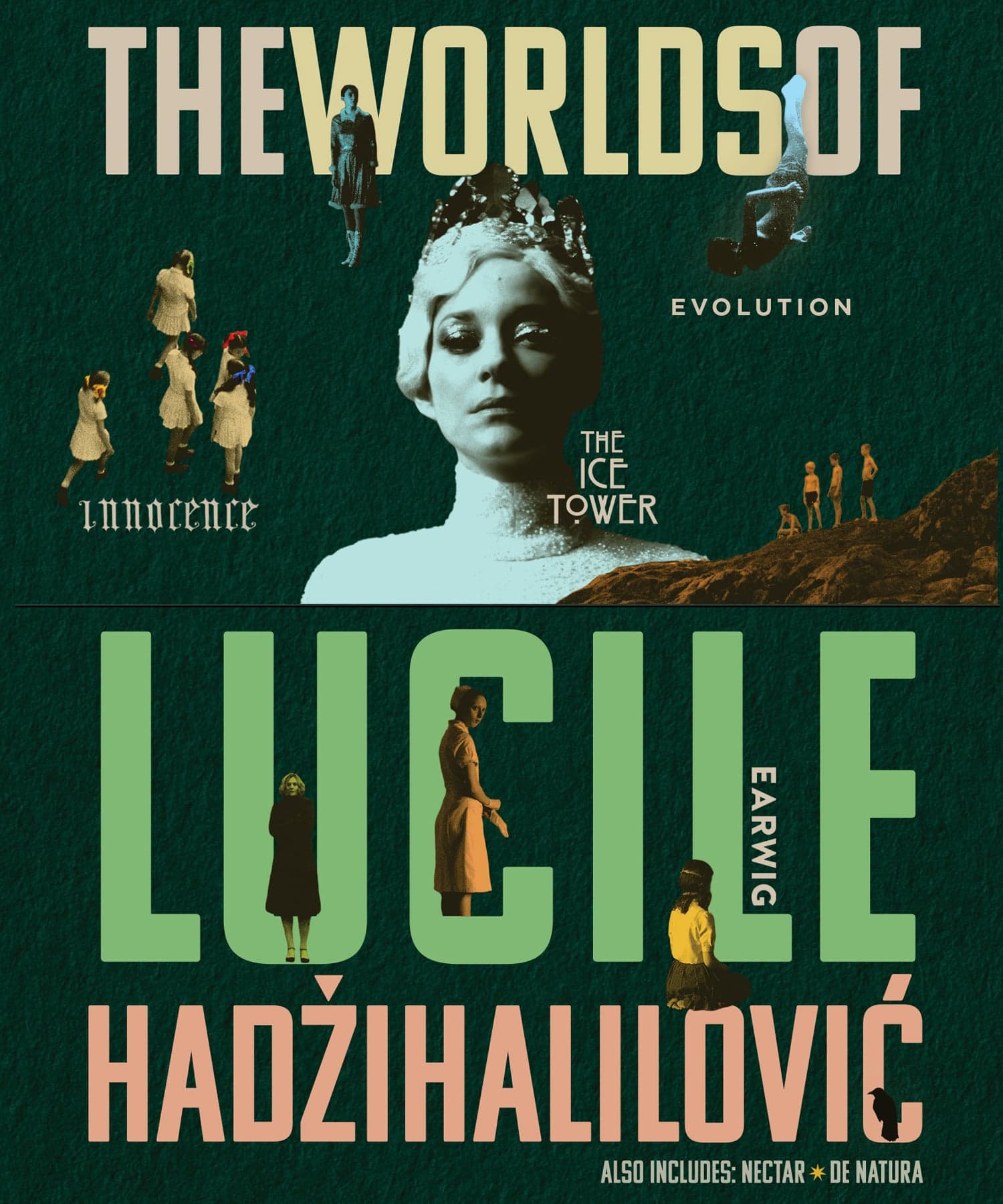
 Yellow Veil’s stellar new box set gives the under-sung Lucile Hadžihalilović her due, with a strong A/V presentation of each of her features and a generous heaping of extras. Hadžihalilović’s fantastical worlds are ruled by a rigid social order that feels both startlingly foreign and vaguely threatening. Through the director’s strange, sinister lens, her four feature films shed light on the nature of social, behavioral, and sexual norms and the systems of control that we take for granted even as they govern our lives.
From 2004’s Innocence to last year’s The Ice Tower, Hadžihalilović’s unflinching fascination with bodily and psychological metamorphoses is geared toward examining children on the precipice of various types of changes. By defamiliarizing both her characters’ surroundings and states of being, she renders the worlds around them fascinating enigmas, transporting her audience into the same destabilized state as her characters.
All four transfers beautifully capture the delicate balance of vibrant colors, pools of darkness, and lush textures that permeate Hadžihalilović’s work. The image is consistently sharp and rich in detail, which is crucial to appreciating each film’s meticulous production, costume, and set design. This is particularly noticeable in the films’ many close-ups, with everything from beads of water running down a person’s arm to a steely glance feeling palpable and alive. On the audio front, the soundtracks are especially impressive for their presentation of ambient noises, which are practically characters themselves throughout Hadžihalilović’s work. Derek Smith
Innocence (2004)
Based on a 1903 novella by Frank Wedekind, Innocence is pregnant with birth, menstruation, and orgasmic symbolism. Trapped in the woods by an enclosing wall, the film’s chrildren ritualistically go about their daily duties, with Hadžihalilović portraying their humdrum actions as designed to facilitate the transition to womanhood, a condition viewed by the film as akin to being a whore. Overflowing with watery imagery that speaks to the girls’ inherent physiological coitus-and-procreation functions, Innocence evenly divides its “story” between three girls, each one representing a different stage in female development. Meant to approximate an entrancing netherworld of pre-teen flowering, Hadžihalilović’s beautiful but thematically obvious directorial debut mainly exudes a fetishistic fixation on nubile femmes, culminating in a third-act scene in which creepy faceless men watch, and toss roses to, the eldest girls as they suggestively perform a choreographed dance number on stage. Nick Schager
Evolution (2015)
Evolution abounds in visual motifs that reveal more than they initially appear to, such as the red color shared by the starfish that Nicolas (Max Brebant) spots and the swimming trunks he wears out on the beach. Other images emphasize violation and insertion. Particularly shots of the women, who often linger malevolently over the boys’ belly buttons, after strapping the children into gurneys located in a mad-scientist laboratory that’s painted in dark, swampy greens that suggest that the characters are still underwater. Regrettably, the film interprets itself, offering an essay on rape and gender fluidity that locks us out of the cognitive process of digesting it. There’s only so many prolonged scenes of women torturing children that someone can watch before yearning for a reprieve of spontaneity or variation. Chuck Bowen
Earwig (2021)
Following a young girl, Mia (Romaine Hemelaers), whose teeth are made of ice, Earwig pushes Hadžihalilović’s evocative style past its breaking point. Hadžihalilović’s third feature is as meticulously crafted and densely textured as her previous two films, but it’s also so withholding of narrative information that it verges on airlessness. This virtually plotless work is again indicative of her boundless fascination with adolescents, particularly girls, on the cusp of mysterious physical and social change. Yet, while it’s filled with arrestingly textured, chiaroscuro images, the hypnagogic effects of its glacial pacing and willfully opaque worldbuilding are more soporific than enrapturing. While Hadžihalilović’s other works use the rigid constraints and curiously strange rituals as a means to explore human psychology and behavior, Earwig is all too self-contained, remaining content merely to bask in its own fetishistic constructions. Smith
The Ice Tower (2025)
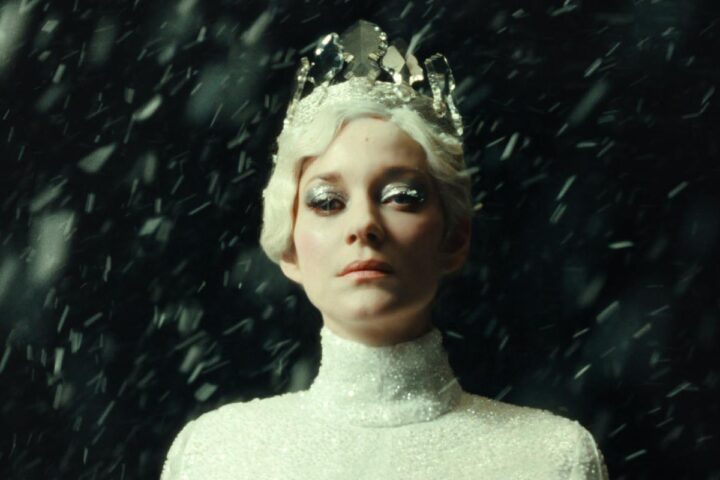
In The Ice Tower, Jeanne (Clara Pacini) gets to roam around a realm defined by seductive artifice, high stakes, and glamorous aloofness. It’s a realm personified by the protagonist of a production of the fairy tale “The Snow Queen,” Cristina (Marion Cotillard), a mysterious and spoiled diva who Jeanne becomes fascinated with. Cristina responds well to the girl’s attraction, and Jeanne ends up taking a major role in the production. The Ice Tower’s allegiance to the fairy tale might suggest that it’s all about twists and turns of plot, but Hadžihalilović pays much more attention to the sensuous qualities of cinema. From the kaleidoscopic shots that open and close the film, as though through the point of view of a child looking through an ornamental snowball, to a marvelous shot of red blood sullying pristine ice, the camera is profoundly alive to the texture of things, and has the puerile fascination of a silent-cinema gaze. Diego Semerene
Extras
This set’s discs, which come housed in a sturdy, elegantly designed box that includes a 60-page, full-color booklet with new essays, are absolutely packed with extras. Hadžihalilović, in addition to providing an introduction to each film, appears in three separate Q&As from 2025 where she discusses working with children and shooting with natural light in Innocence and her approach to adapting Hans Christian Andersen’s “The Snow Queen” in The Ice Tower. She also shows up in a 30-minute conversation with Evolution cinematographer Manu Dacosse to talk about the visual strategies and look of the film and in an interview with critic Beatrice Loayza, in which she touches on her fascination with gialli and her screenwriting process.
The set also includes two video essays by film critic and historian Alexandra Heller-Nicholas, one focused on Innocence’s visual style and the other on the role of abstracted institutions and feminine spectatorship in The Ice Tower. Elsewhere, cinematographer Jonathan Ricquebourg talks about his work on Earwig and The Ice Tower, actress Zoe Auclair discusses her interpretation of Innocence, and Evolution co-writer Alantė Kavaitė shares her thoughts on keeping mystery alive when telling a story. The co-writer of Earwig, Geoff Cox, is also interviewed about the process of adapting Brian Catling’s novel. Rounding out the on-disc extras are two of Hadžihalilović’s short films, “De Natura” and “Nectar.” Smith
Since 2001, we've brought you uncompromising, candid takes on the world of film, music, television, video games, theater, and more. Independently owned and operated publications like Slant have been hit hard in recent years, but we’re committed to keeping our content free and accessible—meaning no paywalls or fees.
If you like what we do, please consider subscribing to our Patreon or making a donation.