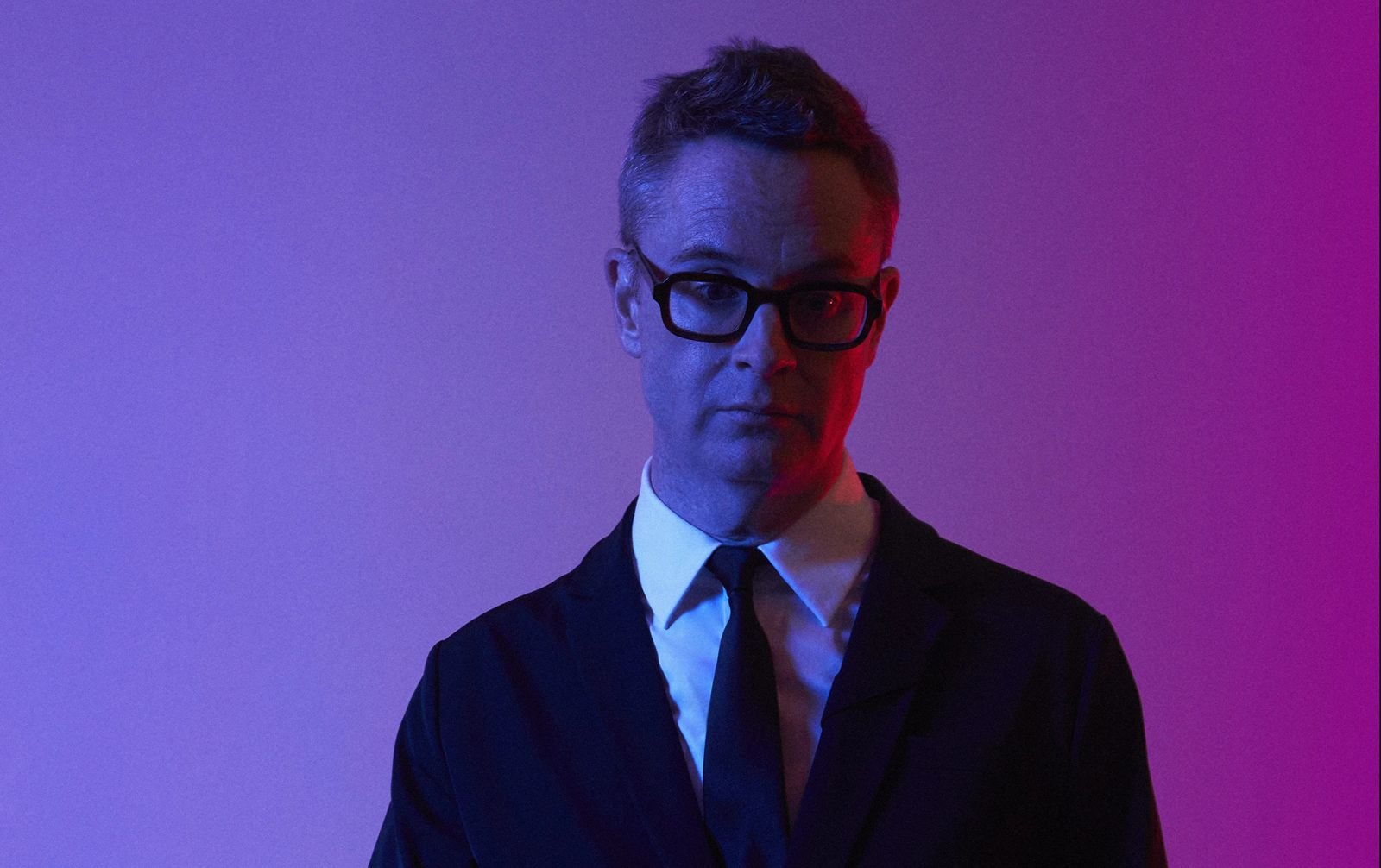
Don’t call it a comeback, call it a resurrection. Nicolas Winding Refn returns to feature filmmaking with Her Private Hell for the first time in a decade after working on multiple streaming series that left him feeling creatively depleted. Also, thanks to a leaking heart valve, he also literally died for 25 minutes in 2023 before a surgery brought him back to life.
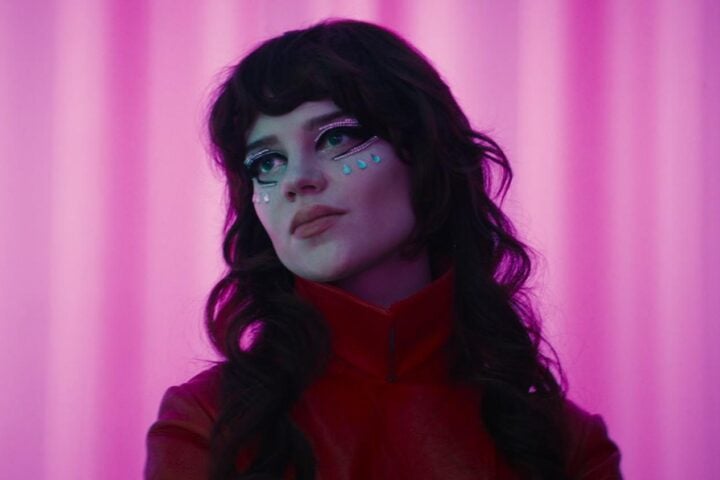
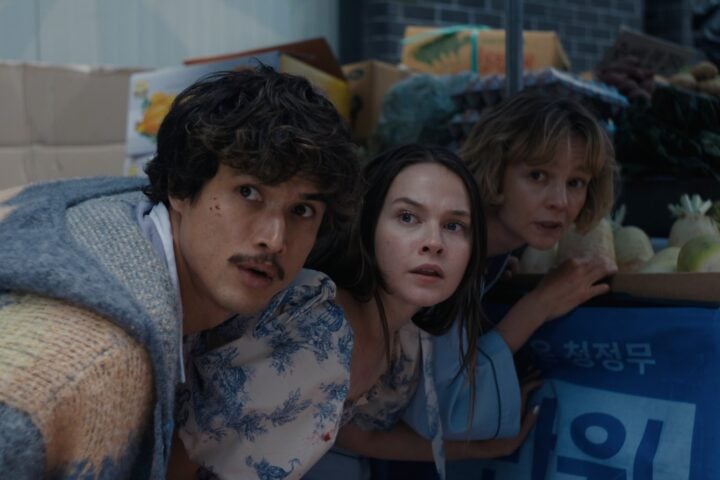
Those who can look past all the bombast of Her Private Hell will feel the presence of a director reborn. Refn’s operatic aesthetics mesh intriguingly with the artificiality and unreality of the futuristic, giallo-inspired setting. As the film’s two narratives—of an actress (Sophie Thatcher’s Elle) grappling with family drama and a U.S. Army private (Charles Melton’s Private K) searching for his daughter—converge, Refn recasts his familiar fixations with a newfound earnestness that sacrifices none of his impish imagination or artistry.
I spoke with Refn about Her Private Hell ahead of its theatrical release. Our talk covered why he loves fairy tales, what he finds liberating about the algorithmic age of audiovisual consumption, and whether the film’s ending reflects his personal journey over the last three years.
This is your first feature film in a decade after working in miniseries. What is and isn’t different about working on a smaller canvas with Her Private Hell?
Well, it’s a bit of a relief that things are shorter. Spanning out either 13 hours or six hours is tough on the soul, so it was pleasant that things were so compact again.
Your fellow Danish artist Hans Christian Andersen gets name-checked early in the film. What has his work and the realm of fairy tales meant to you?
I’ve always been fascinated by fairy tales because I guess it reminds me of when I was little. I never wanted to be an adult, and I don’t necessarily consider myself one. I like the simplicity of the fairy-tale narrative. It’s paper-thin, like this [holds up hand horizontally]. Most entertainment is like a series of codes and information runs like that [flips hand perpendicularly, moves finger across in line]. With experts, you can even begin to dissect the coding [moves finger in a circle], almost a chicken-and-egg kind of collaboration with the mechanics of the viewers and their experiences. But, obviously, everything changed with the internet. Suddenly, everything just imploded, in my opinion.
What I’ve always loved about fairy tales is that, because of the thinness, I could create a very simple narrative that you could literally follow from anywhere in the world. But then, if you turned it, it was no longer lines of code, but it was interpretations. And those are endless, which is why we continue to try to understand what Hans Christian Andersen’s fairy tales are really all about. After so many years, we’re still reading into it. Because what happens with an experience is that you, through evolution, look at it from a different perspective always.
Which is why the movies you may like, the books you read, or even music, you keep on repeating. It’s not so much because you don’t know what the outcome is, but it reminds you of something, or you see something new in it as you’re moving ahead. Because with every minute, you age. And age is usually a part of evolution, so you will see things in different ways.
The influences on Her Private Hell range from the films of Douglas Sirk and John Waters to the feeling you get when you’re in Asia. How do you approach sublimating a grab bag of references into something that’s distinctly NWR?
It’s like you create your favorite playlist, and you just put it on repeat. Then, you see what comes out of it. We all steal. Everyone steals. That’s part of the process. You know the ones who say they don’t are lying, so just steal from the best.
Melodrama has such a specific wavelength. How did you guide your actors to find it in Her Private Hell? Because if you go too far in one direction, it’s sedate. And if you go too far in the other, it’s kitsch.
Well, I like both because I like heightened emotions. I think, in this movie, it was all in the premise. There was a father-daughter foundation that was already in the works, and Elle’s former lover [Havana Rose Liu’s Dominique] marries her father [Dougray Scott’s Johnny Thunders] and becomes her stepmom. I mean, that’s already very melodramatic. Then, she conjures up an imaginary father. That’s pure fantasy. You combine the two in a very fake setting, because everything in the film is artificial. It becomes like an opera. It’s all very heightened.
You’ve referred to Her Private Hell many times as an “opera.” What does that artistic medium mean to you, and how might cinemagoers want to adapt their viewing of the film knowing that you’re approaching it as such?
I think that all you can really do, or all you’re supposed to do, is create an experience. Transform everything around you into something that’s not really there. I don’t know how I would do an opera on stage, because I very much like the moving image. I’m a voyeur, so I need a camera to see through. But it’s a bit like having your own dollhouse, and moving the figures around, telling them where to stand and sit, and you play really loud music. But from an audience perspective, it’s about transforming into something unexpected. Then, hopefully, they will travel with you.

You’ve referred to this “unreality” you create, and I’m curious how tactile things like the Leather Man’s leather jacket play into this effect. It reminded me a little bit of the famous scorpion jacket in Drive, which also grounds us in iconography even as you’re going somewhere only you can imagine.
It’s all code. There’s a human desire to be attracted to something that’s literally paint, or wood, or metal, or fabric, and I like to objectify. That’s what I do. I like to objectify something and then fetishize it because it speaks to the senses. The Leather Man, who’s obviously a made-up monster, is like my glam monster because he’s all black leather with crystals around him. There’s something very pop about him. Using how you photograph men, especially from behind and right above their lower back, is almost like the symbol of masculine power. We can film the torso, which we do a lot with Charles, of course. He’s like a Greek god. All those elements speak to the subconscious in many ways. It’s almost like you can reach out and touch it. Even the stage we were building for the movie…in the end, I had to use some CGI just to make ends meet because we didn’t have a lot of dough, but we still built everything. It was still silver paper, paint, plastic, wood, metal, and fabric because it had to feel artificial.
You’re one of the few directors who approaches the change in which people receive narratives through algorithmic distribution as a point of curiosity or challenge rather than a threat. How has exploring this contemporary means of receiving audiovisual information affected the way you produce your own work?
I think it’s incredibly liberating. The reason why I fell into the rabbit hole of streaming was that I felt that cinema had difficulty extending itself again. Suddenly, there was something called “streaming,” and it was a whole new landscape because it was about longevity. Suddenly, you could make films that were 13 hours long, and that deconstructed the whole premise [of cinema]. At least the two shows I created, I never looked at them as series. I just looked at them as long films because that’s the one thing I couldn’t do for theatrical.
But when I came to the end of my second series [2019’s Too Old to Die Young, starring Miles Teller], I was given the chance to work in fine arts, where I could build and create something that was no longer in the ethos of the commercial world, meaning that there was no transactional desire. And then, I obviously died. I was dead for 25 minutes. You can say I was reborn, and once you’re reborn, you have options. I decided to go back to where I began, like starting over again, because there’s something very rewarding about finding the same passion and desire. But now, it’s for different reasons than when I originally started making movies.
Now, if you want to see a movie, there are movies all around you, and most of it’s for free. Take your pick. The longevity of things has obviously shortened because there’s so much more. The accessibility is so simple, and other avenues are much more mind-expanding. Obviously, gaming is one aspect because technology continues to evolve, and it continues to involve impossibilities. What is it really about film that is so special? Well, it boils down to one very simple concept. It’s the communal experience, the idea that you watch with other people that you have no connection to, but you share a common dream.
I think that’s the most important thing right now in these days of [extreme] polarization, infrastructure inequality, more and more [content] going through your algorithms, or digitalization of access. But if there’s something the pandemic taught us, it’s that life isn’t fun without others around. That’s why cinema is so essential, because it’s like a cathedral, or a concert. It’s the most inexpensive collective experience, and I think we need to preserve that. So I think almost every village in the world needs to have a cinema, just like it needs a church.
We’re coming up on the 15th anniversary of Drive, and your Pusher trilogy got a re-release here in New York to celebrate its 30th anniversary. Since you’ve been talking a lot about death on this press tour since it happened to you since the last time you made a project, has that experience given you new eyes to think about what it means for these films to have a life of their own?
Well, I’m just very happy that people are happy. Probably years ago, I would have said something more stupid or sensational, but I’m way past that age now. It’s very simple: A creator needs an audience, and an audience needs a creator. If you can continue to share, newer generations come along for the ride. That’s all you can ever ask for.
On the flipside, there’s that great Woody Allen quote: “I don’t want to achieve immortality through my work. I want to achieve immortality by not dying.”
Obviously, that’s very human, especially when you do get older. I remember asking God for five more minutes. That’s all. But at the same time, the next time—when I will probably never come back—I’m not so afraid of it. I’m afraid of not living my life to the fullest.
Your endings are never set in stone when you start rolling cameras. Do you find them or do they find you? I’m struck by the parallel between a father being reunited with his daughter after staring death in the face, and that feels fated.
Oh yeah, it’s predictable, but that’s what cliché are. They work because they’re cliché. But like anything, I think I’ve come to realize that if you stay true to your desires, the film eventually begins to dictate itself, and you now have to follow it, which is very exciting because then you’re obviously living in complete danger.
You make it sound like the pursuit of a lover.
Try to seduce as much as you can before time runs out…or you don’t have any more money left.
Since 2001, we've brought you uncompromising, candid takes on the world of film, music, television, video games, theater, and more. Independently owned and operated publications like Slant have been hit hard in recent years, but we’re committed to keeping our content free and accessible—meaning no paywalls or fees.
If you like what we do, please consider subscribing to our Patreon or making a donation.