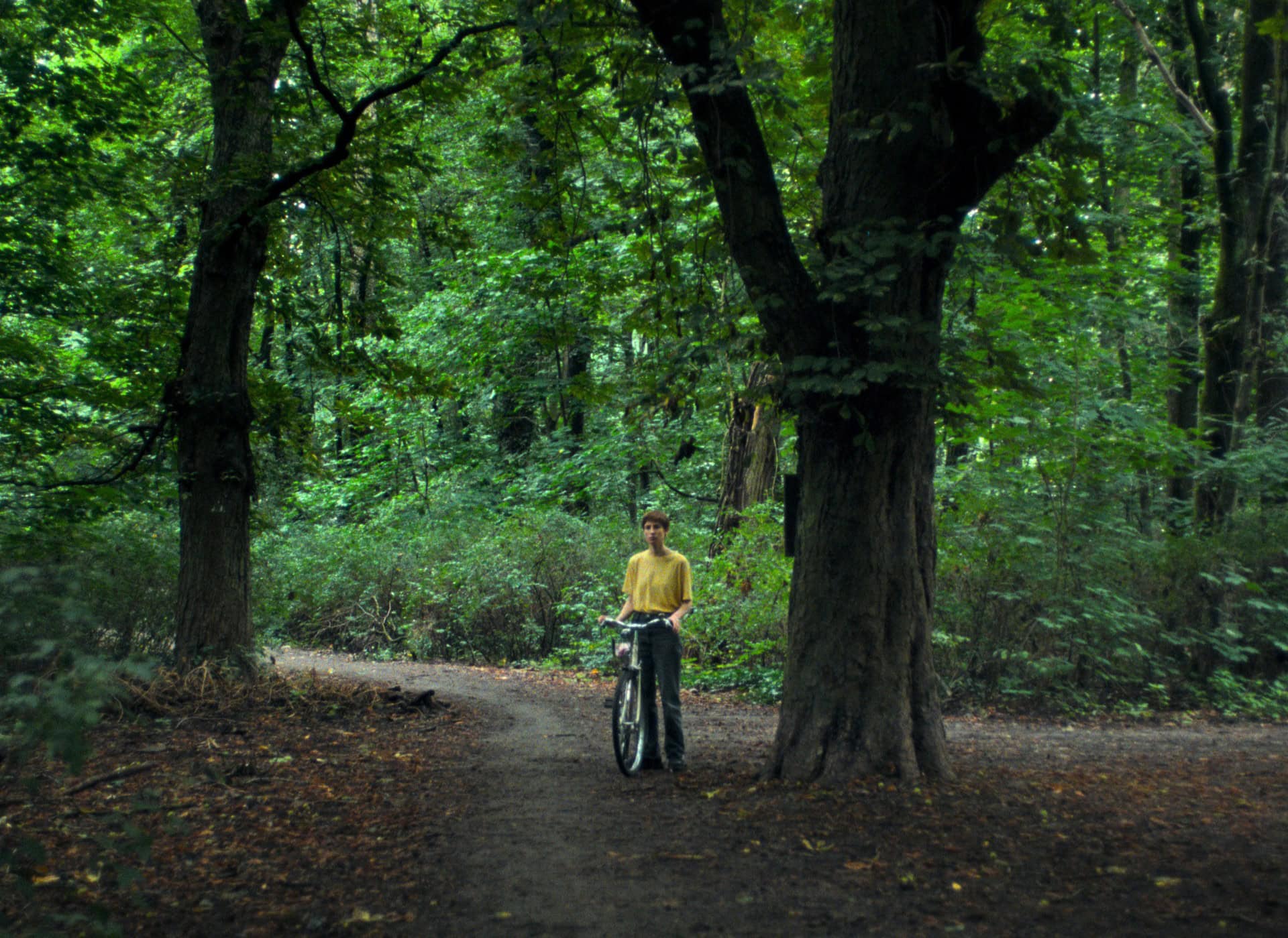
Angela Schanelec’s austere filmmaking style—extended static shots, off-kilter blocking, rare but dramatic close-ups—has managed to stand on its own in a filmmaking culture long acquainted with minimalistic storytelling devices. That’s in part because her films abound in imagery that resists easy metaphorical readings. My Wife Cries is no different, starting off as an ostensibly simple tale of infidelity before it begins to grapple with even more anxious themes as it shuffles its characters into a series of memorable tableaux.
Thomas (Vladimir Vulević) leaves his construction worksite to find his wife, Carla (Agathe Bonitzer), inconsolable on a park bench. She’s been involved in an accident, she says, and by the time she’s composed herself enough to go back home, she brings up the complicated emotions she felt when Thomas didn’t want to continue their dance lessons into the advanced course.
Schanelec shoots their walking and talking in one continuous take, as twilight turns to night and Thomas realizes that Carla has fallen for the young dance partner who replaced him. Now he’s the inconsolable one, frozen in a squat by a tree, his head buried in his hands, suggesting an embarrassed gargoyle as a nearby young woman, not knowing what to make of his posture, calls an ambulance. This dazzling take is a forerunner of many more to come.
Soon, My Wife Cries begins to catch glimpses of the romantic lives of other people in Thomas and Carla’s orbit. Mysterious interactions abound as Carla, a kindergarten teacher, drifts around Berlin, like one with a poet in line for a Nobel prize whose young son shares the same name as Carla’s lover and with whom she becomes infatuated. Later, a small party brings together friends who poetically describe what their lives will become now that they’ve fallen out of love. Meanwhile, footage from the Gaza War plays on a TV in the background of Thomas’s worksite.
These sequences may suggest an impossibly fractured film world, but Schanelec connects them through clever tricks of editing, often rhyming one sequence with another. There are moments of tonal whiplash, such as when one of the couple’s friends (Thorbjörn Björnsson) ends his lengthy monologue about how the little things in life, such as a pat on the back for a job well done and the possibility of getting reprimanded, will suddenly mean so much more if the main source of meaning in his life—his partner’s love—dissipates. Then, steadily, the friends assemble a choreographed dance set to Leonard Cohen’s “Lover Lover Lover” outside.
At first, the moment is vexing, until it becomes clear that one of the lyrics from the song, “lover come back to me,” is so obviously in conversation with the romantic travails of the characters. Also, “Lover Lover Lover,” in toto, references the shame of the Yom Kippur War, which had consequences that can be traced to the Gaza War. These kinds of choices make My Wife Cries feel like an aesthetic puzzle box that still retains its mystery even if one feels it can be “solved.”
Schanelec is also content to find beauty in the bizarre and mundane. Her compositions suggest the paintings of Vilhelm Hammershøi, with her actors only taking up fractions of the frame, allowing the late afternoon golden light to bounce off walls, doors, windows, and faces in a way that wouldn’t be evident if it were a standard medium shot with a face in the center.
Another sequence, one of the best in the film, shows Carla and her friend Claudia (Clara Gostynski) discussing hobbies (of which Carla proudly announces that sex is her favorite and only) while biking around the park. Though it’s a tracking shot, the frame never wavers, and the friends speak to each other both casually and poetically, stilted yet friendly. When their conversation is over, only then does My Wife Cries reveal their surroundings, as they look out at a band playing in the distance, one that had interrupted their progressively serious talk with the joyous humming of its brass instruments, as, suddenly, it begins to rain.
For every detail that’s immediately beautiful and comprehensible, there are a few that peculiar to the point of absurdity. But those are also by design. One shot shows the admired poet writing on a dilapidated desk out in the park with reeds forming a makeshift hut around him and his fortuitously named child. And an almost-sex scene is shot exactly like a scene from Robert Bresson’s Pickpocket, only with a penis standing in for the wad of cash. But My Wife Cries separates itself from other austere arthouse productions by making these images just inscrutable enough to neither be dismissed as meaningless nor obvious enough to be forgotten.
Since 2001, we've brought you uncompromising, candid takes on the world of film, music, television, video games, theater, and more. Independently owned and operated publications like Slant have been hit hard in recent years, but we’re committed to keeping our content free and accessible—meaning no paywalls or fees.
If you like what we do, please consider subscribing to our Patreon or making a donation.