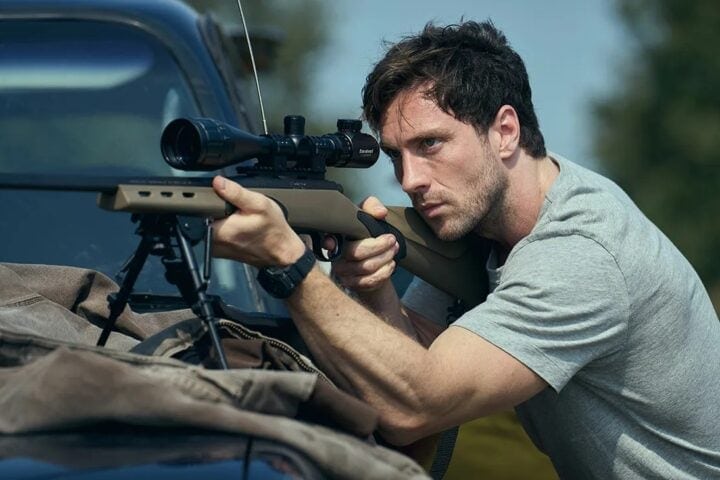
One of the most famous writers on the topic of Tourette’s syndrome, Oliver Sacks once said, “One can diagnose Tourette’s 100 yards away, but what it is to be that person with Tourette’s needs very close interrogation.” Thanks to a mixture of compassion and clarity that would make Sacks proud, that’s exactly what I Swear provides.
John Davidson would go on to become a nationally renowned advocate for people with Tourette’s syndrome, but when we first meet him in writer-director Kirk Jones’s film, he’s just a regular 12-year-old boy (Scott Ellis Watson). A nice kid with good friends, a lucrative paper route, and a starring role in his local football team, John seems to have life pretty well figured out. The dreary suburbs of ’80s Galashiels might not look much like paradise, but it’s hard to imagine a happier existence for a teenage boy. Until he starts to tic.
John’s Tourette’s emerges out of nowhere and rapidly takes over his life. His wild twitching and obscene verbal outbursts isolate him at school, ruin his sporting prospects, and enrage his parents. “Tourette’s” isn’t uttered during this early stretch of the film, which is partly a matter of simple historical accuracy since the condition wasn’t well known at the time. But it’s also an effective narrative choice that serves to immerse us deeper in John’s confusion and his loneliness as his world is turned upside down by an unnamed, unknown force.
From there, I Swear skips forward 13 years, with John (now played by Robert Aramayo) slowly beginning to build an independent life for himself after being taken under the wing of a local woman, Dottie (Maxine Peak). He gets a job at the community center and finds another ally in the center’s manager, Tommy (Peter Mullan), who encourages him to speak up about his condition. Peak and Mullan’s warm, funny performances are a constant source of comfort in an often-painful tale, and the scene in which Tommy defends John in court is especially cheering.
I Swear is a very conventionally told story—equal parts tear-jerker and heart-warmer, and reminiscent of a great many films that are marketed as being “based on an inspiring true story.” Although it’s working from a well-used template, things get a little wonky in the third act as Jones’s script tries to cram in a few too many events from John’s actual life. A second scuffle with the law feels dramatically redundant, and this narrative overcrowding leaves too little room for important beats to breathe. But the thing that elevates I Swear above the easy sentimentality offered by many other tales of disabled people overcoming adversity is that it always remains laser-focused on where that adversity is really coming from.
The perception that most of John’s problems are caused not by Tourette’s but by society’s ignorance of it is voiced by Tommy late into I Swear, but we understand as much from the start. We see it in the response John gets from his parents when his tics first emerge. His father, William (Steven Cree), keeps order at home by glowering across the dinner table, while his mother, Heather (Shirley Henderson), snaps at her children to sit straighter and dress neater, always subjecting them to the test of suburban propriety. They’re not trying to be cruel, but their worldviews are too narrow to accommodate something as complex as Tourette’s, so they try to force John into a category that they can understand—labeling him as an attention-seeker, a troublemaker, and, once he grows into an adult with an official medical diagnosis, an invalid.
Fortunately, the film itself never tries to box John in. Able-bodied actors have often been celebrated for portraying people with disabilities, but many of these performances are more about impersonating symptoms than truly embodying a character. And though there’s an impressive physicality to Aramayo’s performance, he always plays John as a full, multifaceted human being. That’s clear in the way the character seems to transform when he’s with someone who makes an effort to understand him versus those how treat him like a novelty or a burden. Thanks to every pained grimace and hopeful smile on Aramayo’s face, it’s not John’s tics that make us empathize with him, but the aching desire to be accepted.
Aramayo’s performance is also exceedingly funny. John’s verbal tics frequently result in the sort of rapid-fire punchlines that Sacks observed in his Tourette’s patients, and the film is happy to play these moments for laughs. But it does so without ever undermining the seriousness of the condition; for every naughty punchline, there’s a vicious insult or an unintended assault that causes real harm and devastates John. We get a full sense of what it is to be that person with Tourette’s, which is perhaps the most important thing a film like I Swear could hope to achieve.
Since 2001, we've brought you uncompromising, candid takes on the world of film, music, television, video games, theater, and more. Independently owned and operated publications like Slant have been hit hard in recent years, but we’re committed to keeping our content free and accessible—meaning no paywalls or fees.
If you like what we do, please consider subscribing to our Patreon or making a donation.