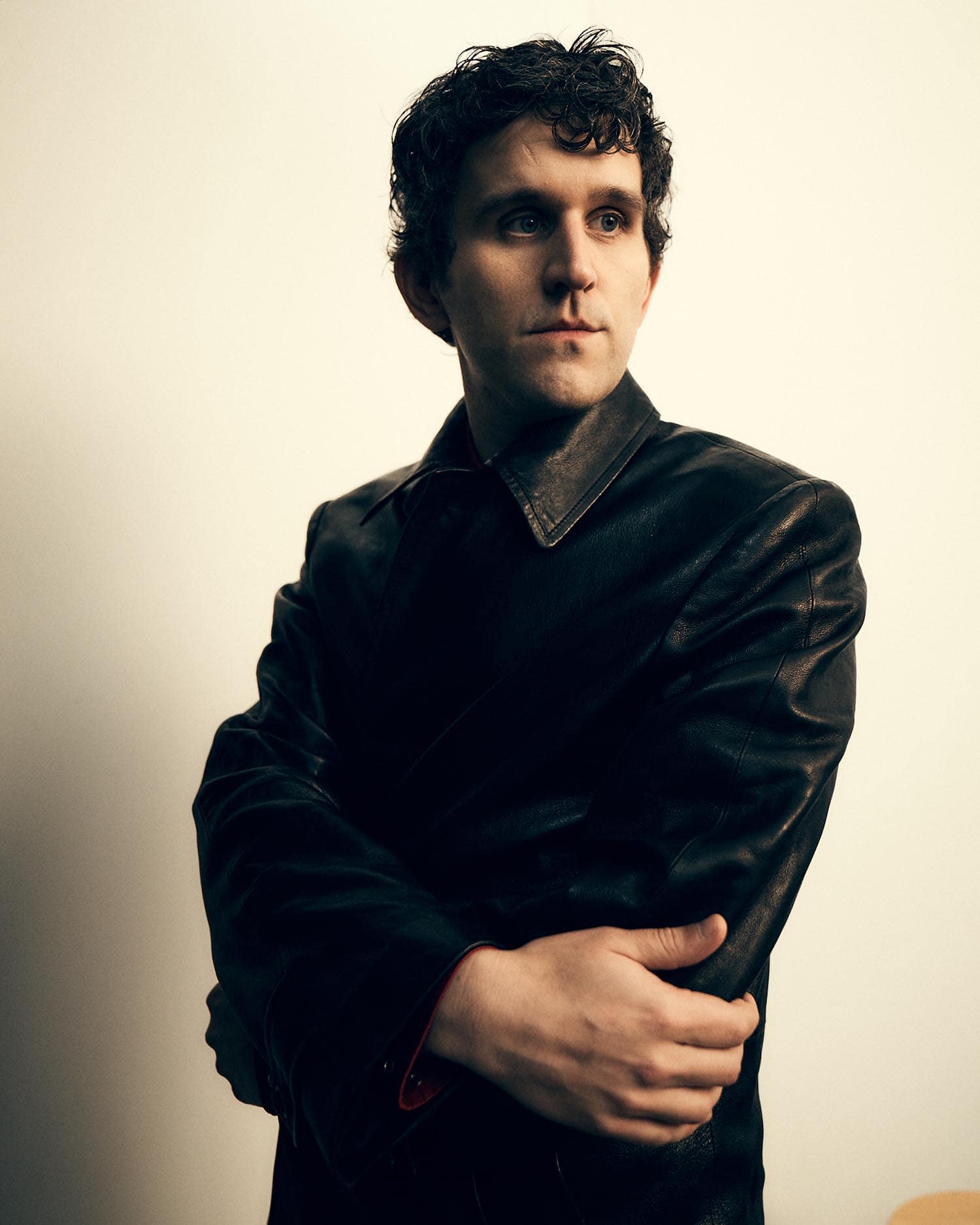
One of the more welcome recent trends in the film industry is the number of actors who’ve transitioned into independent cinema after having established their screen personas within franchise fare. They’re helping to get adventurous projects financed, before then complicating, if not demolishing, the image of themselves that they’ve left in the public eye.
Harry Melling, first introduced to audiences as the insolent Dudley Dursley in the Harry Potter films, has taken a quieter but no less impressive path out of YA adaptations than Daniel Radcliffe, Kristen Stewart, and Robert Pattinson. Highlights of his post-Harry Potter résumé include appearances in films by Joel and Ethan Coen (including one directed by Joel solo), James Gray, Gina Prince-Bythewood, Antonio Campos, and Athina Rachel Tsangari.
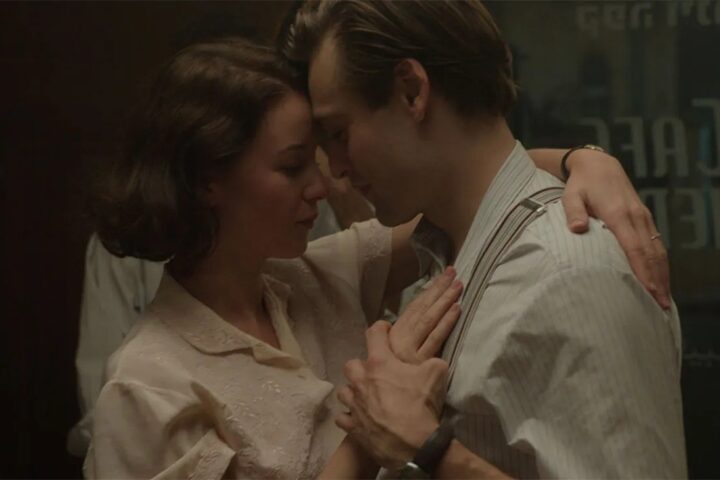
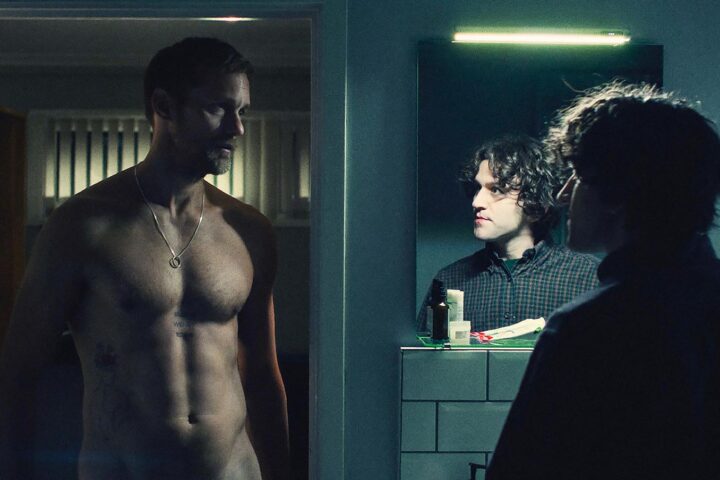
But Melling steps fully into the spotlight with Pillion, Harry Lighton’s feature-length directorial debut. His Colin, a traffic warden and barbershop quartet singer, is a shy gay man still living with his accepting parents. But his personality is fundamentally transformed after beginning a relationship with Ray, a leather-clad biker played by Alexander Skarsgård.
Through Ray, Colin is introduced to the subculture of BDSM bikers, which expands his sexual horizons and allows him to build his self-confidence. Melling’s unfailingly earnest performance anchors the tonally adventurous Pillion in a tender humanity. The actor proves game for whatever turn a scene takes, be it silly, sensual, or somber.
I caught up with Melling at A24’s offices ahead of Pillion’s theatrical release. Our talk covered how he approached Colin’s passivity, why it helped to shoot for a week before Skarsgård arrived on set, and what he makes of the film’s final shot.
You’ve worked with directors such as the Coens and Athina Rachel Tsangari, who I think of as having very specific and unique approaches to tone. Was there anything you took from those experiences that was helpful preparation for Pillion?
I don’t think it’s a surprise that I really gravitate towards those kinds of directors, and I’m lucky enough for them to want to work with me. I have no idea what they see in me, but certainly in them, I see everything that I want to do as an actor, which is to play things that are unique and individual. All their voices are very specific and different, and that’s what I really get a kick out of. I guess it all started with Joel and Ethan on The Battle of Buster Scruggs, opening up the opportunity to work with such incredible people, because when they give you the thumbs up, it helps. They’ve been instrumental in all of my career, Joel and Ethan.
In terms of prepping me for something like this, I think when you work with different, very unique visionaries—which I think they all are—you realize that you are serving them. It’s not about you, really. You very much are there to serve their vision, to offer them something that is going to help tell their story. So you are submissive, I guess!
Some of Harry Lighton’s references for tone and character were films like Godland and Toni Erdmann. When you receive something that’s not necessarily a direct correlation to the work from a filmmaker, how do you interpret it?
I always knew that Toni Erdmann was Harry’s favorite movie of all time, [and] I’d watched it prior to him saying that [it was an influence on Pillion]. Having that in the back of my mind whilst reading it gives you a flavor of fun and mischief, but also being grounded in reality. All those things are very much in the DNA of Pillion. Godland is way, way, way over there, but I also see what he meant about the main character, who was a weird, beater character on a mission. I think that was really useful in terms of Colin. My fear in playing someone like Colin was that he would just be so passive that he’d have no agency. He wouldn’t be doing anything. I really wanted to try and understand how you play someone who’s receiving information all the time and make it interesting so the audience really gets captivated by him. Because he is, in some way, the lens through which we see the movie.
I think what’s interesting about Colin is watching him compute the information that he’s receiving. That’s the thing that gives it a comedic quality. The more we can see him thinking, the more we see him trying to understand. You see the drive in him, albeit while he’s in the corner. That became the interesting contradiction: how you make someone passive incredibly alive.
The book is told through Colin’s first-person narration, which doesn’t make its way into the film. Was that still helpful for understanding Colin’s state of mind?
I’m one of these annoying people who has to try and understand all the source material, even if it’s not useful. You’re right, it’s very different tonally. It’s a very different beast, but I loved the book. I felt that what Harry was after was slightly different. In terms of it being in first person, it’s always useful. Certain lines in the book were copied and pasted into the movie. “Aptitude for devotion,” I think, is an Adam Mars-Jones line. That was useful. But I read it quite early on to have it in the back of my mind. Then, I quickly realized this movie is a different beast. It’s more Toni Erdmann. I don’t know what you’d compare Box Hill to. But I like to have as much information as possible and then disregard stuff.

Did anything from Harry’s versions of the script set in ancient Rome or the cruise ship help?
I have not seen them! I’ve heard about them. I just discovered another version today that he wrote, but I can’t remember he set it. But that’s very much Harry. He likes to throw things in the air and see what might land. I haven’t read those versions, but he said he’s gonna send me them one day. I look forward to reading them.
Alexander has said that coming onto set and interacting with you changed the way he saw Ray. Did you feel like interacting with him brought out something different in your character or showed things you didn’t realize?
Absolutely. I think that’s probably true of every performance that I’ve ever done. You do your work at home, rehearse how you might be, how you might walk, all this stuff. Then, your job is to turn up on the day and see what’s happening. I think early on in my career, I really was trying to control it in a way that was not useful. Surrendering to whatever is there on a film set is probably one of the most important things. There were things in Colin that really surprised me, one of them being the scene where his mum has passed away and he’s cooking for Ray.
That moment of collapse or cracking was a moment that took me by surprise. I didn’t think it was going to be as bold a moment as it turned out to be, and I don’t think in the script it was marked as a moment. That was a lovely discovery. Maybe Alex said this, but we didn’t have much time to talk prior, so it meant that what we discovered on the day was what we were chasing. That’s often quite exciting because you’re not trying to chase things that you’ve worked out before. It’s a lovely way to work.
Harry Lighton shot the film in a way to give himself options in the cutting room to play around with the tone. Was there anything that surprised you about seeing the final film in terms of how he put scenes together?
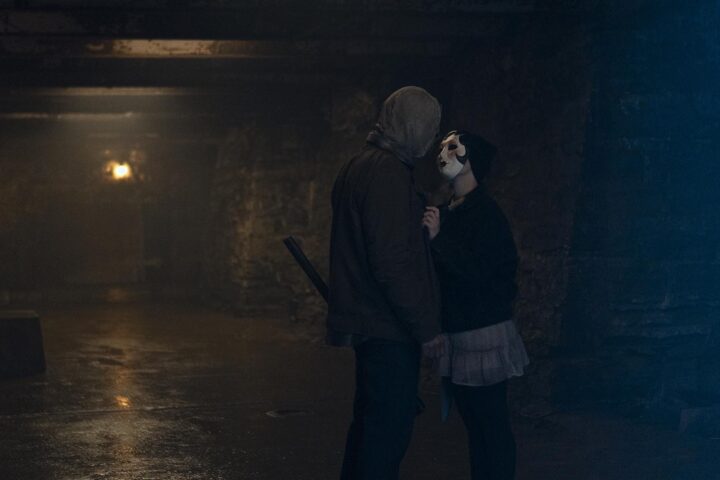
We did shoot various versions of things, like things that were leaning into the comedic value and, then again, the same moments that weren’t. I actually saw quite an early cut of it to talk to Harry about it before going into ADR, and there were a few things in that car that didn’t make the final cut. I’m sure Harry’s mentioned this, but in the alleyway scene when Ray’s doing the big reveal, you saw the penis. That was very much in the first cut I saw, and then in the second cut, it had gone. Actually, it was a moment that the audience laughed at. There was a moment of release. And [Harry Lighton] didn’t want a moment of release. He wanted the audience still in the moment of, “What’s Colin gonna do about this?” Things like that were the subtle adjustments in terms of calibrating the tones.
Colin has both an emotional and physical evolution in Pillion. Was it helpful to have both to track the character’s progress in a given scene?
Having such a drastic hair change really helped in terms of where I was in my journey. Am I with hair? Am I without hair? Am I with leathers? Am I without leathers? It’s quite a subtle journey, in lots of ways. It’s not big, dynamic sweeps, in terms of Colin suddenly jumping from one to 10. It’s very gradual, and I really wanted to try and take care of those gradual movements, those steps that he takes. Physically, even the costume, having the onesie or leather just changes the way you walk and hold yourself. And I also feel that, as the story progresses, Colin does become somewhat empowered in who he is and what he wants. Again, I wanted to try to imbue that journey with a sense of physical strength or coming into his own from where we first meet him. All that stuff was definitely at play.
How did that determine the way you looked in the coda of the film? The hair is growing back, but it’s not the same mop as it was at the beginning. It’s cut more stylishly, almost like he’s integrating the two selves.
Well, we had Colin point one, Colin point two, and Colin point three. We all said Colin point three is a halfway house between the two, and I think that’s very true in terms of where he does land at the end of the movie. He knows that the Ray version of himself and that dynamic isn’t going to work all the time. It’s something that’s in him and feels correct and right to him. But he also knows that he can’t be a 24/7 sub-dom. He has to have some breaks. He has to listen to that Colin from way back when singing barbershop. That’s who he truly is, and I think the look at the end truly reflects that combo.
What did you make of Colin being a traffic cop? His repeated refrain of “just following orders” probably primed him to be sub in many ways.
Harry and I spoke a lot about that because we didn’t want it to be too on the nose, in terms of it being a submissive person who gets abused. But at the same time, it felt like such an interesting thing to explore. What we landed on was the idea that what’s interesting is about watching someone who was shouted and screamed at suddenly, because of his experience with Ray, actually take joy and glee at these people berating him. That became an interesting thing that we played with. I shadowed some traffic wardens in London, which was very entertaining. I worked out the system of taking a ticket and all that stuff. All that research is fun to do.
What little we learn about Ray in the film comes from the breaks in his façade, and they’re oftentimes instigated by Colin’s behavior. Alexander said that they weren’t pre-planned. Knowing that was how we learn about the character, were you actively trying to elicit those moments?
Part of the game with Colin is trying to understand who this man is that I’m falling head over heels in love with. Who the fuck is he? I want to know! Those moments of insight you get that Colin sees, even when he starts reading book one of My Struggle when Ray’s reading book six, it’s him trying to glean a bit of information about who this man is that he’s besotted with. That became a nice game, and it’s a way of making Colin proactive in the pursuit of someone who is quite held in himself. I loved all those little moments. Even looking at the tattoos when he’s sleeping, trying to work out where this one and that one came from, I loved all that stuff.
Alexander didn’t start shooting until a week into production. Was it helpful for you to have had time beforehand to establish who Colin was separately from Ray?
Absolutely, and what was great as well was that we did a lot of the barbershop quartet rehearsals early on before we started shooting. Again, that gave us a bit more time to establish the family unit and who they were. We were establishing early Colin and who he was before the entrance of Ray. Obviously, when Alex came in, it just changed the trajectory of where I was in terms of the shooting schedule, and certainly in terms of Colin’s journey. I’m sure it was logistical things, but actually, it helped a lot. It really did. And Alex was working on something else prior, so not having a lot of time to reach out to him to talk about what we were thinking was a happy accident. It meant that we were very much listening to what happened on set as opposed to what we would have spoken about three months prior.
What do you make of that final look on Colin’s face that closes the film? It starts as a smile, but then curdles into something a little more tentative.
I can’t remember if it was on the page, but I remember speaking to Harry about it. We wanted to end feeling…is hopeful too strong a word? We want to feel that he’s okay, but at the same time, we don’t want to leave on a note where Ray isn’t somewhat lingering there. The song [Charlie Chaplin’s “Smile”] is incredibly sad, and I do hope that although there’s a moment when he has the final note of a smile, where it’s hopeful, full of life, and resilient, there’s also a moment tinged with how this experience has impacted him. My experience with first love, it impacts you. It’s in you for a long time. I think it was all about calibrating those things and not making it a one-dimensional narrative beat, but trying to house as much detail and layering as possible.
Since 2001, we've brought you uncompromising, candid takes on the world of film, music, television, video games, theater, and more. Independently owned and operated publications like Slant have been hit hard in recent years, but we’re committed to keeping our content free and accessible—meaning no paywalls or fees.
If you like what we do, please consider subscribing to our Patreon or making a donation.