 Remaking a 2002 Hong Kong hit and setting the story in Irish-Catholic Boston, Martin Scorsese would seem to be out of his element with The Departed—if not, that is, for the fact that the film marks a return to the director’s bread-and-butter mean streets, and that his source material, Wai Keung Lau and Siu Fai Mak’s Infernal Affairs, was itself heavily influenced by his iconic gangster films. Something of a genre homecoming after recent detours into the arenas of the historical epic (Gangs of New York) and the period biopic (The Aviator), The Departed again finds Scorsese trawling a gritty, brutal urban underbelly where racial epithets spit from roughnecks’ mouths, class divisions are as sharp as a switchblade, and allegiances to others and one’s self are always tenuous at best.
The Rolling Stones’s “Gimme Shelter” plays over a blistering opening sequence edited by Thelma Schoonmaker with gunshot-punctuated bursts that beautifully condense a wealth of introductory information. But there’s no safe haven to be found in this gray New England hellhole, a fact confirmed by the ensuing portrait of encompassing duplicity and paranoia, and vividly conveyed by Scorsese’s electrified direction, which initially proves as vicious, nasty, and deceptively sly as his saga’s larger-than-life Irish mob kingpin Frank Costello (Jack Nicholson).
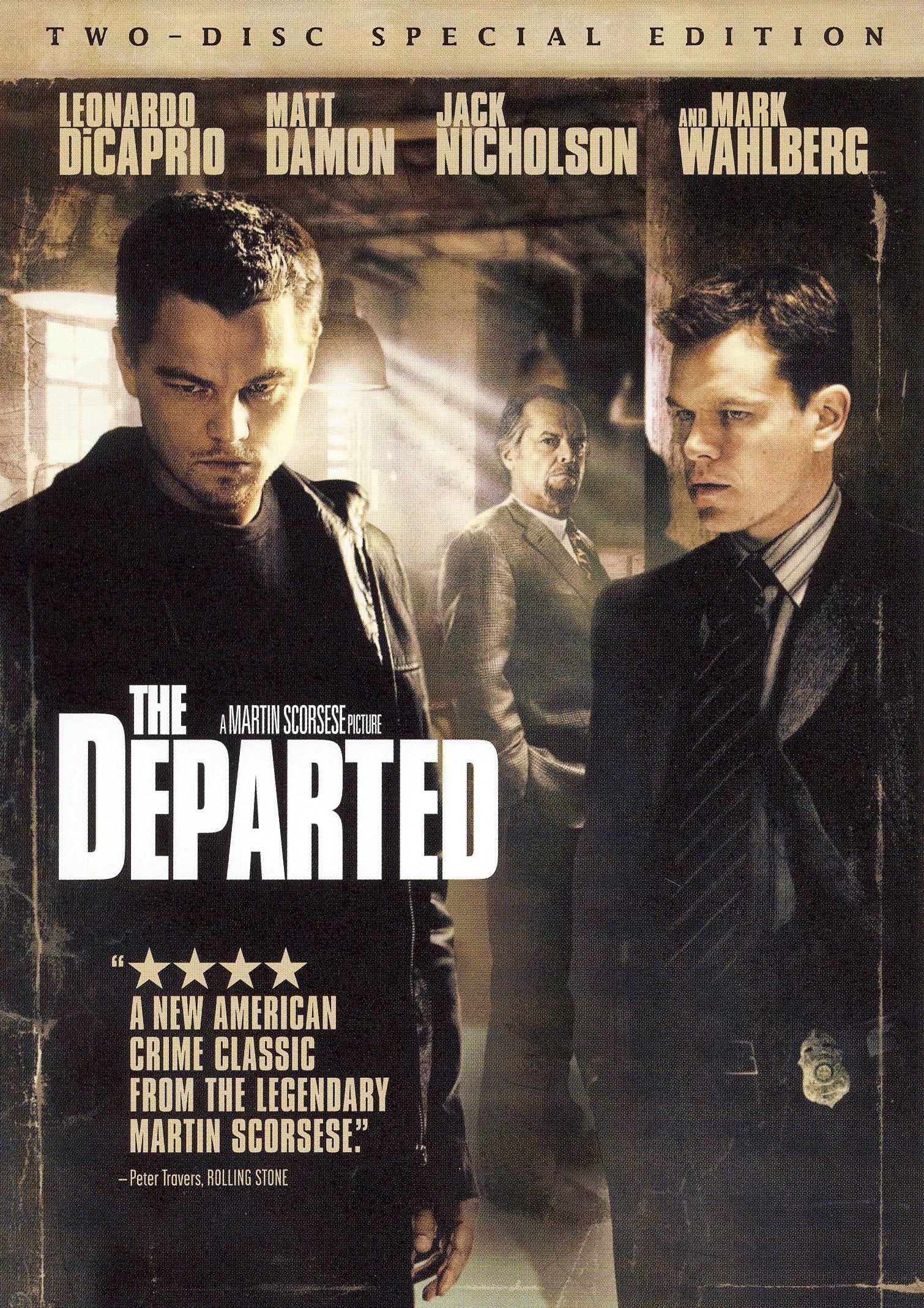
With the constantly roving cinematography bringing a measure of unease to the underworld action, The Departed jumps out of the gate like a caged lion freed into the wild. The film delivers a rapid-fire primer on the congruent paths of state police academy trainees Billy Costigan (Leonardo DiCaprio), an intelligent recruit desperate to reject his family’s criminal past, and Colin Sullivan (Matt Damon), a careerist with political dreams and deep-seated ties to Costello. Sullivan is Costello’s mole in the police department and Costigan is the cop infiltrating Costello’s crew, and both are soon ordered to discover the other’s identity, a conceit that William Monahan’s script embellishes with trademark Scorsese preoccupations: Catholicism, double lives, issues of honor, honesty, and deceit, and the bond shared between fathers and sons.
Faithful to Infernal Affairs, this adaptation nonetheless substitutes the original’s sleek, cool demeanor with a feverish, foul, funky energy that’s layered with a thin coating of sexual deviance (epitomized by Nicholson’s porn-theater dildo antics) and dysfunction (with Sullivan cast as the impotent son to Costello’s seriously virile papa). Deftly employing classic rock for clever commentary—never more so than with adjacent Nicholson and DiCaprio love scenes subtly linked by Pink Floyd’s “Comfortably Numb”—and swiftly crosscutting between multiple subplots, Scorsese’s film, for much of its 150 minutes, rocks violently, passionately, urgently.
As the story’s thematic backbone consists of Costigan and Sullivan’s parallel struggles to maintain identity and sanity, it’s DiCaprio and Damon who are asked to carry the brunt of the story’s emotional and psychological baggage. DiCaprio radiates wounded-child scars beneath his exaggerated tough-guy exterior, while Damon expresses, during moments of silent contemplation, a sense of constant analysis and reconsideration.
Much of their thunder, though, is stolen by the supporting players, namely Mark Wahlberg as Staff Sergeant Sean Dignam, a hardass and insult maestro whose lower-class “Southie” ancestry manifests itself in hilariously no-nonsense appraisals of—and vulgar invectives aimed at—Costigan. Wahlberg and Alec Baldwin, as Captain George Ellerby, share a vibrantly bawdy, rat-a-tat-tat rapport that’s Mamet-ese minus the pretension, and their humorous scenes together are smoothly balanced out by the stern, sturdy performances of Martin Sheen (as Costigan’s boss Captain Queenan) and Ray Winstone (as Costello’s viciously loyal right-hand man).
On the other hand, the script’s conspicuous attempt to achieve something resembling gender parity, along with a bit of romantic tension, via the introduction of Dr. Madolyn Madden (Vera Farmiga), who finds herself dating both Costigan and Sullivan, is a DOA endeavor. The character is such a contrived, under-dramatized device that even Farmiga’s impressively fierce turn can’t prevent the character from coming off as a pesky, phony annoyance.
Regrettably, Madolyn’s perfunctory role in The Departed’s cloak-and-dagger intrigue is symptomatic of the film’s eventual, aggravating plotting missteps, with its elongated twists and turns and multiple false endings interfering with, and finally diffusing much of, the first half’s high-wire ferocity and anxious tension. Worse than its narrative bloat, though, is Scorsese’s abandonment of his initial fast-and-hard approach to the material in favor of a grander operatic line of attack. What begins as a breakneck descent into blunt cruelty and moral turmoil soon morphs into a cat-and-mouse game encumbered by self-consciously overcooked extravagance.
That’s a tonal and stylistic shift that not only doesn’t quite suit the seemingly tongue-in-cheek Boston Massacre finale, but is compounded by Nicholson’s lurid shtick. Quoting James Joyce, cursing with racist glee, enjoying cocaine-fueled threesomes, and licking squashed bugs off the palm of his hand, his is a routine of typically outsized Jack-ness that’s chillingly fearsome and daunting in spurts—that is, when his gaze remains stern and his arching eyebrows remain lowered—but flamboyantly cartoonish in its entirety. It’s a descriptor that too often also accurately applies to the alternately scintillating, silly, and distended The Departed.
Image/Sound
Image is clean, boasting fine grain levels and excellent detail, and though there is very little evidence of edge-ringing and other digital junk, blacks can be a little inky (note Leonardo DiCaprio’s caps throughout). Audio is very aggressive but not obtrusive, with excellent fidelity and striking surround work. The film’s score overwhelms the sound stage but it does so robustly and intelligently, never feeling as if it’s overcompensating for any lack of sonic excitement elsewhere.
Extras
If Martin Scorsese was kind enough to come into the studio to record introductions to the fascinating reel of deleted scenes included on this disc, why not record a commentary track? But The Departed comes to us less than two weeks before the Academy Awards, leading us to assume that Warner Home Video is simply trying to capitalize on the film’s pre-Oscar buzz. Our guess: If Scorsese loses that golden idol he’s been chasing for years, keep this DVD edition in your permanent collection; if he wins, expect a deluxe addition in the near future with all the bells and whistles. Still, the extras included on this two-disc set are not without interest. Bound to please Scorsese wonks, even the ones who know everything about the man’s character (from Mean Streets to his recent American Express commercial), is a 90-minute TCM career profile on the director, a featurette on the director’s interest in violence (which is a lot), and a look at the real-life gangster behind Jack Nicholson’s character. This last featurette also doubles as a behind-the-scenes doc, and though it isn’t exactly thorough, I did appreciate the confirmation that some of the film’s actors (here’s looking at you Whalberg) didn’t have to rehearse very hard for their roles. Rounding out the extras is a theatrical trailer.
Overall
The Departed’s lucky-charmed score is one of many subliminal devices in the film: No one better lay a hand on Scorsese’s Oscar.
Since 2001, we've brought you uncompromising, candid takes on the world of film, music, television, video games, theater, and more. Independently owned and operated publications like Slant have been hit hard in recent years, but we’re committed to keeping our content free and accessible—meaning no paywalls or fees.
If you like what we do, please consider subscribing to our Patreon or making a donation.