 Like most ersatz-feminism from the same era, the escape-from-domestic-oppression storyline of Jack Cardiff’s Girl on a Motorcycle makes its protagonist seem more irresponsible than iconically recalcitrant. Consisting primarily of the inner monologue of a leather-clad, blond biker, Rebecca (Marianne Faithfull), whose mind wanders as she drives from France to Germany to meet her similarly transient lover, Daniel (Alain Delon), Girl on a Motorcycle vertiginously simulates the Summer of Love’s emancipatory values and Dayglow décor.
At the film’s start, Rebecca sleeps beside her Swiss husband, Raymond (Roger Mutton), a man so impotent that he can’t control a classroom of French youngsters; her dreams are a wild circus where she’s enslaved by the whims of two ringmasters, Raymond and the more mercurial, desirable Daniel. (Coincidentally, Faithfull would perform in the Rolling Stones Rock and Roll Circus during the same year, a taped-for-television studio concert that was later shelved until the ’90s and appears to have been inspired by Cardiff’s lysergic sets.)
Troubled, Rebecca soon sets off on her bike, wearing nothing under her leather one-piece. (“It’s like a second skin!” she whispers to herself as she pulls it on.) She occasionally flashes back to how she and her hubby met, as well as to when she first found time to cuckold him between fondue parties on a ski trip, and then to her motorcycl -riding lessons with—swoon—Daniel. As she drives, the camera favors eyeline and low-angle shots that accentuate her power, and in one scene she literally blows the camera out of the road and into a flowerbed.
Despite the control she exerts over her vehicle, though, Rebecca isn’t entirely comfortable with her sexual prowess. She’s stopped by gendarmes and does nothing to keep one of them from fondling her. She stops for a beer and imagines unzipping her suit from neck to crotch to entertain a legion of leering pub patrons. If we’re seeing the world from her perspective, it’s curiously tinted. Her sexual liberation compartmentalizes the males in its periphery into three stringent categories: emasculated spouse, lecherous throng, and exaltedly seductive lover.
But this curved psychology, however reductive and patronizing, informs the most engrossing content in Girl on a Motorcycle, and also explains how the film can be so redolent of the ’60s while lacking stock footage of protests and anything resembling rock or go-go on the soundtrack. (Les Reed’s score pilfers heavily from Burt Bacharach’s brassy side.) Rebecca has the ’60s inside her, and it roars while exiting to bleed blues and reds and greens into the road ahead—never mind that the colors are actually the result of a video synthesizer.
And though Cardiff can’t quite get inside of Rebecca’s head, he excels at desexualizing her kookily erotic body, deconstructing the image of the girl on the motorcycle into feet pressed into kickstands, hands clenching handles, and not-necessarily-feminine curves resting against seats and plastic prongs. These shots are neither arresting nor arousing, but their splashy numbness achieves a kind of commercial hippy apotheosis. Girl on a Motorcycle gives us the thrill of putative freedom and the letdown afterward in unison.
Image/Sound
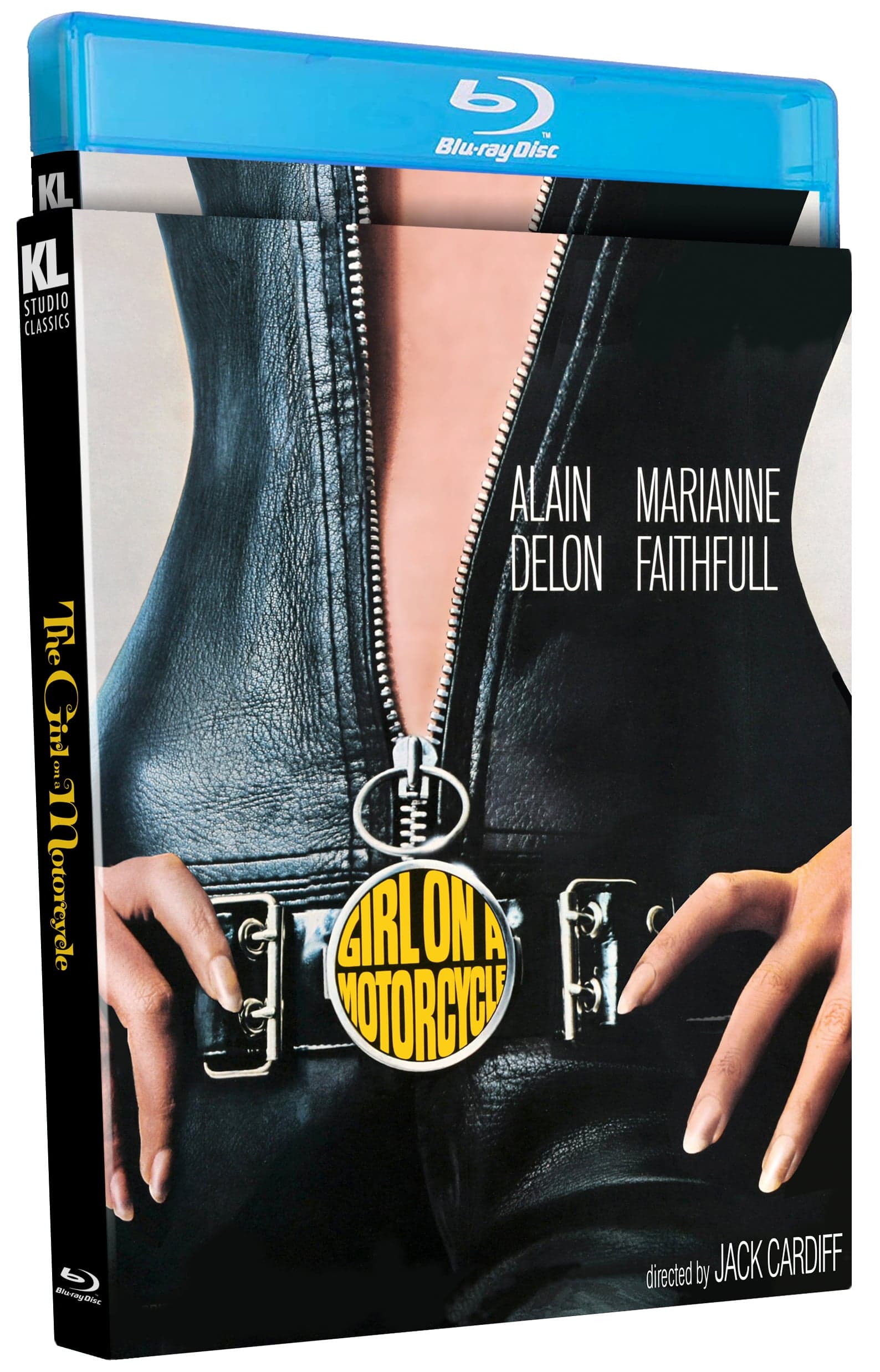
Kino Lorber presents Girl on a Motorcycle in a brand new 4K transfer that does justice to the film’s painterly use of color and solarization effects. Primary hues—especially those radiant reds and vegetal greens—practically leap off the screen. Brightly lit and outdoor scenes reveal a fair bit of depth and clarity of fine details, while darker scenes show well-balanced grain levels. The two-channel Master Audio mix legibly conveys the dialogue (even Marianne Faithfull’s breathy internal monologue), and puts Les Reed’s freewheeling orchestral score front and center.
Extras
Kino carries over the Jack Cardiff commentary from its 2012 Blu-ray release, and includes a brand new one from film historian and critic Alexandra Heller-Nicholas. Both tracks are united by the fact that they contain long swaths of silence between bursts of talk, though what’s on them is usually pretty compelling. Cardiff’s track is dominated by technical considerations leavened by the odd, self-congratulatory asides. Heller-Nicholas states right off the bat that her track will focus on the intersection of Girl on a Motorcycle with notions of feminism as well as the biker movie genre. Along the way, she has lots of interesting things to say about Joan Didion’s film criticism, the real life inspiration for André Pieyre de Mandiargues’s source novel, the contributions of Gillian Freeman to the script, contemporary and more recent assessments of the film, Faithfull’s brief acting career, and Cardiff’s work as both a cinematographer and film director. As it happens, one of the pieces that Heller-Nicholas quotes at some length is Joseph Jon Lanthier’s review from 2012 that’s been reprinted above.
Overall
A countercultural curio of almost painterly beauty, Jack Cardiff’s Girl on a Motorcycle gets a stunning 4K upgrade as well as a meaty new commentary track from Kino Lorber.
Since 2001, we've brought you uncompromising, candid takes on the world of film, music, television, video games, theater, and more. Independently owned and operated publications like Slant have been hit hard in recent years, but we’re committed to keeping our content free and accessible—meaning no paywalls or fees.
If you like what we do, please consider subscribing to our Patreon or making a donation.