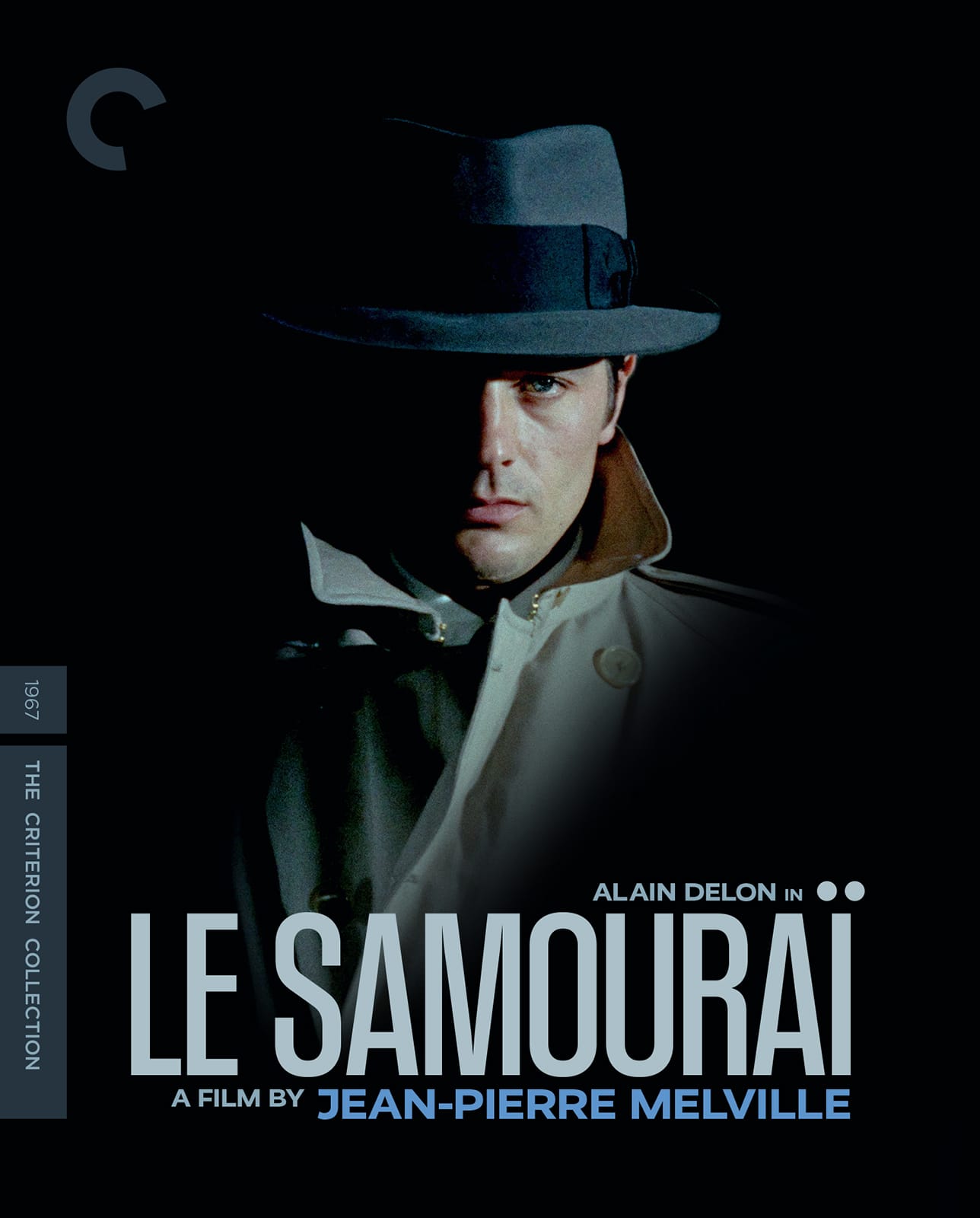
 Jean-Pierre Melville’s Le Samouraï concerns perfection of form and etiquette as a way of life. For Melville, perfection means the absence of extraneousness, especially in terms of professionalism and art. Jef Costello (Alain Delon) lives in a bare and gray apartment that’s so comically Dickensian in its austerity that he can almost immediately discern where an enemy has bugged the place. When Jef isn’t killing people for money, he lies in bed and smokes and listens to the melancholy chatter of his caged bird, informing loneliness with the sort of grandeur that we project onto ourselves when we’re convinced that we’re the saddest people alive. Jef embraces the solitude of the Japanese samurai as technically established by the Bushido, but, more likely, as defined by the cinema of Kurosawa Akira.
Melville’s films celebrate code of conduct as a self-justifying reward—a notion that enjoys less currency in our self-absorbed present day. Le Samouraï specifically is driven by the subterranean merger between Jef and Melville’s working credos. Jef derives satisfaction from his sense of style, which fuses dandy poetry with a working man’s enjoyment of the quotidian.
As played, or more accurately inhabited, by one of cinema’s most beautiful men, Jef wears his fedora, trench coat, and white gloves with the precision of a model, adjusting his hat with a dancer’s grace, its brim seemingly ready to slice through metal. But Jef also steals cars and barters with middlemen of the criminal underworld, revealing the grit underneath his neat and nearly androgynous presence. Jef fingers a ring of keys, used for stealing cars, with a grace that weds white- and blue-collar modes of sexuality. He’s dancer, mechanic, killer, and high-stakes thief all in one, an antihero for people of all classes, who’re governed by all erotic hungers.
The film’s aesthetic walks a similar tight rope between the rarefied and the everyday. Moony, blue, utterly gorgeous images of Paris at night are counterpointed by drab yet pristine shots of a police precinct that’s working overtime to hang a murder on Jef. A modernist club, probably the height of French chic in 1967, with white orbs and mirrors and plastic-looking chairs, is counterpointed by the rigorous montages set in and around a metro station. Melville’s images are pared down and governed by bold strokes of black, white, and gray, yet documentarian details emerge, contrasting behavioral modes that vary depending on social caste.
Throughout Le Samouraï, Melville downplays the violence that’s since taken over the crime film, devoting his attention to moments that ordinary filmmakers would deem perfunctory. He transforms the scene in which police assemble “the usual suspects” for a lineup, fashioning an intricately absorbing analysis of procedure. Le Commissaire (François Périer) paces between witnesses scattered throughout a variety of interview offices, seeking to detonate Jef’s alibi for a murder, though the sequence’s punchline hinges on an exquisite irony: In order to be exonerated, Jef must be fingered rather than overlooked by a witness.

Elsewhere, when Jef’s apartment is bugged, Melville emphasizes the precision of the interlopers as they find a key for the door, which they produce from a ring similar to the one Jef uses to lift cars. The men navigate the apartment with similar fastidiousness, staking out the windows and hammering a nail into place for the recording device, all while Jef’s bird, perhaps the loneliest character in Le Samouraï, chirps its plaintive chirp.
In its lucid merging of exotic and proletariat textures, Le Samouraï has proven enormously influential, refining a sex appeal for the modern crime film that can fascinate even the most self-consciously macho types. The cinema of Michael Mann, particularly Heat’s melodramatic yet elaborately observational set pieces, is unimaginable without this film, as is much of the work of Walter Hill and John Woo, respectively, to name two of Melville’s most famous disciples.
In Le Samouraï, Melville merged the self-pity of the postwar American crime film with the doomy existentialism of modern French pop culture, proving two disparate worlds to have more in common than one might’ve otherwise expected. Within Melville’s aestheticism lurks a democracy of consumption and reconfiguration.
Image/Sound
This new 4K restoration, undertaken by the Criterion Collection and Pathé, offers a substantially more elegant and insinuating image than Criterion’s 2017 Blu-ray release. The uptick in quality is most obvious in the film’s black and gray tones, which are sleeker and deeper and more varied than they were on the prior disc, as well as healthier and more attractive. As a result, Le Samouraï’s painterly lushness is noticeably intensified. Browns, whites, and flesh tones are subtler than before and mesh better with the blacks and grays.
The French monaural soundtrack hasn’t been as noticeably upgraded as the image, but that doesn’t seem as if it was necessary. As with the 2017 Blu-ray, there’s plenty of minute noises in this soundscape, which create a diegetic jazz that complements the film’s visual celebration of work as a kind of religion. These notes are presented here with visceral pristineness, and François de Roubaix’s romantic score resounds with velvety decadence.
Extras
Apart from new and improved cover art, these supplements haven’t been updated from the 2017 disc, which weren’t updated from Criterion’s 2005 DVD either. Which is to say that while they are worthwhile, a bit of dusting is overdue. Generally, these supplements are most valuable for offering contemporary viewers a glimpse at the art of Jean-Pierre Melville’s personal style, particularly the footage of him that’s featured in archival interviews. Melville favors sunglasses and a cowboy hat, striking the sort of cool pose that’s familiar to that of many of his characters, with a deep and suave voice that suggests a person in total command of his public impression.
Unsurprisingly, Melville mentions the challenge of presenting oneself, which mirrors the difficulty of creating art that resonates with a massive audience. Other elements of Melville’s working life and aesthetic are documented, too briefly, by the interviews with Rui Nogueira, editor of Melville on Melville, and Ginette Vincendeau, author of Jean-Pierre Melville: An American in Paris, which were recorded in 2005. Meanwhile, “Melville-Delon: D’honneur et de Nuit” explores the friendship between Melville and Delon, interviewing their friends and family, though this 2011 documentary is also too short and glancing, gliding from sound bite to sound bite. The theatrical trailer rounds out this evocative but slim package, with a booklet featuring a characteristically ecstatic essay by David Thomson, as well as an appreciation by John Woo and an excerpt of Melville on Melville that whets one’s appetite for the entire book.
Overall
Jean-Pierre Melville’s nearly abstract masterpiece has been refurbished with a revelatory 4K transfer, which is enough to make up for the fact that the extras haven’t been updated in years.
Since 2001, we've brought you uncompromising, candid takes on the world of film, music, television, video games, theater, and more. Independently owned and operated publications like Slant have been hit hard in recent years, but we’re committed to keeping our content free and accessible—meaning no paywalls or fees.
If you like what we do, please consider subscribing to our Patreon or making a donation.