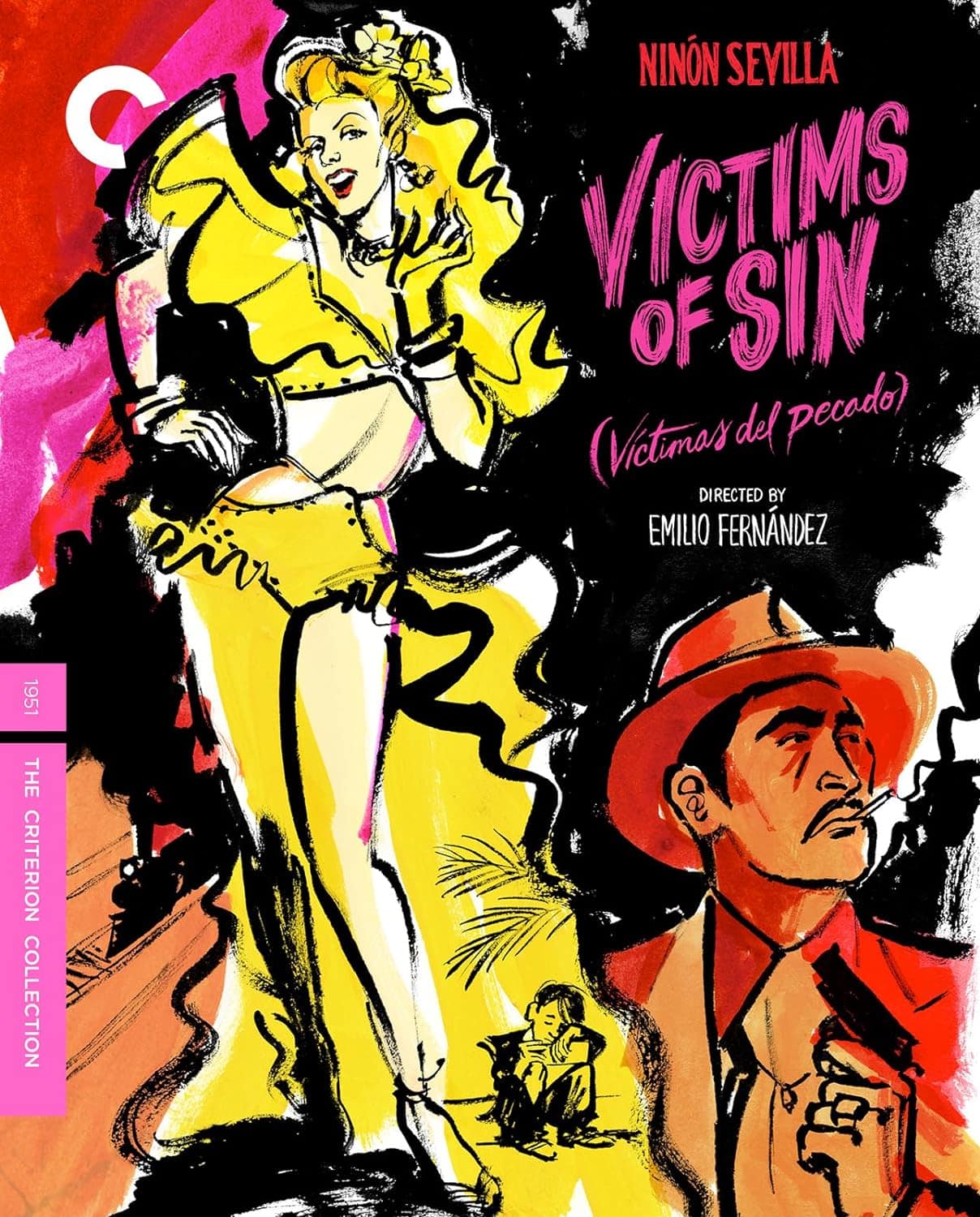
 “Film is like a battleground. There’s love, hate, action, violence, death. In one word: emotion.” So said Sam Fuller of Jean-Luc Godard’s Pierrot le Fou, but he could just as easily have been speaking about Emilio Fernández’s Victims of Sin given how drastically and often ferociously the 1951 film shifts in emotional registers, from the erotic to the violent, from the tragic to the transcendent.
As one of the quintessential cabaretera films from the golden age of Mexican cinema, Victims of Sin moves at the quickening pace of the Afro-Cuban rumba dances we witness throughout. These dances, and the music supporting them, underscore the sensuality that seems to run beneath almost everything in the seedy little corner of Mexico City where the film takes place, as well as set up the female characters as objects of male lust and jealousy.
Written by Fernández and Mauricio Magdaleno, the film centers on Violeta (Ninón Sevilla), an almost heroically resilient cabaret dancer who doesn’t put up with any nonsense from her demanding boss, Don Gazalo (Francisco Reiguera), or the sleazy gangster, Rodolfo (Rodolfo Acosta), who gets her friend Rosa (Margarita Ceballos) pregnant only to disown the baby. In a tragic turn befitting the film’s melodramatic tendencies, Rosa abandons the infant in a trash can in order to be with Rodolfo, only for Violeta to rescue the child and raise it as her own.
Victims of Sin refuses to present Violeta as some sort of pure, angelic force. Strong, smart, and independent, she’s determined to raise the child even if it means losing her job or incurring the wrath of the dangerous Rodolfo for keeping his abandoned offspring in his orbit. Both Violeta’s aggressiveness and fearlessness make her stand apart from other cabaretera heroines, since, despite the film’s title, she never allows herself to be made a victim, retaining her agency and independence even as she endures threats of violence and is forced to engage in sex work.
Throughout, Gabriel Figueroa’s stunning noirish cinematography captures the kineticism of Violeta’s performances and the sense of impending danger that seems to grow with every second. A particularly gorgeous, yet foreboding, shot of Violeta sees her walking to the side of a bridge over the nearby train station. She watches a train come in from the distance, and as it gets closer, it releases a giant plume of smoke that darkens the bright yet cloudy sky as it swoops in toward the bridge. It’s a harbinger of things to come for Violeta—a symbolic reminder of the precariousness of women’s lives in this world. But it’s only fitting that she remains unphased, and like many other situations in her life, appears like David standing before Goliath.

The vibrancy of Sevilla’s performance is a consistent marvel, especially when Violeta takes the stage, dancing as if trying to transcend the cruel determinism of fate. But it’s her ferocity, which seems incongruous to her small frame, that makes Violeta such an iconic character. Indeed, her unbridled passion is evident off stage as well as she directly confronts a world that wants to diminish her and refuses, time and again, to ever back down.
Image/Sound
The new 4K digital restoration that Criterion has sourced for this release looks flawless. Between the very strong contrast and high level of detail, the presentation really highlights the beauty of Gabriel Figueroa’s chiaroscuro lighting. The image is consistently sharp and grain distribution is even. Short of the film getting a 4K UHD release, it’s hard to imagine the film looking any better. The audio presentation is also quite strong, featuring a nice depth to the various music played throughout the film and dialogue that’s crisp and clean, free of any hisses and pops.
Extras
In a new interview, cinematographer Rodrigo Prieto discusses the work of Gabriel Figueroa and his skill when it came to shooting skies and clouds. Prieto gets into the nuts and bolts of cinematography, discussing color filters, aperture, and exposure and how Figueroa used them across his work. Another new interview finds filmmaker and archivist Viviana Garcia Besné discussing how she got her start preserving Mexican films before diving into the career of Ninón Sevilla, who was as strong, smart, and resilient as the character she played in Victims of Sin.
The disc also includes a 1983 episode of the Mexican TV show Those Who Made Our Cinema, featuring a variety of directors and actors, including Sevilla, talking about the rise of the cabaretera film and the importance of the sex worker and dancer characters in the mid-20th century within the genre. Rounding out the package is a foldout booklet, with a wonderful essay by scholar Jacqueline Avila, who pays particular attention to the film’s use of music and dance.
Overall
Criterion has outfitted Emilio Fernández’s classic of Mexican cinema with a dazzling 4K transfer and a small but compelling slate of extras.
Since 2001, we've brought you uncompromising, candid takes on the world of film, music, television, video games, theater, and more. Independently owned and operated publications like Slant have been hit hard in recent years, but we’re committed to keeping our content free and accessible—meaning no paywalls or fees.
If you like what we do, please consider subscribing to our Patreon or making a donation.