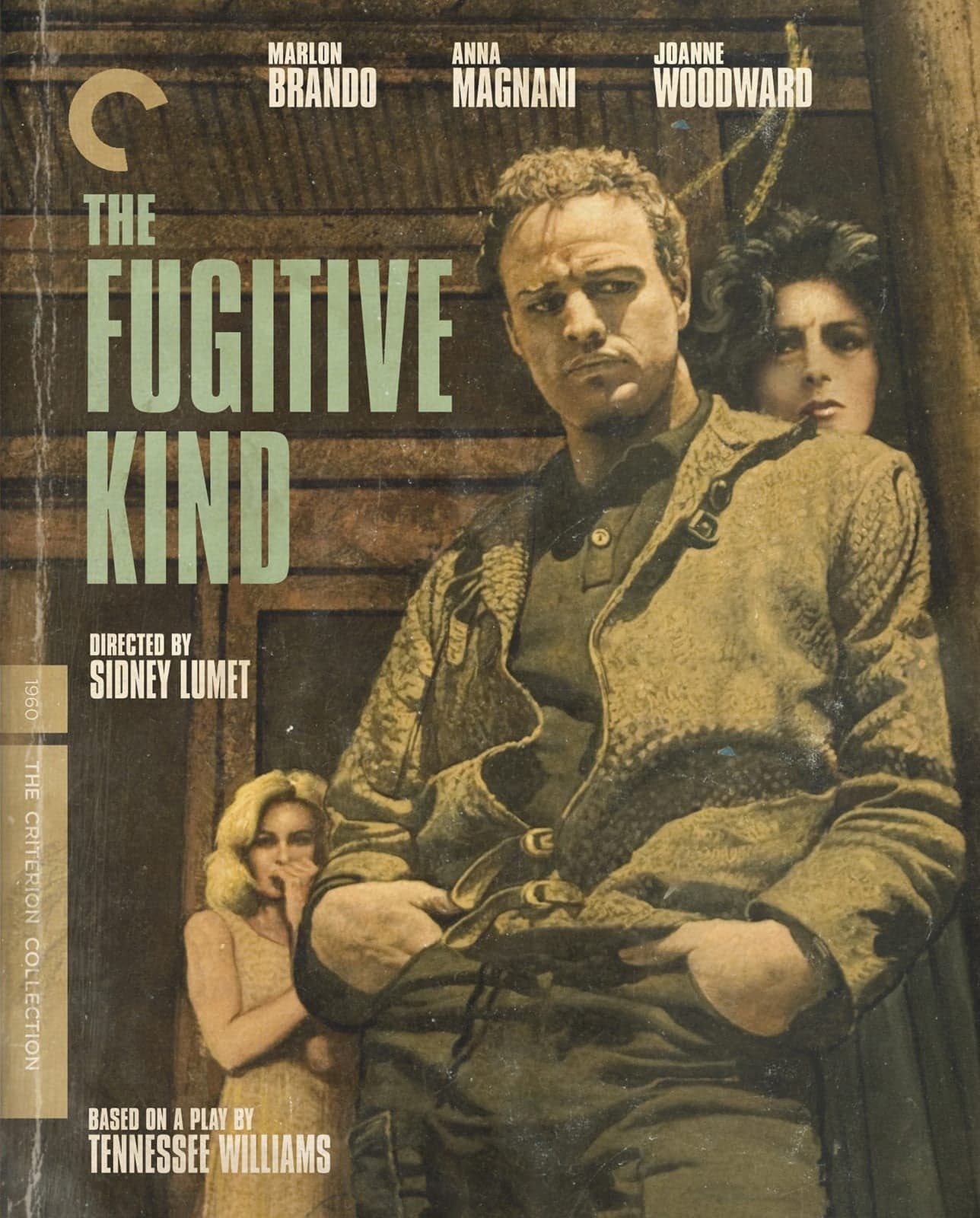
 Tennessee Williams’s work thrives on risk, often striving for the rhythm and tenor of verse poetry, and at times collapsing into absurdity. His plays sometimes suggest film noirs that have been pumped up with the heightened fatalism of Greek tragedy, abounding in hothouse dialogue, literary symbolism (especially of the castration variety), domestic prison motifs, and frustrated women trapped between male captors and potential saviors. When one of his plays soar, like A Streetcar Named Desire, it feels as if the primordial manna of American working-class frustration has been unearthed and writ beautiful, and when one of them thuds, like Orpheus Descending, the floridness is ludicrous. Source material, then, is an issue dogging Sidney Lumet’s 1960 film The Fugitive Kind, an adaptation of Orpheus Descending that plays as a lesser imitation of Elia Kazan’s extraordinary film version of A Streetcar Named Desire.
Written by Williams and co-screenwriter Meade Roberts, The Fugitive Kind is a story of broken people stewing in close quarters, wrestling with atrocities of the past. Appropriately in such a context, the film opens with a man in the midst of atonement. Valentine “Snakeskin” Xavier (Marlon Brando) explains to a judge in New Orleans his involvement in a bar fight. The judge is unseen, suggesting a priest who’s receiving Val’s confession. It’s evident that Brando is attempting to differentiate Val from his Stanley Kowalski in A Streetcar Named Desire. Stanley is a brute wrestling with his impulses, a friction that Brando peerlessly dramatized, while Valentine suggests a former hell-raiser who’s achieved relative stability after great struggle. Val’s snakeskin jacket (later parodied in David Lynch’s Wild at Heart) is a promise of wildness that Val is no longer fulfilling, setting him up for damnation. The women of the Mississippi town that Val settles into want the man he used to be, while the town’s old codgers assume him to be a threat to their reign of racist terrorism.
The oft-referenced events in New Orleans sound more compelling than most of what happens on screen in The Fugitive Kind. The film makes its points and keeps making them, visually as well as verbally, feeling increasingly predigested by its creators, leaving the audience with little space to ruminate. Lumet and cinematographer Boris Kaufman conjure a black-and-white neo-expressionism that physicalizes the ghosts of the Mississippi town, favoring thick shadows that are punctuated with rays of light that expose buried truths and faces on the verge of confessions, and buildings are rife with latticework that serves as a readymade symbol of self-imprisonment. Lest we miss the point, there are speeches about drifting, about birds without legs who can’t land, and about our essential loneliness. Near the film’s climax, Val goes so far as to say, “We’re, all of us, sentenced to solitary confinement…for as long as we live on this Earth.” The cumulative effect of all this business is stultifying, as no moment here is allowed to simply breathe and exist, unburdened by arty signifiers. (Williams once said that the actors in this film were lit as if they were dipped in chocolate.)
Compared to the intense, ambiguous sexual neuroticism of A Streetcar Named Desire, the central conflict of The Fugitive Kind is pulp-fiction thin: Val starts working in the shop of an old man, Jabe (Victory Jory), who’s bedridden, a condition that forces his wife, Lady (Anna Magnani), to run the operation. Lady inevitably grows close to her new employee, who represents the passion she sacrificed many years earlier for the sake of stability, in the wake of dual tragedies. More or less, we’re waiting for the handyman to screw the bored housewife, though they keep debating the merit of going on with life or giving up, with Lady maddeningly repeating certain phrases for the sake of a poetic effect that grows maudlin.
The Fugitive Kind has vividly erotic moments, especially as Val talks Lady into hiring him at her shop, with the discussion becoming an extended double entendre. At this point in his career, Brando was an astonishing physical specimen, a statuesque hunk with the intellectual ennui of a philosopher, who moves with a panther-like ease that’s so pronounced that it’s even worked into the dialogue, and who speaks in a tenor that’s both tremulous and authoritative. (He’s the misfit we all want to be.) But Val is composed of nothing but Brando’s self-consciously simmering gestures, and the actor also indulges his propensity for fetishizing aloofness as his impression of averageness; even at the height of his powers, Brando’s tricks can be tedious. Magnani also has a robust physical intensity, but Lady’s prattling about her father’s destroyed wine garden does the actress no favors. (No one could save a line like “I had pride that summer they burned the wine garden of my father.”) In fact, everyone in this film is a type: Jabe and Sheriff Talbot (R.G. Armstrong) are superficial racist monsters, while Carol (Joanne Woodward) is a hoary cliché, the alcoholic as soul who’s too sensitive to stay sober.
The film has a strange pull nevertheless, as its powerful and embarrassing moments merge to offer a fever dream of an America, on the verge of the civil rights movement, that’s about to eat itself alive. There are pointedly no people of color in The Fugitive Kind, but the white characters divide over how to combat the legacy of American slavery, and Lady is particularly torn between liberation and oppression. This text is complemented by the gothic imagery, especially when Lady visits her father’s destroyed wine garden, a monument to dashed hope and personal as well as social fertility. Ultimately, there’s not quite a sense that Lumet has a take on this material, as The Fugitive Kind has nowhere near the drive of 12 Angry Men or his 1970s-era classics. Lumet prefers straight plotting uncluttered by symbols and fanciful allusions, and he eventually became a poet of the divide between procedure and chaos. In this film, he’s a dutiful student aware of the baggage he’s carrying.
Image/Sound
The image is beautiful, if occasionally inconsistent. Many sequences are crisp, with pristine black-and-white imagery, while others are softer, most notably in terms of the whites of close-ups of actors’ faces. This inconsistency intensifies the dreamlike spell of The Fugitive Kind, especially in certain unforgettable shots of Joanne Woodward’s character as she’s illuminated by the moonlight. Blacks are generally robust, even in the soft scenes, and there’s a remarkably subtle variation of whites, with an appealing level of grit that tethers this dream world somewhat to reality. The monaural soundtrack is clean and stable, offering a particularly heightened emphasis on the diegetic sound effects.
Extras
“Hollywood’s Tennessee and The Fugitive Kind” and the liner notes by critic David Thomson offer a concise and thoughtful exploration of Tennessee Williams’s rise as a playwright and his subsequent relationship with Hollywood. Williams is portrayed as a generous, if sometimes cantankerous, filmic collaborator who understood that cinema and theater were different disciplines and welcomed the input of his directors. (Williams even said that, while writing, he envisioned his plays unspooling in cinematic images.) In “Hollywood’s Tennessee,” scholar Robert Bray and film historian R. Barton Palmer also analyze The Fugitive Kind’s symbolism and its relationship with its source material, Orpheus Descending, which is complemented by an archive interview with Sidney Lumet from 2009 that vividly details the director’s working relationships with Marlon Brando, Anna Magnani, Joanne Woodward, and Maureen Stapleton, and all the various juggling of egos and insecurities that process entailed.
The best supplement, though, is a collection of three one-act plays by Williams, directed by Lumet, which aired as a single program on TV in 1958, featuring actors such as Ben Gazzara and Lee Grant. These plays, early works of Williams’s, lack the overbaked poetry of Orpheus Descending, with blunt, searing, poignant dialogue and spare sets that evoke the claustrophobia of the characters. These plays aren’t trying so hard to live up to Williams’s legacy, and they embody his ability to render the ordinary ecstatic and uncanny. (One of the plays, featuring a sexually confident young girl, would be daring even today.) Only one regret: All of these supplements were available on the 2009 Criterion disc.
Overall
Criterion very ably honors the neurotic beauty of The Fugitive Kind, though new extras would’ve been appreciated.
Since 2001, we've brought you uncompromising, candid takes on the world of film, music, television, video games, theater, and more. Independently owned and operated publications like Slant have been hit hard in recent years, but we’re committed to keeping our content free and accessible—meaning no paywalls or fees.
If you like what we do, please consider subscribing to our Patreon or making a donation.