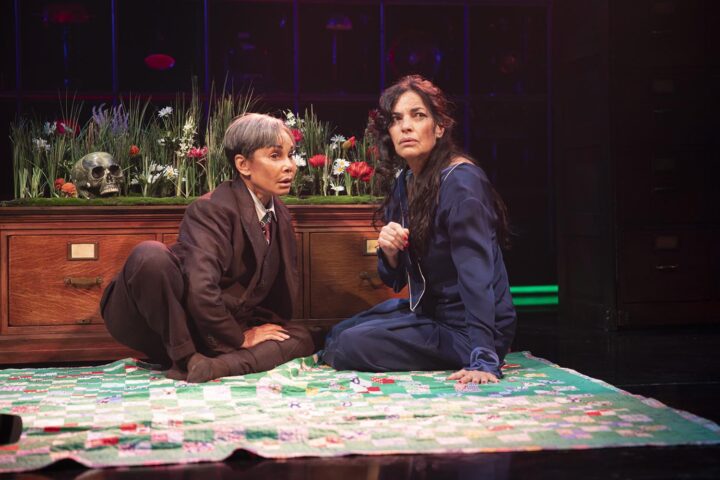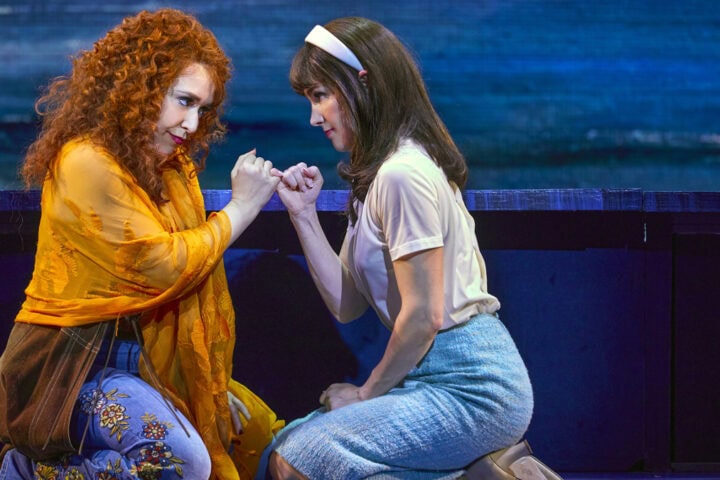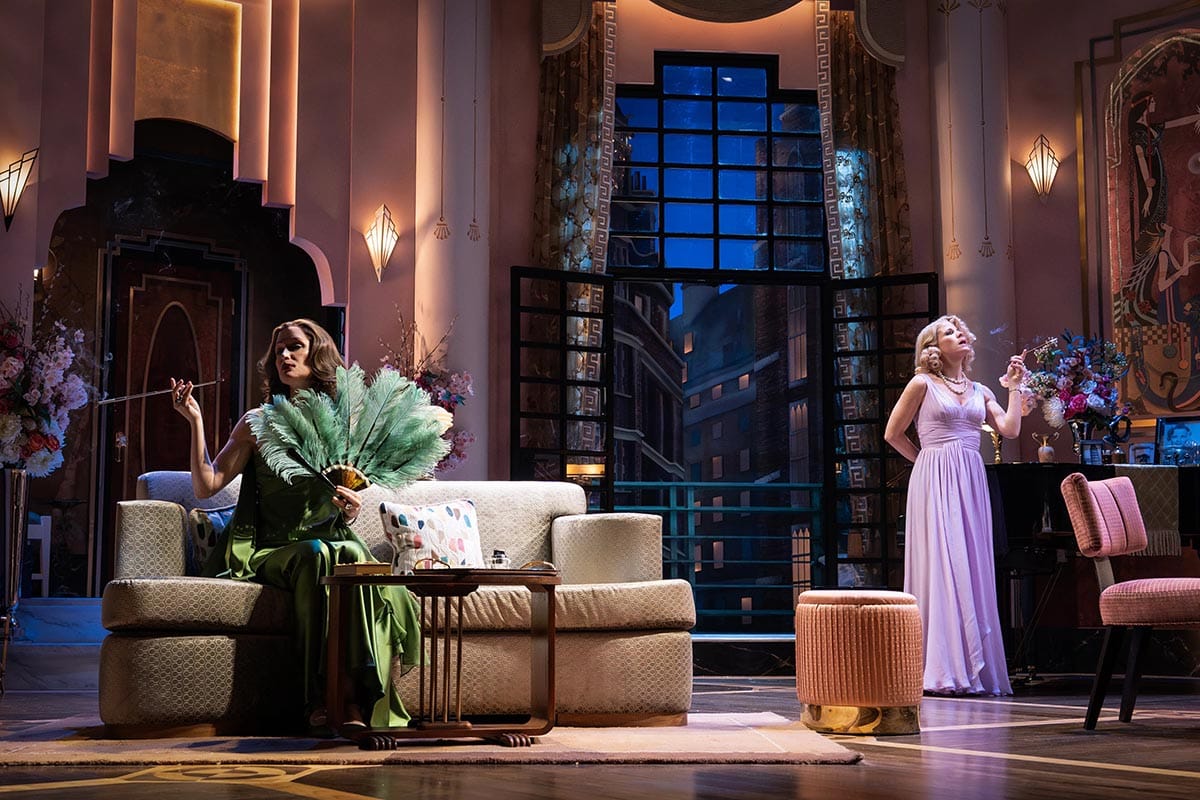
Julia (Kelli O’Hara) and Jane (Rose Byrne), the besties at the center of Fallen Angels, don’t want the maid to overhear their most indecent conversation about how horny they still are for the studly Frenchman they each romanced nine years ago. So every time Saunders (Tracee Chimo) barges in with another delicacy or apertif to serve them, these usually morally upright socialites start improvising bon mots, the kind of utterly random remarks they imagine society wives ought to be making over dinner. “I have heard that the worst part of parenting is the children,” Julia intones pendulously. “And how do they know if an animal is extinct?” Jane responds, with solemn irrelevance. “Have they looked everywhere?”
It’s the funniest recurring bit in the Roundabout Theatre Company’s revival of Fallen Angels, as the play’s lustful heroines try to present as witty, worldly wise women, perhaps like those in a Noël Coward play. But it’s rather ironic, too, that director Scott Ellis’s jaunty staging of an actual Noël Coward play should be at its best when the characters are most self-aware of the stylistic sparkle that most of the actors themselves often miss.
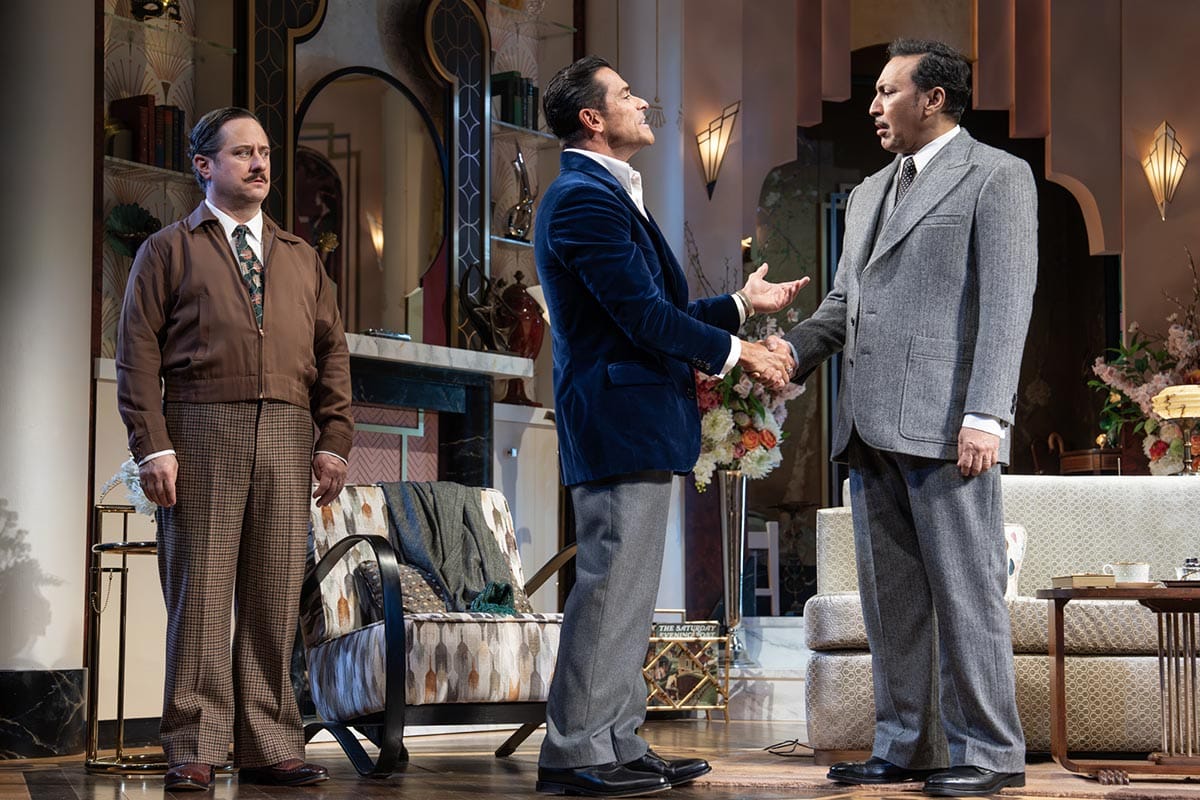
When the play begins, the oh-so-English Fred (Aasif Mandvi) and Willy (Christopher Fitzgerald), content in their loveless marriages, are off to a golf trip, trusting their wives to their own devices. But Julia and Jane know that Maurice (Mark Consuelos), the hunk that got away, is back in town and might show up at the door to reignite their passions for him at any minute.
For the first scene of Fallen Angels, as the actors bound about David Rockwell’s stunningly decked-out drawing room set, adorned with silver pillars and tall, dramatic windows, nearly everyone seems to be approximating what sort of play they’re in. The husbands are doing some rather broad clowning. The maid is a vaudevillian ham. Byrne’s Jane leads with funny voices.
Initially, only O’Hara, playing the breezily cool Julia, gets at something distinctly Cowardly: What makes the sexual perversities of his 1920s characters shocking is the convivial casualness with which they unburden their dirty minds. “Apparently a man was arrested for, how do I put this, scaling the tower and trying to have relations with Big Ben,” Julia alerts her husband as she reads the paper with unruffled prurience. “The gentleman’s doing time for doing time.” In this circus troupe, she’s the only one who seems like a possible person.
Fortunately, though, the motor of Coward’s very frivolous plot helps to make up for the stylistic mismatches as the play transitions away from the idle banter of drawing-room chat. Coward’s chief instrument is his tightly wound wit, and this cast launches into goofy physical comedy and buffoonery right away. But all of Fallen Angels’s second act (the three acts are staged here in 90 brisk minutes without an intermission) involves Julia and Jane getting progressively drunker as they anticipate Maurice’s arrival, as if they’re in a blotto Waiting for Godot, now with fabulous evening gowns. Even if the script doesn’t explicitly call for it, all the physical clowning starts making sense once the drinks start pouring and the ladies lose control.
Byrne is pure silliness, throwing herself melodramatically at the mantelpiece, dropping her voice two octaves in mock fury, and, in one particularly ridiculous moment as Jane feels the full effects of the cocktails, dancing in kooky bliss to the sound of a telephone ring. O’Hara reveals a delightful knack for slapstick, tipsily launching herself over the back of an armchair and sliding down face-first to the floor like she’s auditioning for Oh, Mary! (And why shouldn’t she?) There’s plenty of pleasure to be found as the camaraderie turns to sloshed contempt when the friends each begin to suspect that the other has had secret communications with Maurice.
If, after 90 minutes in their company, there’s still little to distinguish Julia and Jane from one another, personality-wise, at least when they’re sober, that’s partly Coward’s fault. Written when he was in his early 20s, Fallen Angels is ultimately powered by mountingly goofy but predictable plot turns, not by character development, and the final act sets up parallel, near-identical scenes where Julia and Jane, miserably hungover, each reveal far too much to the other’s husband.
There’s not much to be done about the fact that the women serve identical functions in the story’s machinery, but there are still undercurrents in their relationship that this production could better tease out. Coward plants a nearly explicit sexual desire within the friendship: Imagining their future escapades with the Frenchman, Julia, making a typically posh declaration, avows, “I don’t mind standing together, but I won’t fall together—it would be most unseemly.” And Jane, ever so cautiously making a pass, responds, “Oh…I don’t know, would it?” Coward’s work is ever-ripe for queer interpretation, but Ellis is a bit of a coward himself about letting the actresses lean into the interest that bobs just below the surface.
Oh, and then there’s Maurice himself, who actually does appear in the play’s final minutes to tie things up in a naughty bow. Consuelos proves himself entirely incapable of pulling off the French accent, but, by that point, events have gotten so ludicrous that it almost lands as a meta-theatrical joke: Maurice may still be sexy, but he’s a dreadfully unpersuasive Frenchman.
O’Hara, whose glorious singing voice throughout her musical theater career has often stolen focus from how excellent an actress she is, gets to show off her capacity for unaccompanied farce at last though. She’s the chief reason to see Fallen Angels, the next stage of her decades-long affair with Broadway audiences, alit with a flame that only keeps burning brighter.
Fallen Angels is now running at the Todd Haimes Theatre.
Since 2001, we've brought you uncompromising, candid takes on the world of film, music, television, video games, theater, and more. Independently owned and operated publications like Slant have been hit hard in recent years, but we’re committed to keeping our content free and accessible—meaning no paywalls or fees.
If you like what we do, please consider subscribing to our Patreon or making a donation.