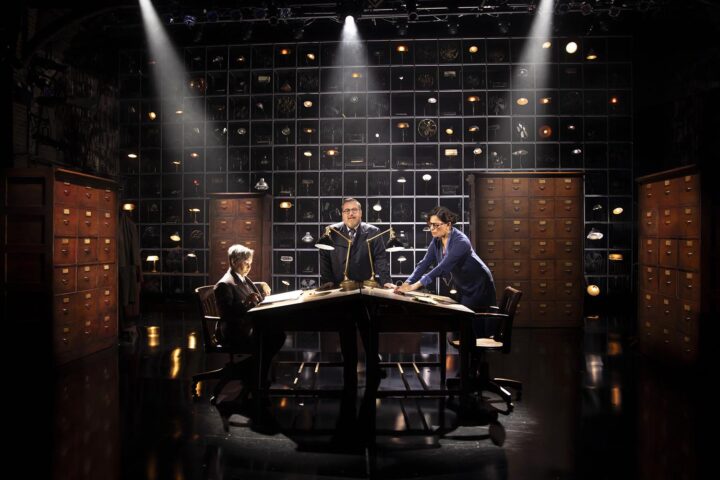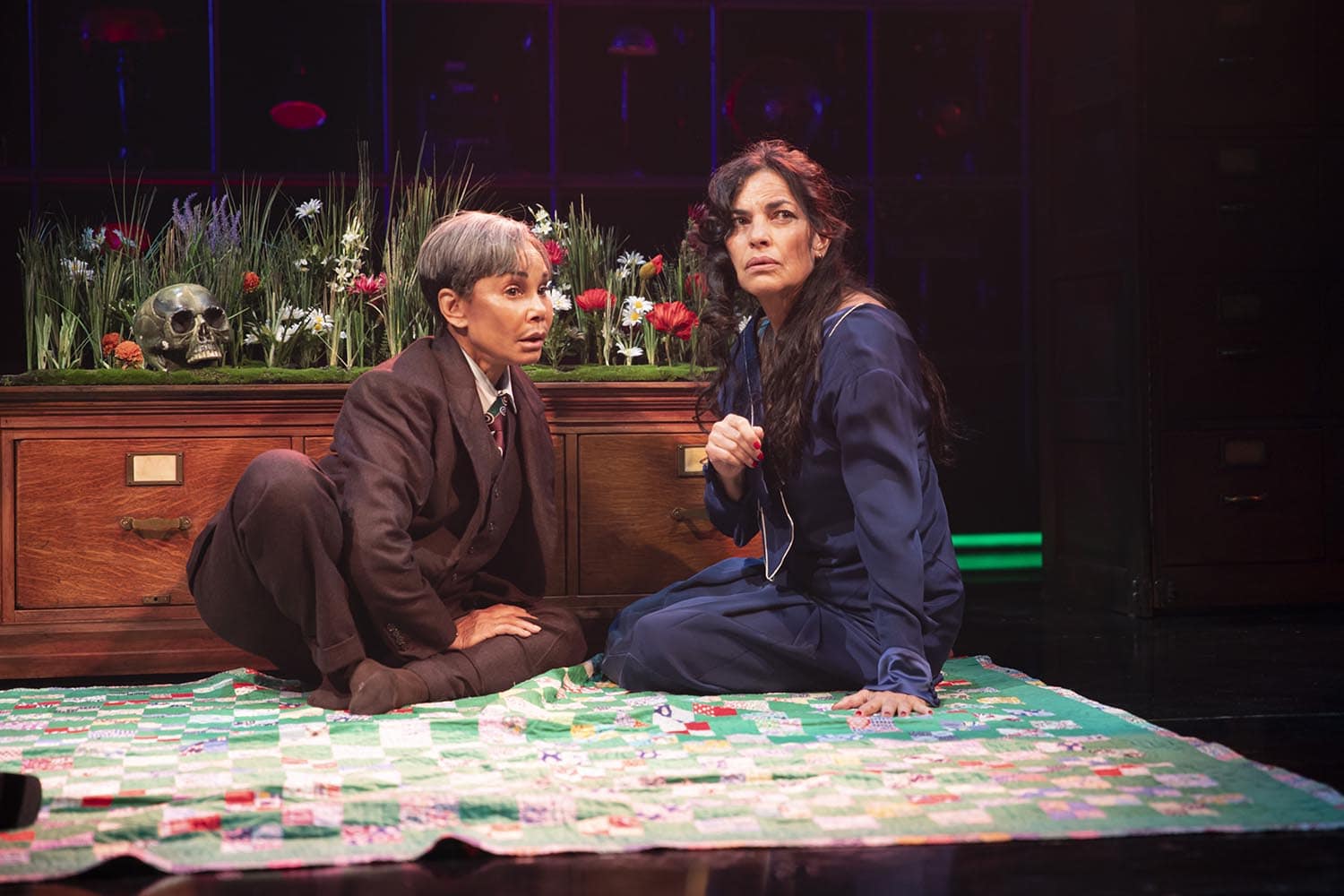
In the New Group’s off-Broadway revival of Elmer L. Rice’s 1923 play The Adding Machine, Sarita Choudhury stars as Daisy, a plain bookkeeper’s assistant whose only escape from an unfulfilled life is her imagination. Choudhury, who made her acting debut playing the romantic lead opposite Denzel Washington in Mira Nair’s 1991 film Mississippi Masala, says that she’s always made surprising turns during the course of her versatile 35-year career. “Maybe it’s the fear of being trapped,” explains the London-born actress. “The minute I do one thing I need to shift it completely; I think I’ve done this all my life.”
Rice’s century-old satire has an uncanny resonance in our contemporary age of technological anxiety. Directed by Scott Elliott and revised by playwright Thomas Bradshaw, the play tracks the mundane existence of Mr. Zero (played by Daphne Rubin-Vega in a cross-gendered role), a bookkeeper who has slogged at his mediocre job for 25 years. He’s spent much of his life in an unhappy marriage with his wife, Mrs. Zero (Jennifer Tilly), and at work he’s blind to the devotion of Daisy (Choudhury), the co-worker who sits across him. Zero is driven to a murderous rage when his job is made redundant with the advent of the latest technological advance: an adding machine. The startling expressionist drama then follows Zero and Daisy into the afterlife, concluding with disquieting truths about the human condition.
In a recent conversation shortly after the revival commenced performances at the Theater at St. Clement’s, I spoke with Choudhury about The Adding Machine’s resonance, working opposite Daphne Rubin-Vega, what draws her to working with Scott Elliott and Mira Nair, and how appearing on And Just Like That challenged her approach to acting.
This century-old play packs quite a punch, doesn’t it? What was it like first encountering the script and then rehearsing it?
It made me remember why I wanted to be an actor. If you can find a play where you have to figure out how the words lead you into what you’re doing, as opposed to doing a lot of the creating as [you would] with maybe not as great writing, that’s enough.
I’ve never worked on something like this, to be honest. This play is so hard to get a grip on. We had to read it a lot out loud because the language, the punctuation, is a bit of a different era. Even just learning how to enunciate loudly when you don’t really know what you’re saying, it reminded me of Shakespeare in a way. You had to leap before you understood. And with my character, Daisy, there’s this freedom she reaches that I was so in love with.
The play has a rather dark view of life, and the women are pretty much downtrodden. But both Daisy and Mrs. Zero have monologues that bring out a personality and a humanity that, ordinarily, the world of the play wouldn’t allow.
Yeah. You know, it’s funny, because if you ask me about the play, it’s full of cheekiness and lightness and dance, which I know isn’t in it at all. So it’s kind of fun in that, even though these women, like you said, there’s a downtroddeness to them and a suffocation, all they have are their dreams and their fantasies of the movies that they get to go to. They watch people kissing [on the screen] and they’re like, “Oh, my God!” So, in a weird way, their portal, their fantasy, is where I guess there’s some lightness in the play. Jennifer [Tilly] plays a housewife and I play an office worker, but half the time we speak in terms of our desire—our inner life.
What’s it like playing opposite Daphne Rubin-Vega, who’s cross-gender cast in the role of Mr. Zero?
We don’t even think about that. The other day we ran into an actress on the street and we were talking to her and Daphne is like, “Oh, yeah, actually she’s my work wife in the play.” And then Daphne said something like, “I get to kiss Sarita!” I looked at her and I realized it didn’t even dawn on me. I guess living in New York it seems so normal to have this kind of situation in theater. It just was like, “Oh, Daphne’s a great actress and she’s playing Mr. Zero. Okay!”
Looking back to the start of your acting career, can you talk about working with filmmaker Mira Nair?
I was a film student at the time and I was obsessed with Mira. I’d seen her early films like India Cabaret and Salaam Bombay. I happened to be in London when they were looking for the person to play Mina in Mississippi Masala. It was so random. Someone submitted me and I went and met her. And it changed my life. It was so unexpected and yet, if I think about it—everything I’d studied up to then and my kind of obsession with her films—I can put it together and say, “Oh, that makes sense.” But she was in America going through London to India, so it was a lot of happenstance. It makes you realize: Get ready for your life and life will happen.
After that big break in the movies, however, you chose to work in the theater…
I did. I think it’s kind of what I’m doing now again. There’s always been a part of me that realizes when I get this chance in film and television, there’s this other part of me that knows it needs to balance. It’s like going back to school in a way. So after I did Mississippi Masala, back then, I thought I need a lot of practice at this. Acting’s not easy. So when Cheek By Jowl, this British company that does Shakespeare, came to New York [in 1998 to do Much Ado About Nothing], I practically begged the director Declan Donellan. It was like, “Please take me, I know I’m not that good.” He’s so bright and so knowledgeable in the world of Shakespeare and I learned so much from him. And then Scott [Elliott, artistic director of the New Group] hired me for my next play [The Flatted Fifth in 1997]. Theater has always been my school in a way. When you’re an actress, there’s a lot of gaps in your career where you’re up for a film and you don’t get it. So the beautiful thing was to have stage as my constant craft.
You seem to gravitate toward the same directors. You’ve worked with Scott Elliott and the New Group before and you’ve starred in several Mira Nair movies.
I’ve never thought of that until now. It’s a beautiful feeling because it’s like the old-style company and rep, you know? I love the feeling of it, but you can’t really aim for that because there has to be the right project. So I don’t know how that happened. When I met Mira, it was like I was meeting someone who had a similar experience of life as I did and who wanted to show it on film. She became like family to me, she raised me in film. So working with her again just seemed so natural. And I got to grow with her. Such a blessing!
I remember when I did Rafta Rafta with Scott [in 2008], the role was so strange and I was like, “Why am I doing this?” But he’s got a very acute, precise way of dealing with situational comedy. I remember doing a scene and he was like, “Actually, what’s funny is when you take the sip of tea, you put it down, you say the line and then you pick it up.” And I remember thinking, “Oh, I’m going to learn a lot from this.” It’s in the precision. I like working with people like that.
I guess your stage work is quite different from the work you’ve been doing recently in television…
When people say that, I don’t know what that means, really. And Just Like That was really crazy and hard to do. Doing comedy with that many props and that speed, wearing high heels—you have to be a mathematician. And you don’t have rehearsal. So I find both hard.
I’m sure you get asked about Seema Patel quite a bit. Is it fair to say And Just Like That propelled your career to a very different place?
Completely different. First of all, I was like, “Why are they hiring me, do you trust me to be in your show?” I don’t wear heels, I wear t-shirts and jeans! And then learning comedy on television, I’ve never done that—and watching Sarah Jessica Parker do it effortlessly. In the first week, while they were setting up the camera, I really had to go over my lines and practice it on the stage because it didn’t come naturally to me. Then when it started to become something I was getting a little at ease with, I kind of got into it and I was like, “Oh, this is fun!” And Michael Patrick King is really super bright and knows exactly what he wants. He also knows comedy like a mathematician and is always there to watch you.
To get back to The Adding Machine, what would you most like audiences to take away from this production?
Well, if we pull it off properly the night they see it—because every night is different—it’s an odd thing to say, but I think: hope. With A.I. and everything that’s happening right now, one thing I’ve noticed is that, throughout the ages, the more things that happen that make us feel out of control, the more art happens—the more original thinking happens. At the end of this play, they even say the word hope, it’s a character. That’s how I always feel: When the brain goes, “Okay, this is happening,” what am I going to do to stay within my dreams?
Since 2001, we've brought you uncompromising, candid takes on the world of film, music, television, video games, theater, and more. Independently owned and operated publications like Slant have been hit hard in recent years, but we’re committed to keeping our content free and accessible—meaning no paywalls or fees.
If you like what we do, please consider subscribing to our Patreon or making a donation.