A.I. evangelists prone to expounding on the revolutionary potential of the technology also tend to preach of staggering improvements to productivity. It’s all about the bottom line, with human input sacrificed on the altar of efficiency. This friction between mechanized output and our humanity is at the center of Elmer Rice’s The Adding Machine. A vanguard of American expressionism, the century-old play feels, in most places, starkly contemporary in a new revival by the New Group at the Theater at St. Clement’s.
This production begins with a direct address by a narrator played by Michael Cyril Creighton. The prologue is an invention of playwright Thomas Bradshaw, charged with revising The Adding Machine. Rice’s text is at times punishing, a litany of 21st-century trigger warnings: suicidal ideation, racism, sexism, homophobia. Those haven’t been softened by Bradshaw, a writer with his own reputation for provocation. However, as the narrator promises, “There’s plenty of humor in watching humans try to navigate a society that keeps nudging them toward becoming polite and obedient.” The humor, what there is of it, is dark, and much of it supplied by Creighton himself, who enacts nearly every supporting role in the production.
Despite some minor rejiggering, the plot remains largely the same. The Adding Machine’s protagonist, Mr. Zero, a low-level number cruncher at a department store, is informed that he’s being replaced by the titular new technology in the name of automation, a victim of cost-benefit analysis. Shackled with the ignominy of being dismissed after quarter of a century of labor, he murders his boss. He subsequently confesses to his crime, is executed at the hands of the state, then explores the afterlife, before his soul is scrubbed and he’s reincarnated.
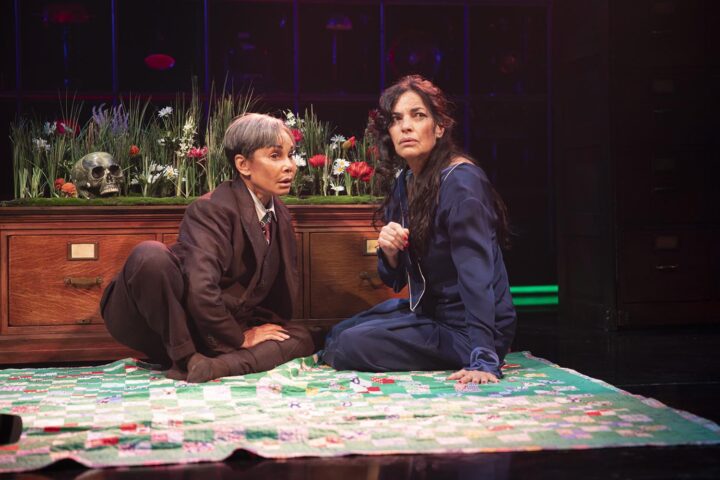
Played by a committed Daphne Rubin-Vega, with a sharp three-piece suit, spiffy shoes, and a broad Noo Yawk accent, Mr. Zero is a crude, emotionally arrested loudmouth, a victim of an industry’s grind mentality and his own ignorance. As he learns late in the play, he’s been “here” thousands of times, and while some souls get better each time they’re reincarnated, some get worse, which is Mr. Zero’s lot. “You’re a failure, Zero, a failure,” he’s told by the cosmic functionary known as Lieutenant Charles (played by Creighton).
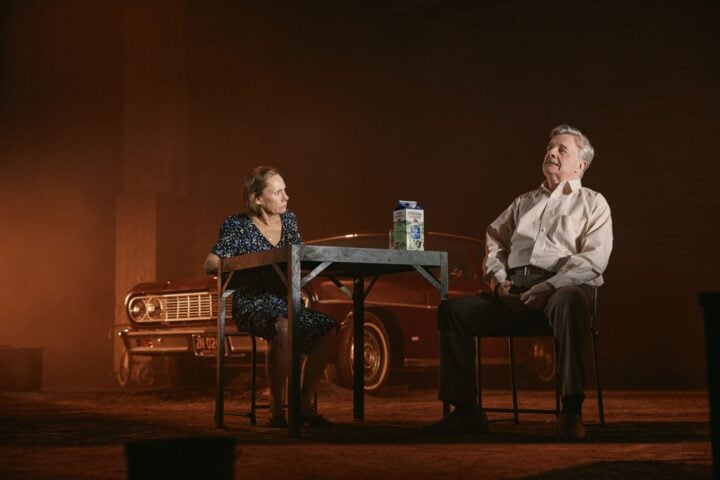
Following the prologue, the play proper begins with Jennifer Tilly’s Mrs. Zero, sporting a flapper bob, delivering a three-page monologue in bed, while Mr. Zero lies next to her, under covers and near-catatonic, unmoved and unmoving. Tilly’s personality is such that she tempers the bitterness of the character’s harangue, with Mrs. Zero seeming less like the overbearing harridan that she is on the page and more like a champion yapper.
Several tracks from Radiohead, including “Everything in Its Right Place,” “No Surprises,” and, most fittingly, “2+2=5” are part of the revival. (Additional zaps, shocks, squelches, and other mechanical noises are courtesy of sound designer Stan Mathabane.) The band’s anthems of angst, alienation, and paranoia function as emotional shorthand, engendering a connection to the characters that’s not easily established by the text of the play itself.
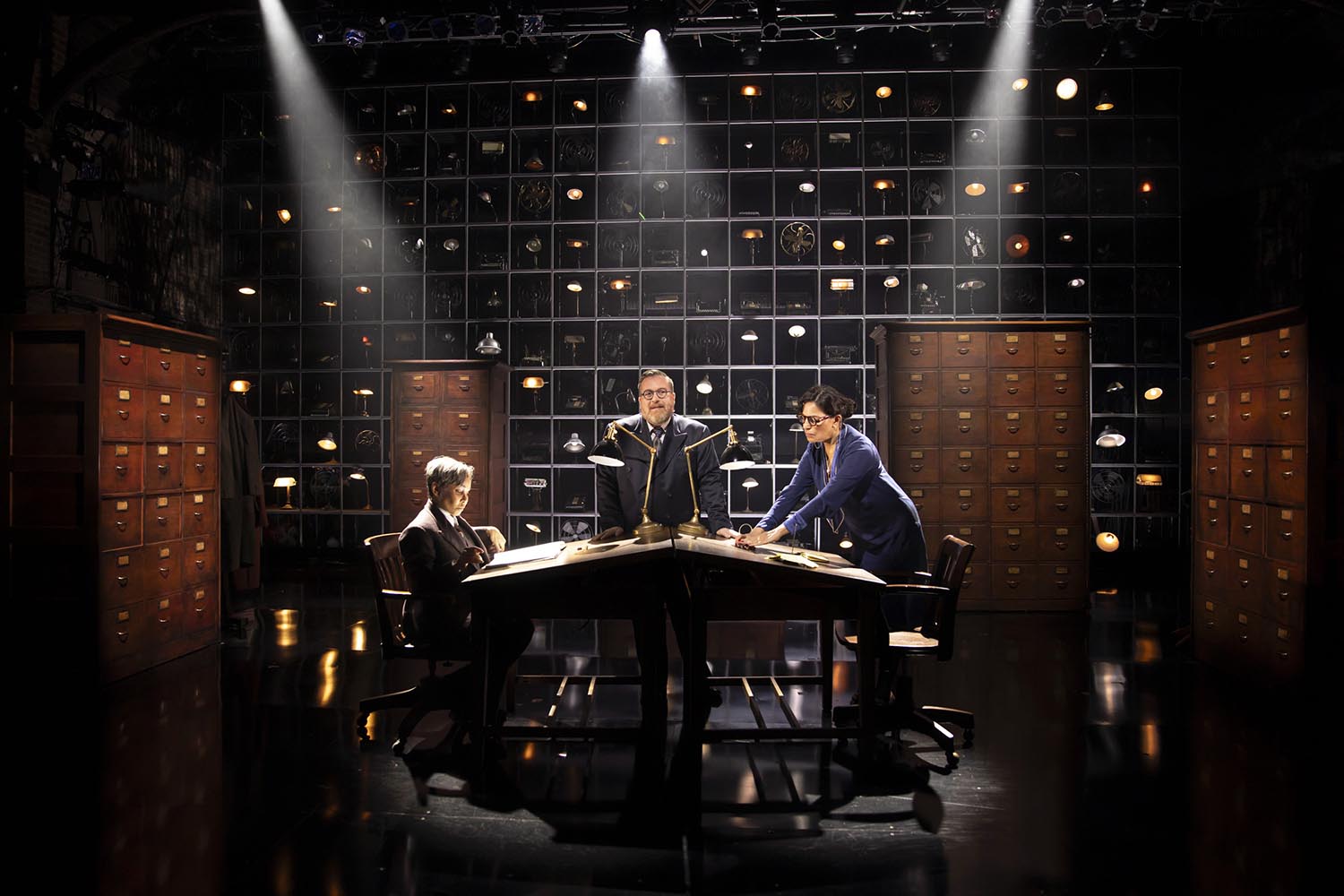
The cast is rounded out by Sarita Choudhury as Daisy Diana Dorothea Devore, Mr. Zero’s work wife and object of his yearning, who sits across from his desk on a set—all solid oak furniture and heavy file cabinets—that conveys functional, anonymous bureaucracy. A free-spirited pas de deux set to “Creep” between Mr. Zero and Daisy, who follows her crush to the afterlife, provides a moment of levity and grace that balances out the sourness and existential dread of preceding scenes. Choudhury is wonderful, mapping Daisy’s emotional life legibly and believably, even when the character is running through a laundry list of ways to take her own life.
In a recent interview, Tilly indicated that the choice by director Scott Elliott to cast a woman as Mr. Zero was to counter his profound misogyny. This is a character, after all, who called the cops on a sex worker he’s observed across his apartment’s air shaft and pleasured himself to. But casting a woman of color doesn’t mitigate the unpleasant aspects of Mr. Zero. Nor should it need to, unless there isn’t an inherent trust in audiences’ tolerance for discomfort.
In the final scene of the play, Mr. Zero learns, to his consternation, that reincarnation is nothing but a series of repetitions. Life is reproduced almost like a series of carbon copies, with departed souls rinsed, recycled, and repurposed. Charles indicates that there’s always some unseen force above thumbing the scales, and even eternity can be a slog. Some audiences might find The Adding Machine one too, given how central despair and regret is to the play. But if they clock in with full knowledge of what’s in store, perhaps they will find a play worth reckoning with.
The Adding Machine is now running at the Theater at St. Clement’s.
Since 2001, we've brought you uncompromising, candid takes on the world of film, music, television, video games, theater, and more. Independently owned and operated publications like Slant have been hit hard in recent years, but we’re committed to keeping our content free and accessible—meaning no paywalls or fees.
If you like what we do, please consider subscribing to our Patreon or making a donation.