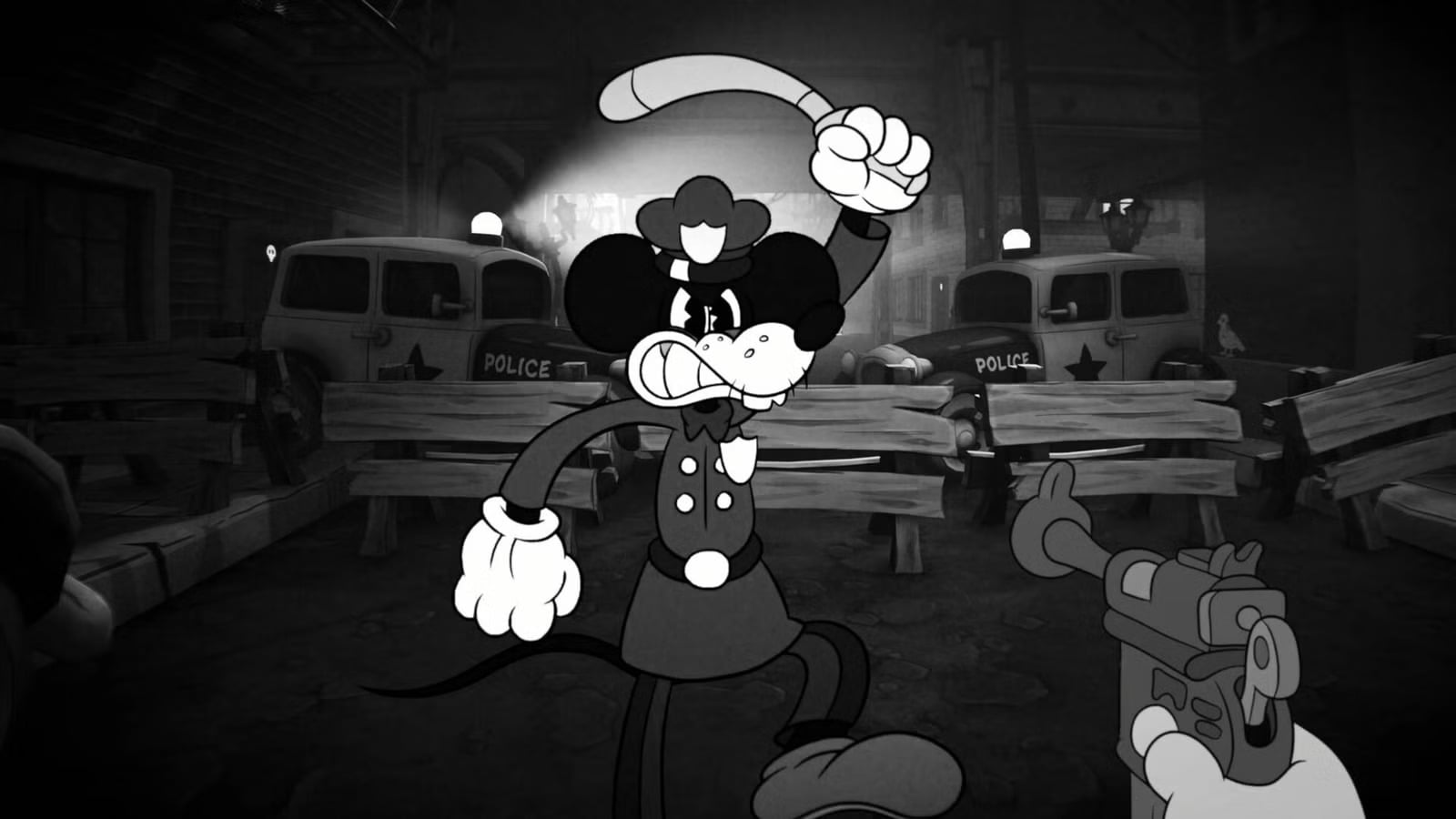
The sheer volume of pastiche on display in Mouse: P.I. for Hire is overwhelming. This is a 2026 video game modeled after 1930s cartoons that also marries ’40s noir tropes with ’90s-era first-person-shooter mechanics. On paper, its target audience would seem to be tech-savvy 60-year-olds who worshipped Ub Iwerks on Usenet in 1994. The reality, though, isn’t that cynical. There’s still plenty to love and respect about the game—it’s just that it’s more of a sincere, heartfelt tribute to various tropes rather than a gleaming example of any of them.
The story, at least, gets the closest to being its own unique thing, telling the sordid tale of Jack Pepper (voiced by Troy Baker), a grizzled war hero-turned-private eye in the mean streets of Mouseburg who finds himself tangled in a mystery that starts with trying to find a war buddy of his who goes missing and winds up leading to mouse Nazis and eldritch horrors. That’s just another boring Sunday for, say, Wolfenstein’s B.J. Blaszkowicz, but that’s heavy territory for just another cartoon mouse trying to keep cheese on the table in a hostile cel-shaded world.
There’s some strong dialogue, set pieces, and wild twists along the way, but it never quite gels the way that it should, largely due to the shotgun-blast approach to the game’s frame of references. When Mouse: P.I. commits to being an over-the-top Raymond Chandler story with cartoon mice, it works, but it’s also trying to commit to being an over-the-top parody of that same thing, along with a parody of gaming tropes and the Silly Symphony aesthetic.
Jack’s back-and-forth chinwags with the citizens of Mouseburg are sharply written, and the game’s seemingly infinite pool of cheese-based wordplay never gets old, but the marriage of darkness and silliness often feels incongruent. It doesn’t help that Mouse: P.I.’s excuse for detective work amounts to pinning pictures on a board and waiting for the “I’d Like to Solve the Puzzle” button to pop up. That was already somewhat inadequate for the multidimensional shenanigans of Alan Wake 2, let alone what’s ostensibly a Depression-era murder mystery.
Things get much more focused once Jack has to settle his problems with guns and explosives, with mechanics very much of a piece with the current wave of semi-linear, fast-moving, retro-inspired boomer shooters. Basically, if your mouse detective isn’t constantly moving, he’s dead. Ammo isn’t as abundant as you think in the heat of the moment, and many of the set pieces can get hairy in a hurry without a good handle on the environment that Jack walks into.
Even during these stretches, though, the commitment to the aesthetic works against the game. Some of the lower-level guns have all the bombast of a slingshot, and some of the mass slaughters Jack must commit on his way to justice come off as ridiculously overblown for the gravity of the situation and the often melancholy way some story chapters end.
Imitating cartoons from the early 20th century, even with all our current technology, is no easy feat. (Ask the makers of Cuphead about that struggle.) But Mouse: P.I.’s strengths as a piece of hyperreal noir are a breathtaking wallpaper over a fairly linear, basic FPS that still demands that we take everything about it seriously. It’s a game trying to have its cheese and eat it too.
This game was reviewed with a code provided by fortyseven communications.
Since 2001, we've brought you uncompromising, candid takes on the world of film, music, television, video games, theater, and more. Independently owned and operated publications like Slant have been hit hard in recent years, but we’re committed to keeping our content free and accessible—meaning no paywalls or fees.
If you like what we do, please consider subscribing to our Patreon or making a donation.