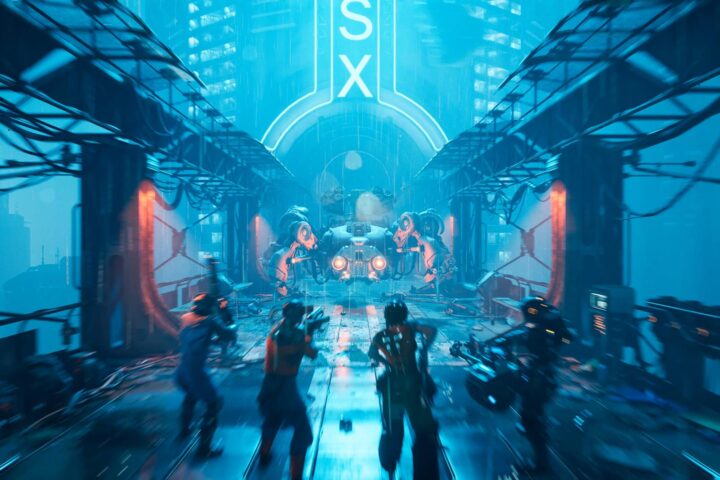
With Hardspace: Shipbreaker, what you see is more or less what you get across the game’s 30-plus-hour campaign. As an employee of the LYNX Corporation, you dismantle vessels in an outer space shipyard. In addition to suit thrusters and a helmet, you’re given a handheld grapple device that lets you push and pull heavy objects from afar, as well as a cutting tool with two settings, one for long incisions and one for a focused beam that vaporizes a target. The ships do grow larger and more complex as you rise through the ranks—you’ll even learn to tether objects together, set off demolition charges, and read the various settings of a scanner mode—but the basics remain the same.
To your character, dismantling ships is a job, and as such it requires you to follow a clearly defined set of rules; the display on your helmet, for one, specifies where to deposit the objects that you’re cutting and pulling out of your assigned vessel. It’s delicate work, too, considering that you’re liable to be crushed at any moment or trigger a screen-filling explosion that obliterates your body and only allows you to keep working by switching to a cloned “spare.”
But it’s also engaging work that’s impressive to behold as the player pushes around objects that are too large and volatile to be handled by anything less than sci-fi technology. Your character even begins each shift surveying your work from afar, seeing how much you’ve already stripped away entirely on your own. The tactility of the experience, like the ambitious sense of scale and progress, never loses its wonder during the game. Within the medium, Hardspace: Shipbreaker has few comparisons, as developer Blackbird Interactive has carved out an exceptionally fulfilling niche by simulating what amounts to futuristic grunt work.
Despite the procedures that are handed to the player throughout the game, the ships vary so much that one can’t rely on a step-by-step, one-size-fits-all process. Some are modular and disposable while others are more intricate, as if they were barely made to be taken apart at all. All ships do have yellow “cut points” that designate where they’re held together, but sometimes it’s just best to ignore those guidelines and dispose of one large chunk at once rather than smaller pieces that would all go to the same place anyway. Hardspace: Shipbreaker is a game that, over time, requires you to feel out your own ideal working method.
You learn and you prioritize, eventually able to spot objects that take more time to remove than they’re worth. Elsewhere, an AI voice will chastise you for being sloppy, but you’ll learn that it can and should be ignored sometimes, along with the occasional “helpful” tip from the corporation that has you in its thrall. The voice will protest when you, say, vaporize an aluminum beam that could have gone straight to the furnace, but it might be quicker to just get rid of such obstructions and focus on the ship’s more valuable guts rather than painstakingly disassemble the whole thing for an extra pittance. After all, you’re on the clock.

Or, at least, the story tells you that you are. Hal, a union-busting administrator, shows up early in the game, grumbling about quotas and time wasted, but in practice you’re free to take your time. Each ship is broken up into salvage goals to mark progress, and there are no penalties for failing to hit a goal during your shift (nor are there any incentives to hit them quickly). The work simply takes however long it needs to, and then you move to the next ship.
Rather than upset an otherwise leisurely and satisfying gameplay loop, Hardspace: Shipbreaker relies on the world’s exploitive backdrop to provide the bulk of its commentary. You’re charged for nightly genetic backup for spare bodies, the creation of spares as needed, the use of your LYNX-supplied living quarters, tool rental, and various other exorbitant details that all add up to a formidable amount of debt. Each object you strip is individually calculated for monetary value, and each shift is ostensibly meant to cover the new daily charges, with any further “profits” subtracting from the comically huge remainder of what you owe.
Portraying the grim realities of debt would not make for a traditionally “fun” video game, so Blackbird’s developers can’t help but provide the player with the sensation of forward motion, with progress bars to fill, upgrades to fairly earn, and bootstraps to pull. The game can’t genuinely feel bad and futile because then we wouldn’t want to play it, so it doesn’t portray the constraints that Hal keeps droning on about and it refuses to create roadblocks that are more than a slight nuisance. You do, for example, have to repair your tools and refuel on oxygen by buying from LYNX’s own supply terminal in the shipyard, but compared to the debt, the costs are negligible. You’re never really scrounging, never doing the math on oxygen or opting for ships where you might find a spare tank or two sitting around.
On some level, that’s the point: Debt is all-consuming and you’re probably not going to get out of it once you’re in it, if you were ever meant to. In that context, why not spend more? But the game’s priority on its general entertainment value, the very thing that otherwise makes it so rewarding and so entrancing for a truly impressive number of hours, is also what prevents its commentary from hitting home. Certainly it’s notable to play a game about unionizing, particularly since the video game industry still runs on widespread labor issues and discourages any such efforts from the people who run it. Without any way to express such themes through game mechanics, these issues are more like well-intentioned wallpaper.
In terms of the game’s narrative, shipbreaking is a predatory lie: It promises steady income alongside food and shelter, an apparent escape from earthly concerns that instead presents the player with an enormous bill. In terms of its very status as a video game, however, Hardspace: Shipbreaker can’t help but still be a fanciful escape.
Since 2001, we've brought you uncompromising, candid takes on the world of film, music, television, video games, theater, and more. Independently owned and operated publications like Slant have been hit hard in recent years, but we’re committed to keeping our content free and accessible—meaning no paywalls or fees.
If you like what we do, please consider subscribing to our Patreon or making a donation.