Nerial’s Card Shark takes place in 18th-century France, a time where people wear fashionable white wigs, slap each other with gloves to start duels, and generally ruminate over political unrest from within the walls of their salons. This, according to your mute protagonist’s mentor, Comte de Saint-Germain, means that the time is also right to cheat as many rubes as possible at games of cards. With their minds on more important matters, they won’t notice you covertly bending cards or signaling to the Comte with fingers or stacking the deck in the back room under the pretext of grabbing another bottle of wine.
Having plucked you from obscurity, the Comte is set on educating you on your travels. Your journal entries grow more legible as he tutors you on writing, but, more importantly, he teaches you how to aid him on various cons. From the world map, you select a travel location, and on the ride there, you play a tutorial on whatever new technique he intends to try.
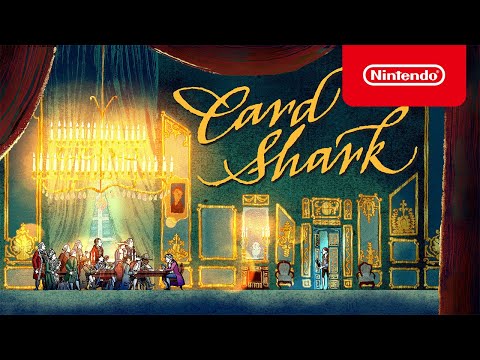
In an attractive mix of painterly textures, printed images, thick ink outlines, and cutout animation, the card-playing process is nothing short of dazzling to behold. Fingers constantly fiddle around the cards, concealing purloined aces or inadequate deck shuffles, though the rules of the card game that you play are, for better and worse, never clarified.
Throughout Card Shark, you never have to learn anything more complex than the basic ace/king/queen/jack hierarchy and the difference between suits, as your main concern is slipping good cards to the Comte or bad ones to your opponents. All the while, only the resulting wins and losses are seen, according to how you’ve tilted the odds in your favor.
While this simplification does rob Card Shark of great depth, it’s also by understandable necessity, since the tricks are difficult enough to keep straight without adding a regular card game into the equation. You’ll repeat a few techniques here and there, but most excursions involve new wrinkles to existing techniques or something different altogether. Indeed, players will spent much of the game in these tutorials, momentarily applying what they’ve learned before being shuffled on to something new. They’re more like minigames, liberally sprinkled throughout a rather thinly sketched story about French aristocracy and conspiracy.
What each trick asks you to perform, though, is inconsistent. Many require pushing the analog stick in the correct direction, while others have you quickly counting up the most plentiful card suit or remembering which duplicate cards to remove as you flip through a deck. A few allow you to restart a step, while others outright display on-screen directions, allowing you to so easily page through options so that you don’t have to memorize anything.
Card Shark allows you to pause at any time and go back over the controls, and there’s a hint button that outright tells you the cards that you’re looking for. But hints are off by default, and stopping constantly to double-check the controls hardly conveys the dexterity that the game is trying to embrace. Even on the easiest difficulty setting, the timing can be annoyingly strict.
You’re allowed to screw up once, but after that, taking too long or pressing the wrong button on a certain step requires you to restart the whole segment after losing some money. In some cases, you’ll be arrested or outright killed based on the context of the story. And because your actions are so cleanly separated from the rest of the card game, the restarts feel needlessly punishing. You’re never experimenting with multiple approaches or choosing how to proceed; you’re simply following instructions or testing your memory, so you always know exactly what mistake you’ve made once the game begins the process of making you start over.
When you’re not performing exactly as instructed, the game’s narrow and inconsistent margin of error is just frustrating. In the end, the most rewarding aspect of Card Shark is less pulling off these techniques in separate minigames than it is learning how they’re performed in the first place. But while Card Shark certainly conveys how difficult it is to keep all these techniques straight in your head, it only does so by constantly threatening you with tedium.
The game was covered with a review code provided by Tinsley PR.
Since 2001, we've brought you uncompromising, candid takes on the world of film, music, television, video games, theater, and more. Independently owned and operated publications like Slant have been hit hard in recent years, but we’re committed to keeping our content free and accessible—meaning no paywalls or fees.
If you like what we do, please consider subscribing to our Patreon or making a donation.