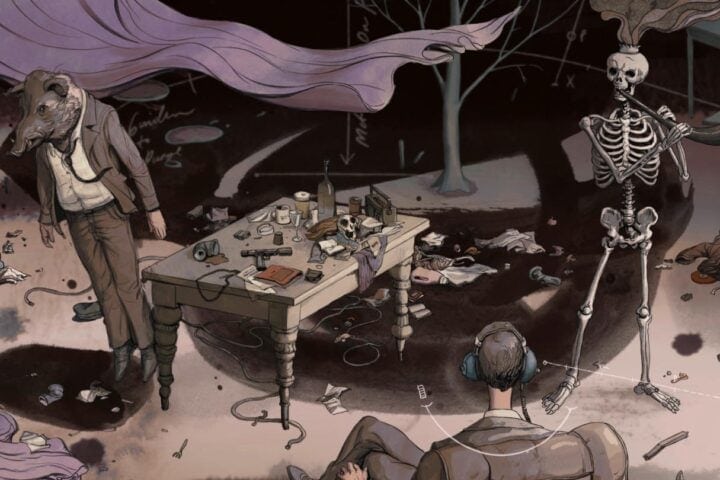
The so-called Cleric, the protagonist of Esoteric Ebb, is drowning in questions. Who blew up the tea shop in the middle of Norvik? Which party should he vote for in the city’s upcoming election? How do you serve a god who died less than three decades ago, leaving behind a titanic legacy and little guidance? What does it mean to be a man?
Esoteric Ebb itself, on the other hand, faces one question above all others: Is this just Disco Elysium with a Dungeons & Dragons sheen? The resemblance in mechanics, philosophical concerns, and plot is uncanny. The Cleric, like Harry Du Bois, investigates a crime alongside a delightful and skeptical sidekick while dealing with a bout of amnesia, communing with elements of his very being, navigating local political forces, and feeling self-conscious about his face. It would be fair to look upon his plight and feel that you’ve been here and done this before.
But this CRPG from developer Christoffer Bodegård distinguishes itself with a roguishly charming sense of humor—meta but rarely too cute or winking—that subverts the fiction and systems of D&D, the seminal work that inspired it. In doing so, Esoteric Ebb interrogates the moral and ethical foundations of that ur-text, upending the reductive ideological schema that has long sat deep in the genre and industry that D&D birthed.
The game’s crowning achievement is the wonderfully inventive Norvik, a cosmopolitan home to mermen landlords and gnome psychoanalysts, reeling from the death of its patron deity and fought over by nationalists, free-marketeers, and socialists. As the foggy-headed Cleric pokes around the tea shop incident, he catches up on ancient history and current tensions by talking with the city’s eclectic and eccentric people. The Cleric must look inward, too, as he’s accosted by the thoughts of his internalized Strength, Dexterity, Constitution, Intelligence, Wisdom, and Charisma (the building blocks of D&D characters), who chime in with abandon.
These aspects of the Cleric’s psyche throw a creative wrench in D&D’s treatment of ideology. Rather than adhering to the rigid axes of good and evil, lawful and chaotic, the Cleric’s identity evokes soup bubbling in a cauldron, a shifting mess defined by whatever floats to the top in any given moment. Conversations are battlefields for his faculties, who vie to gain purchase in his mind and shape his actions—whether it’s Dexterity advocating for mobility across classes and borders; Strength pushing him to hone his death drive, solve problems with might, and support fascism at the polls; or Constitution, calling from his gut, gently reminding him to stay alive.
The Cleric’s ruminations can tend toward verbosity and over-abstraction, especially when dissecting political theory. But his attributes far more often imbue dialogue with an invigorating snappiness, catalyzing amusing epiphanies for the Cleric and gifting us with sharp punchlines. At their best, they do both simultaneously—like when, after a debate between masculinist Strength and egalitarian Wisdom, the Cleric can try to “Suddenly understand gender.”
Ideology is ripe for reinvention, but some D&D traditions are sacred—so dice are rolled throughout the Cleric’s exploration. In social situations, successful checks enable him to read motives, push boundaries, and otherwise exert influence on those around him. In combat—which unfolds like a choose-your-own-adventure book, filled with riveting twists and turns—the dice carry more mortal stakes. To Esoteric Ebb’s immense credit, making choices and taking chances feels as electrifying when spotting an inconsequential lie as it does when pulling the Cleric’s companions back from the brink of doom.
I went into Esoteric Ebb expecting it to end with one of two outcomes: I’d either want to replay it immediately, imagining the Cleric in a different political light, or the game would just make me want to boot up Disco Elysium again. But a middle path presented itself. Norvik proved so captivating—its populace so compelling, the Cleric’s branching quest so tantalizing, the voices in his head so flavorful—that I came to dread the ticking of the in-game clock, which tracks the five days the Cleric has to crack the case. When I had finally solved the mystery of the tea shop, an epilogue allowed me to meander and tie up loose ends in relative leisure. There the Cleric remains, singular in his imperfections, basking in the rest he’s earned.
This game was reviewed with a code provided by fortyseven communications.
Since 2001, we've brought you uncompromising, candid takes on the world of film, music, television, video games, theater, and more. Independently owned and operated publications like Slant have been hit hard in recent years, but we’re committed to keeping our content free and accessible—meaning no paywalls or fees.
If you like what we do, please consider subscribing to our Patreon or making a donation.