
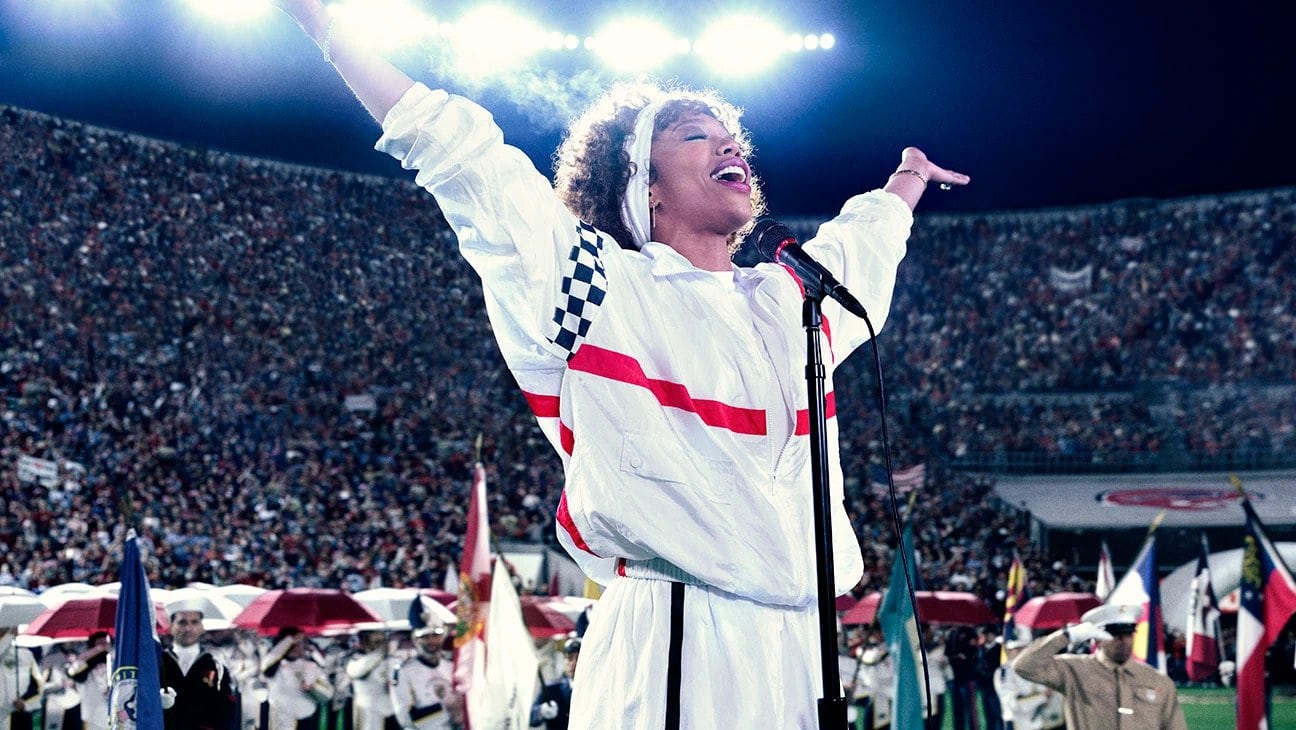
What was it about Whitney Houston’s Super Bowl rendition of “The Star-Spangled Banner” that made it so enduringly world-conquering? Aside from the obvious—that it was performed mere days into Operation Desert Storm—what was the alchemy that turned the national anthem into an unprecedented pop-era chart hit?
It was, simply, the essence of Whitney: a voice unlike any other, gospel-trained but irreverent as a default. The much-heralded “angel” in her throat was never so much evidence of the divine as it was testament to the giddy joy of virtuosity. Even better, at least early on, it was a gift that she never seemed to take particularly seriously. Unlike Mariah Carey, whose pyrotechnics were a raw, natural extension of her talent, Whitney’s flourishes never exposed the efforts of hard work. She simply floated and took her listeners along with her, transcending race, genre, and format.
If Kasi Lemmons’s Whitney Houston: I Wanna Dance with Somebody has an ace in the hole in resisting the now thoroughly picked-over, only-pitfalls musical biopic genre, it’s in the scenes that show Whitney (Naomi Ackie), still a teenager when she signed her contract with Arista Records, in the full flower of naïveté. First seen taking firm but sound vocal tutelage from her mother, Cissy (a deft Tamara Tunie), “Nippy” is frequently shown navigating the advent of her stardom with the same level of easy acceptance as her vocal cords handle even the most difficult of pop challenges: Her TV debut sees her launching fearlessly into The Wiz’s titanic “Home.”
Early on, Whitney meets cute with her lesbian best friend and, likely, part-time lover, Robyn Crawford (Nafessa Williams). The two work out dance routines to Chaka Khan’s sparkling “Papillon (Hot Butterfly).” They squeal like schoolgirls the first time Whitney’s debut single, “You Give Good Love,” plays on the clock radio. And when her shooting star quickly requires her to girl it up and pursue romances with the likes of Jermaine Jackson and Bobby Brown, she’s seen shrugging along with the developments, giving them no particular sense of import.

In these early moments from the film, Ackie’s supple, darting performance dodges the clichés of the material. And the alternation between approachable humor and godhead (lip-synced) belting beautifully matches the energy of one of Houston’s most endearing moments: When she sang “Greatest Love of All” at a 1991 concert in Japan for U.S. troops, juggling a nervous child, his overprotective serviceman daddy, and astonishing vocal runs with truly ethereal ease.
And to be very clear, there are only clichés in this rise-and-fall material; the sole distinctive wrinkle is in the weight given to the rise versus the fall. Since the trailer for I Wanna Dance with Somebody dropped, much consternation has been aimed at the credit “from the screenwriter of Bohemian Rhapsody.” Anthony McCarten—who also spat out Darkest Hour, The Theory of Everything, and The Two Popes—artlessly cashes the check here, more or less tripling down on structuring everything around Whitney’s own “Live Aid moment,” a 1994 performance of what’s affectionately deemed “The Impossible Melody” (“I Loves You, Porgy” followed by “And I Am Telling You I’m Not Going” followed by “I Have Nothing”).
But, really, the credit that should’ve had people worried was “produced by Clive Davis.” That Whitney was the mogul’s pet project was a given. But it takes a certain sort of gall, however hard-earned, to commission a portrait of a troubled relationship that kicks off with the Svengali telling his muse, “I make it a point never to get involved in my clients’ personal lives.” The film itself is an insinuation into his late protégé’s personal life, though Davis was far from the only person who signed off on it, and his and everyone else’s motives are ultimately reasonable.
The participation of Houston’s estate all but ensured the edges would be sanded off. But given how many times Houston’s name has been stained in the last decade, I Wanna Dance with Somebody, mediocre thought it may be, positions itself as a necessary corrective, a recalibration toward the light of Houston’s talents and not the depths of her despair.
Hell, even Bobby Brown (played with audacious restraint by Ashton Sanders) gets the soft glove here, shown proposing to Whitney in the back of a stretch limo only to, once she’s said yes, mention as an aside that he’s fathering a child with his ex in a scene very much played for laughs. That McCarten’s script never once goes below the surface, even compared to the whitewash that was Bohemian Rhapsody, is almost a feature rather than a debit. Though Ackie imparts as much humanity as she can muster, this Whitney is a cypher, neither gay nor straight, neither black nor white—a most utilitarian “every woman.” And if the film’s takeaway is that, boy, Whitney Houston’s career had a lot of highlights…yeah, exactly.
Since 2001, we've brought you uncompromising, candid takes on the world of film, music, television, video games, theater, and more. Independently owned and operated publications like Slant have been hit hard in recent years, but we’re committed to keeping our content free and accessible—meaning no paywalls or fees.
If you like what we do, please consider subscribing to our Patreon or making a donation.



I’m glad that the review says this movie is a necessary corrective. I want a movie that puts focus on her triumphs. If this turned into another “let’s put the focus on their downfall/low times” (like “Judy”) I would have had zero interest in seeing it. Whitney deserves the swivel back to her triumphs the way Elvis’s estate has managed to do with his legacy.