Annie Ernaux is known for writing what it feels like to live, and to love, from a feminine perspective. Which is to say, to always be losing, begging, and waiting—though mostly waiting. The force of Ernaux’s writing lies much more in how a woman feels under the spell of man than in what literally happens to or around them. Often times, only one event will carry her entire novels, which will then consist of her main character nursing that one wound—a haunting childhood memory, the loss of virginity, an abortion—from beginning to end.
Hélène (Laetitia Dosch), the protagonist of Danielle Arbid’s adaptation of Ernaux’s Simple Passion, is a divorced woman living in Paris with her young son, Paul (Lou-Teymour Thion). She’s a literature professor and a fearless, film-loving feminist, but when she’s in love, she regresses into stupidity. In such moments, she becomes easily excited and reckless, seemingly always on-call to satisfy the desires of a man whenever he decides to be available for her.
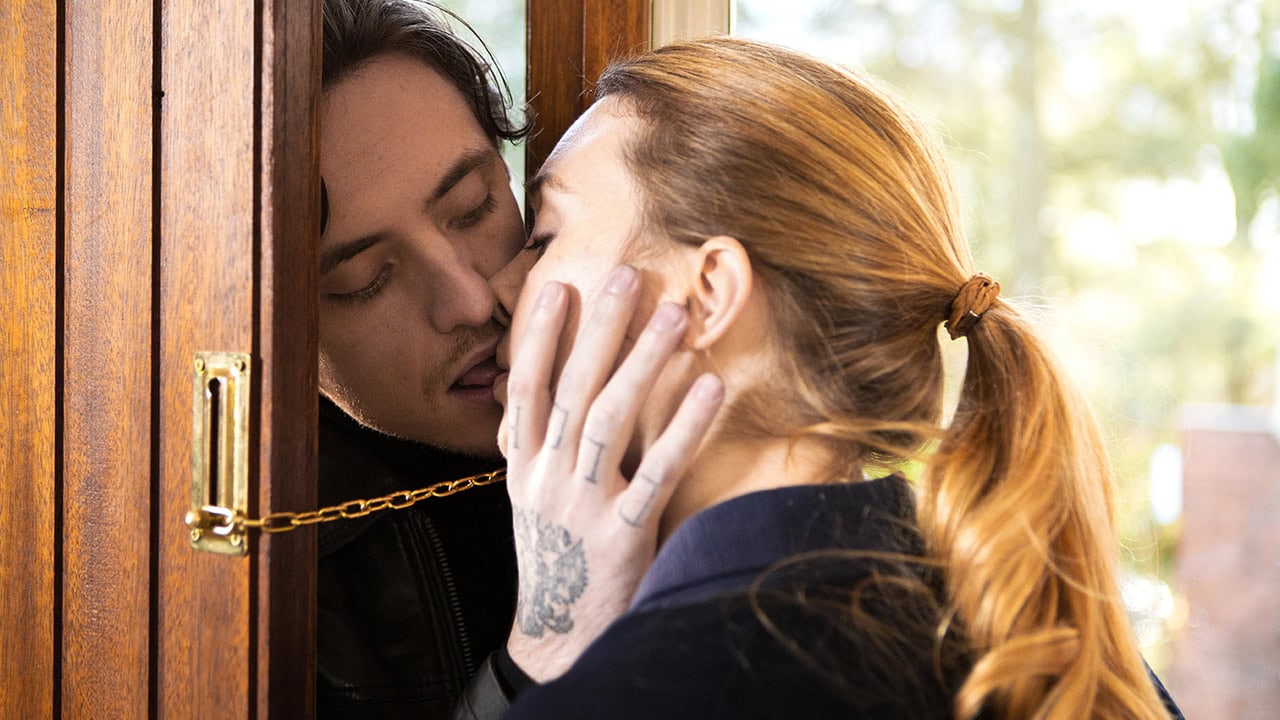
The man in question, Aleksandr (Sergei Polunin), is a married Russian diplomat with a sexy accent and tattoos all over his body. He’s impossible to resist, even if he and Hélène have nothing in common. He comes and goes as he pleases, while Hélène learns Russian while snapping green beans with the resoluteness of someone in a trance. And, of course, she will drop everything she’s doing at the faintest sign that he needs her to get off. Their relationship, or lack thereof, is the prototypical illustration of the absurdities of desire: She wants him because he barely wants her, and he only wants her inasmuch as he wants any woman.
This irrationality is perfectly captured in a scene in which Aleksandr and Hélène have sex. He’s on top of her, of course, and his movements are mechanical, while she’s full of desperation. The more she stares at him the more he avoids her gaze. When she tries to kiss him, he turns away. And when, despite all evidence that he only sees her as an interchangeable body, Hélène goes so far as to say, “I love you,” he burrows his head in the mattress in agony.

The impasse between these essentially incompatible animals has served as narrative fodder for many masterful films, from Yvonne Rainer’s Film About a Woman Who… to Ingmar Bergman’s Scenes from a Marriage. In the hands of Arbid, these farcical entanglements are brought to the fore in surprisingly unemotional terms considering the searing nature of the novel. Instead of trying to translate Ernaux’s uncanny ability to viscerally connect readers to Hélène’s despair, through affect or mood, Arbid’s film coldly relies on the novel’s narrative situations, while transferring the characters to present-day Paris (the book was first published in 1991).
The result is a series of predictable situations where Hélène neglects her research, students, and child in order to pick up a call or read a text message from Aleksandr, followed by short-lived moments of bliss when they have sex. There’s no attempt to embody the themes—boredom, angst, heartache—that form the core of Ernaux’s story in the aesthetics of the film. As Arbid deploys a distinctly neutral visual language, it’s perhaps inevitable that little room is left for the self-reflexive melancholy made possible by Ernaux’s subjective writing.
Elsewhere, Arbid resorts to a barrage of popular songs to stitch sequences together and hamfistedly evoke Hélène’s state of mind. Only the briefest attention is paid to the character’s own writing and her time alone with herself. The film, then, is a kind of betrayal, as Ernaux’s writing calls for much more nuanced and impressionistic representation of the sheer madness of trying to love a heterosexual man and expecting him to love you back in equal measure.
Since 2001, we've brought you uncompromising, candid takes on the world of film, music, television, video games, theater, and more. Independently owned and operated publications like Slant have been hit hard in recent years, but we’re committed to keeping our content free and accessible—meaning no paywalls or fees.
If you like what we do, please consider subscribing to our Patreon or making a donation.