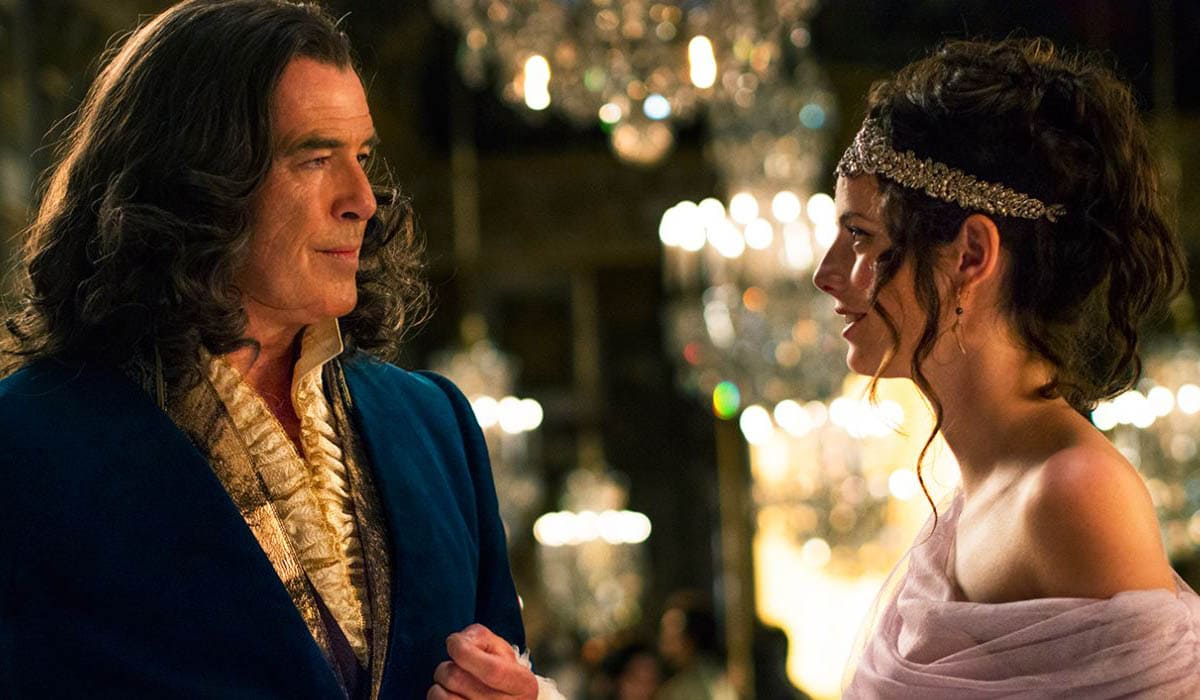
Shot way back in 2014, Sean McNamara’s The King’s Daughter bears all of the signs of a film that’s been awkwardly cobbled together in order to finally push it over the finish line. The opening text explains that King Louis XIV (Pierce Brosnan) has ordered a search for Atlantis in hopes of finding the secret to immortality. Then, in a storybook-like sequence narrated by Julie Andrews and illustrated by some images run through a watercolor filter, the film immediately repeats this same information at greater length.
The early events of the story, too, are mashed up in confusing fashion. Louis is bored of the music that wakes him up each morning, a detail that the king conveys by hollering “Boring!” from beneath his luxurious wig at the musicians outside of his window. When Louis’s confessor (William Hurt) sends for the king’s secret daughter, Marie-Josèphe (Kaya Scodelario), at the convent where she’s grown up, oblivious to her heritage, one might assume that bringing the musically talented young woman to court is meant to address this issue. But since Louis’s outburst is only shown after she’s packed up and headed for the capital, her eventual appointment as the court composer plays more like a happy coincidence.
The King’s Daughter is in a visible rush to get to the moment where the search for Atlantis yields a mermaid (Fan Bingbing) whose sacrifice can supposedly bestow eternal life. Marie-Josèphe befriends the mermaid and is horrified to learn of its fate, and this incident is one of many that have been clumsily lumped together in a seeming attempt to heighten the drama. No sooner has Marie-Josèphe learned the truth of her parentage than Louis has promised her to a snooty rich suitor (Ben-Lloyd Hughes) even though she’s fallen for Yves (Benjamin Walker), the hunky sailor who led the crew behind the mermaid’s capture. The film provides no space to explore its relationships, and as a result there’s little friction to the climax.
Even Marie-Josèphe’s friendship with the mermaid is meant to land simply because we recognize the former’s alienation through a comedic onslaught of shots where people glare at her like mean kids in the hallway of a high school movie. The creature’s connection to others is largely nonverbal, reinforced through effects sequences that never convey the kind of wonder that the other characters say they experience. Here, at least, there may be some excuse for rushing things along: As a dead-eyed CGI fish person filmed in murky, similar-looking, if not outright recycled, shots, the mermaid leaves little impression, so the decision not to focus too long on any interactions with her at least saves the film some embarrassment.
For all the grousing about how sacrificing an intelligent being would be unforgivable, Louis isn’t wrong when he remarks that the mermaid is more or less a pet to Marie-Josèphe. As such, it’s tough to shake the sense that The King’s Daughter is akin to watching a spin on Free Willy set in 17th-century France, and how that film at least bothered to give the pet a name.
Since 2001, we've brought you uncompromising, candid takes on the world of film, music, television, video games, theater, and more. Independently owned and operated publications like Slant have been hit hard in recent years, but we’re committed to keeping our content free and accessible—meaning no paywalls or fees.
If you like what we do, please consider subscribing to our Patreon or making a donation.