Lest prickly horror fans find the idea of resurrecting a franchise seven years after the death of its driving creative force—hallowed auteur Wes Craven—distasteful, the fifth Scream movie makes sure to let us know that it knows just how, well, craven it is. As self-aware as the prior entries, this new one couples its gory thrills with commentary on its own status as a belated, possibly creatively bankrupt, franchise commitment.
At first blush, the always self-reflexive Scream franchise might seem like the ideal one to pick up on the Hollywood trend of quasi-remakes that one can refer to as “requels,” per this film’s horror expert, Mindy (Jasmin Savoy Brown). From David Gordon Green’s Halloween to Spider-Man: No Way Home, such movies depend on the kind of genre awareness and extra-textual knowledge that made 1996’s Scream so rewarding. But while most requels exploit rather than directly address this kind of knowledge, the new Scream makes this subtext text, constantly pointing up its own calculated fusion of the recognizable and the deceptively novel. As with most of the sequels to Craven’s original film, this is reasonably fun until it gets tedious.
This new Scream’s prologue treats audiences to many overt reiterations of iconic moments from the earlier installments that serve to underline the way that the tripartite institutions of horror, media, and audiences have changed in the past 25 years. As in the original Scream, a small-town teenager, Tara Carpenter (Jenna Ortega), gets a creepy phone call—and on the house’s landline, much to her annoyance. On the other end is that familiar raspy-voiced person interrogating her about her favorite horror movie, but Tara isn’t quite the oblivious, initially flirtatious victim that Drew Barrymore played in the first film.
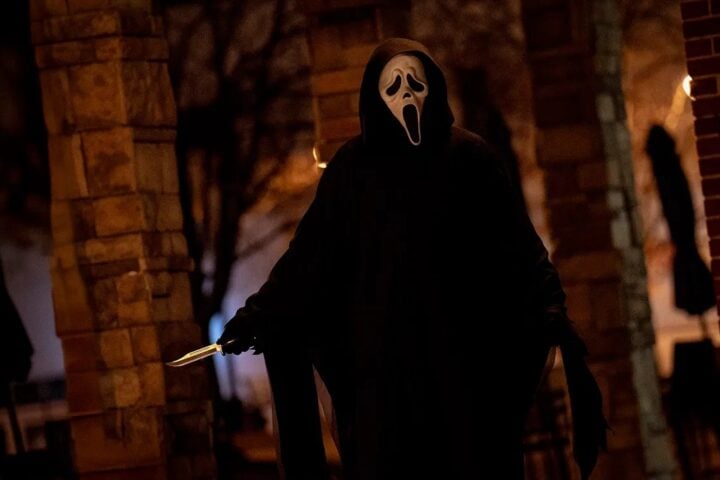
Craven’s prescient original, penned by Kevin Williamson, aligns the know-it-all male horror geek with the gendered violence of the slasher flick only at the expense of the genre’s traditional sacrificial co-ed. In contrast, Tara both picks up that she’s being harassed in short order and ultimately, barely—and perhaps suspiciously—survives the encounter with a knife-wielding psycho who’s wearing the iconic Ghostface mask and robe.
As it turns out, Tara lives in Woodsboro, the mundane small town where most of the murders depicted in the prior films took place. These killings have put her hometown on the proverbial map via the Stab series, the films-within-a-film that they inspired, though Tara prefers “elevated horror,” as she tells the creep on the other end. All things being equal, she would much rather be stuck in The Babadook than an ostensibly outmoded slasher flick.
After the prologue, we meet her friend group, consisting of Mindy and other disposable teens (Dylan Minnette, Mikey Madison, Mason Gooding, and Sonia Ben Ammar)—all of whom, in traditional slasher-movie fashion and unlike the 19-year-old Ortega, look like their high school years are well behind them. Tara feels like a product of today’s serious-minded horror film, while her older-seeming peers might as well be refugees from the slashers of yesteryear.

This clever incongruity constitutes one of the more subtle elements of the movie’s constant acknowledgement of, accounting for, and anticipation of its position in the cultural cosmos. Reflecting our own sense that we’re coming back to accustomed territory, the story stages several prodigal returns to Woodsboro. First, a new character, Tara’s sister Sam (Melissa Barrera), takes over the narrative reins after a certain point as the primary victim-hero for the rest of the film. Then, inevitably, well-known old faces flock back to the scene as word of a new Ghostface killer spreads: disgraced sheriff Dewey Riley (David Arquette), his estranged ex-wife Gale Weathers (Courteney Cox), and, of course, Sidney Prescott (Neve Campbell). Together, they form an intergenerational team determined to stop this copycat killer who’s inspired to reinvigorate the Stab films by committing a fresh set of real-world murders to provide new material for a reboot. If that rings a bell, that’s because it’s more or less the plot of Scream 4.
To the credit of the filmmakers, though, the new Scream feels less moribund than that unnecessary addendum to the original trilogy. A playful suspense sequence repeats a visual joke involving open cabinets and doors that occlude our view with Andy Kaufman-esque insistence; it’s funny, then tiresome, then so tiresome that it’s funny again. It’s echoed in a subtly comic suspense scene in which Sidney enters a room with a gun and reflexively begins shooting all the doors. And a sequence in a darkened, empty hospital works at once as self-conscious homage to the original Halloween II and as a thrilling chase in its own right.
Ultimately, though, a few enjoyably staged murders, accompanied by clever meta-commentary thereon, doesn’t save this Scream from a creeping sense of tedium. The first film was the expression of a horror auteur grown disenchanted with his artistic milieu, crafting, with trademark postmodern dread, a story out of the thematic kernel that there were no new stories to tell. Now, four movies later, screenwriters James Vanderbilt and Tyler Gillett can do little more but adapt the same message to new times, incorporating smartphones and toxic online fan culture into a case that remains, in essence, unchanged.
It’s at a certain point toward the finale—perhaps around the moment that a character watches a scene from Stab based on a scene from the first Scream while she’s unwittingly placed in the same scenario—that this Scream becomes almost as drearily repetitious as the reboot culture that it skewers. The ready-made excuse that it’s a commentary on that very repetitiveness can’t help but feel like a cop-out as it goes through the same motions as the original. In the end, the film might be more effective as a work of criticism-in-practice, destined for undergraduate seminars on film-industry studies, than it is as a horror experience.
Since 2001, we've brought you uncompromising, candid takes on the world of film, music, television, video games, theater, and more. Independently owned and operated publications like Slant have been hit hard in recent years, but we’re committed to keeping our content free and accessible—meaning no paywalls or fees.
If you like what we do, please consider subscribing to our Patreon or making a donation.