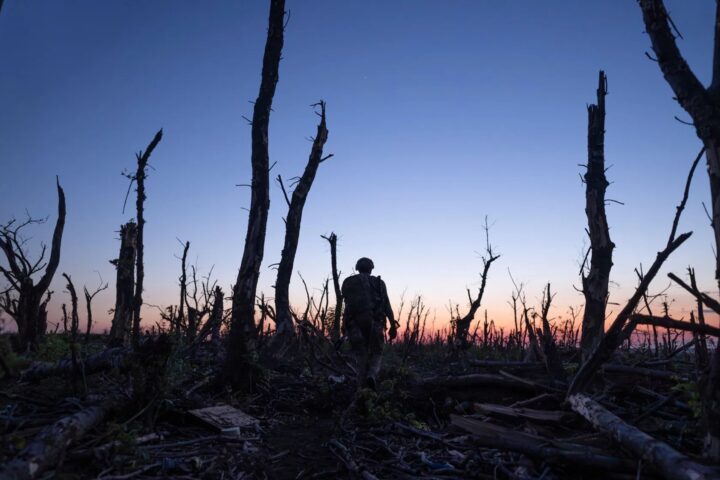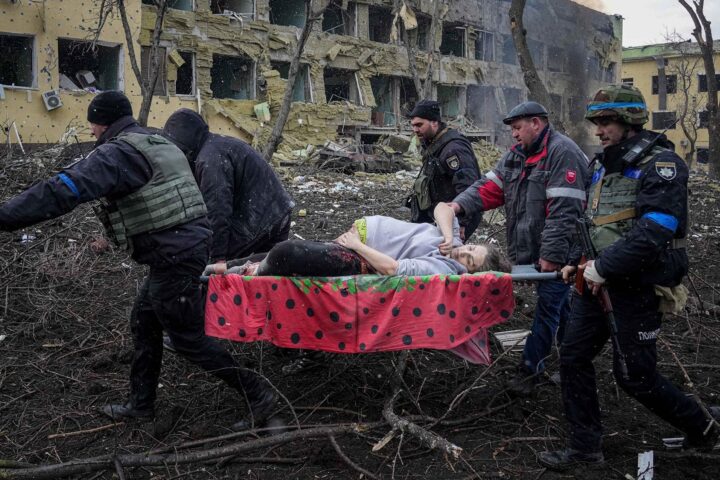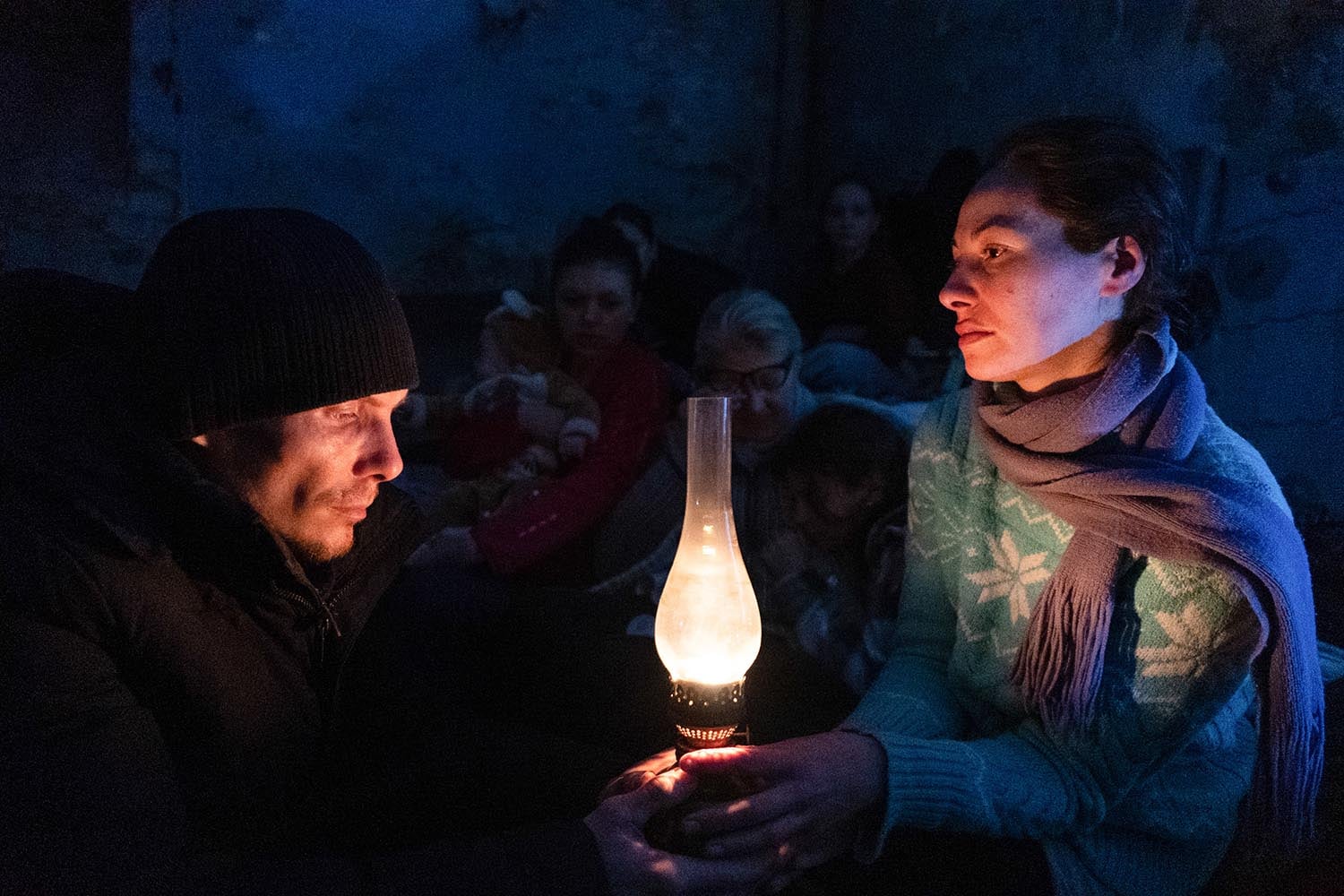
“I can’t see how human lives became a bargaining chip in any conversation,” laments Mstyslav Chernov as we discuss the frustrating stalemate for American aid to Ukraine’s defense. As the Russian invasion of the country nears its second year, the world has been awash in images and videos from intrepid journalists like Chernov reporting from inside the war. Documentary features like his 20 Days in Mariupol serve a vital function of adding context and humanity to the material so that it inspires action rather than anesthetization.
The purpose of Chernov’s work quickly advances beyond the pull of its immediacy as it assembles a first draft of history. The documentarian’s perspective, as seen in the mastery of how he frames, assembles, and narrates the footage he captured, reflects his many years of serving in conflict zones. But it also encompasses his own personal subject position as a journalist, a Ukrainian citizen, and a parent. Through the act of capturing and contemplating the scenes he captured in Mariupol, Chernov tells a larger story about the psychic and physical toll of violence—while still centering victims and survivors—in 20 Days in Mariupol.
I spoke with Chernov shortly after his film received an Oscar nomination for best documentary feature. Our conversation covered how every stylistic choice laddered up to a storytelling theme, what guides his camera in unpredictable moments, and why Russia’s weaponization of disinformation influenced his filmmaking choices.
The film shows what it does because you “stopped filming just news.” How does filming for the news differ from what you shot for 20 Days in Mariupol?
There are different styles of documentary film, [just] as there are different styles of news shooting. Sometimes they’re quite similar, and a lot of that comes from the editing. But as you shoot news, you usually go for much shorter shots, and your main question is basically, “What is happening?” You’re shooting separate scenes and don’t really connect them in any way. When you’re working on a documentary, you want to make sure that all the scenes are connected logistically and there are transitions between them. The kind of questions you ask people when you interact with them are different. It’s more about their feelings, what they’re going through, about the context of their lives…something that news just doesn’t have time to deal with. Of course, your shots are usually longer, and the coverage is wider.
Actually, after working on documentaries, it’s hard to go back to news! [laughs] Because you overshoot, your coverage becomes quite different, and you build the scenes in a different way. Every professional news shooter or every DP who works with verité material in places where things are unpredictable enters the scene and starts editing in [their] head as [they] shoot out of habit. But that sometimes can play against you because you do have to have a different approach to story depending on your theme or focus in a documentary. Because it’s not just about what’s happening. There’s more to that than just the events that are unfolding.
One element that connects the scenes in the film is your narration. Was part of the goal to help further the audience’s understanding beyond what’s happening by serving as a retrospective counterweight to the immediacy of the moment?
Voiceover is also a stylistic choice. Any stylistic choice in a film, whether a scripted narrative film or a documentary, has to be justified by a theme or by the story that you’re telling. In this case, it’s justified by several factors. One is the fact that I’m part of the community I’m telling the story about and, therefore, in a way, I can be their voice for some of the feelings that they are expressing. Another consideration is that an important theme of the film is the impact—or lack of impact—of journalism, fake news, and misinformation. Therefore, having narration from the perspective of a journalist is also a good solution to elaborate on that theme and tell more.
Every choice made in that direction was a choice that corresponded to themes. The theme of parenthood, for example, is very important to this film, [as is] the impact of war on families. I’m a father, so the fact that I’m talking in one of the moments in the film about my daughters isn’t because I want to just throw in some kind of personal information. It’s because this is part of a larger theme where we’re talking about. Every stylistic choice is thought through.
What guides your instinct in making choices around camera placement and movement in the moment? Is it even a conscious process?
Most of the time, especially the most intense moments, it’s almost like a bodily response to the events. Your body does the thinking for you. That’s where the editing experience really helps the shooting. Good editing, in many ways, isn’t a conscious choice. It’s an intuitive process. And shooting is also partly an intuitive process, which later is reflected in the editing. Entering a scene, I intuitively know what I need to do later to [put the scene] on a timeline. I shoot what I need: a master, close-ups. I follow the action. But these choices are intuitive, obviously. There should be reaction shots. It’s all dictated by what camera and lens you have, so you have to have the best equipment to be able to do that coverage without moving much in the scene as well.
You don’t want to interfere with the events that are unfolding in front of you, especially if people are in distress. There are situations where you need, for the sake of a story, to carefully build up a scene and slowly shoot through it to get everything done. When you’re telling the story of something really intimate or quiet, your shooting style corresponds to that. But speaking about action scenes or intense events that are unfolding in front of us, when you know that you want to immerse your audience in those experiences, then that dictates your shooting style as well.
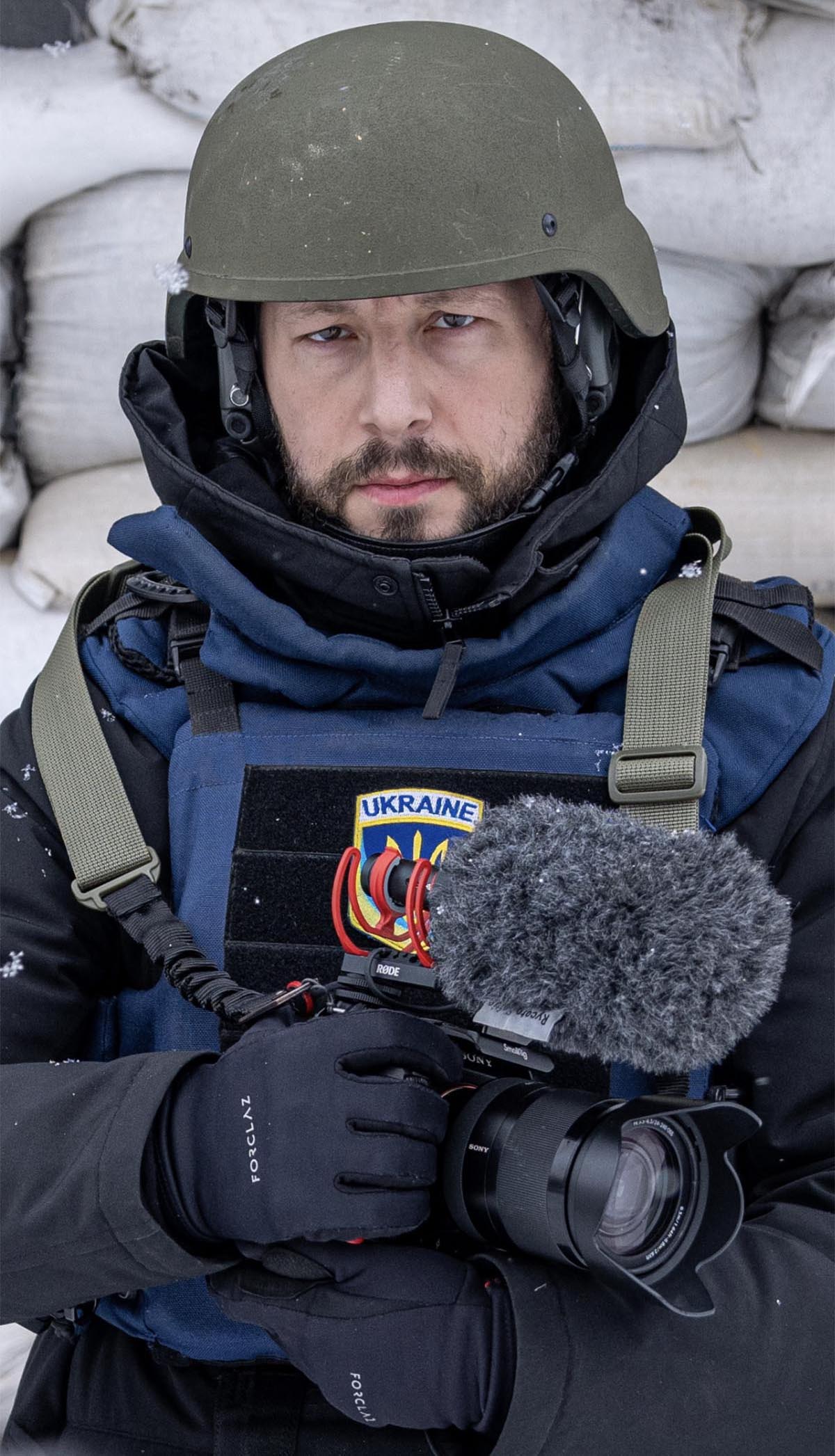
You mentioned not wanting to interfere, but I thought it was striking that during one the medical procedures you film, a doctor says, “It’s good that press are here.” Some people were very aware that you were recording them, so what effect do you think your presence had on the people you were filming?
Specifically in this film, the camera is a character. When I’m saying “interfere,” I don’t mean not being present. I mean not being invasive. Because we’re talking about people in distress and people who are trying to save lives, you don’t want to be there just hanging over them with the camera. The distance is a conscious choice—how much closer you can get to really be immersed in a scene but without being invasive. Because as soon as you become invasive, your presence becomes more important than what’s happening in front of you.
That’s actually the story of the whole film. Yes, it’s told from a journalistic perspective, but it’s never about journalists. It’s a personal experience, but it’s never a story about me personally. It’s still a story about people, the city, their tragedy, and what’s happening. At every step of the production of the film, we were very conscious about how much of me was in this film. How many seconds of the reflection the audience will see of me? What would be the crop to be present there [in the frame] but still not the focus of the scene?
Especially for scenes like that and an experience like this, you don’t want to be too distant as well. Not to criticize anyone, it’s a stylistic choice, but very often I see war documentaries being too distant from the people whose stories they’re telling. Therefore, they lose the strength of their emotion. Even if you’re seeing someone going through a very hard time, if you’re too far [away] and don’t feel like a human being is there, it’s almost voyeuristic when you’re observing someone’s pain. We’re all humans; we all want to connect. If someone is in pain, you do want to come closer. You want to comfort them. That’s what the film does. [It was] a conscious choice, again, to pick shots when the camera drops down [abandoned on the ground]. All those moments, which maybe aren’t really cinematic, are telling you that you’re there with us.
Because you pushed back a bit on using the word “interfere,” I’m wondering if that’s related to concerns that Russia might claim you manipulated the images?
Language is a very interesting thing. Words, especially when we talk about art forms, have shades of importance. Yes, you’re right about fake news and everything. And we were very cautious about this when we were making the film. As an example, there’s no foley sound in the film. What you hear is what we recorded. As much as I wanted to bring this experience closer to the audience by just enhancing some of the sounds, I couldn’t do it because Russia kept saying that this footage was staged. But that’s where documentary actually plays its role because when you see how we came there, it’s much harder to question that. But that doesn’t stop anyone from building false narratives. This month, Russia is releasing a scripted film about Mariupol which they shot immediately after they occupied the city. They sent the film crews and started filming their version of the events, and they called it 2022 Mariupol. You see how they’re trying to replace truth with narrative, and they have a lot of resources to do that.
Did you think of editing the film as having an ethical dimension? That, to some extent, the edit involved choosing whose suffering merited inclusion?
One of the main kind of drives behind the making of this film is to make sure that the people we see aren’t perceived as just images on a screen. Everyone probably saw [this footage] in the news, and they just went by and they disappeared. But in a film, you can feel that they’re real humans. Especially for those people and children who died, my goal was to preserve their memory. Their names are the only names that really matter in the film. It’s wrong to say it’s a monument, but it’s a memory of them—and a respectful one. In the editing room, there are a lot of hard choices to be made. How do you make sure that you don’t sanitize war, that you don’t make it look acceptable for those who look? But, at the same time, you always need to think about being respectful to the victims and the people who are losing their lives.
At the same time, you don’t want to also push the audience away with an unnecessary abundance of violence. If you look carefully at the film, I wouldn’t say there’s a lot of blood or gory, graphic images. The emotional impact is what’s heavy. That’s what hits you. I would say a lot of modern films have much scarier visuals than I have in 20 Days in Mariupol.
Since 2001, we've brought you uncompromising, candid takes on the world of film, music, television, video games, theater, and more. Independently owned and operated publications like Slant have been hit hard in recent years, but we’re committed to keeping our content free and accessible—meaning no paywalls or fees.
If you like what we do, please consider subscribing to our Patreon or making a donation.