
Eva Husson’s Mothering Sunday puts an impressionistic spin on the British heritage film, whipping between hazy close-ups on characters’ faces and enigmatic flashes forward to their futures and back to their pasts. This stream-of-consciousness editing makes a certain sense, since the story deals with a pastoral British community, from aristocrats to their servants, that’s traumatized by the recently ended First World War. Whether the telescoping of time periods adds up to anything particularly meaningful may be another matter. While the film is rife with imagery of studied beauty, its tale of two love affairs that defy class boundaries feels warmed-over, aimlessly capturing details without conveying much feeling.
Avoiding the comparatively heightened drama of something like Downton Abbey, with its similar setting, would seem to be a conscious choice on the part of the filmmakers. In the flash-forwards, we see Jane Fairchild (Odessa Young) struggling to write a book based on an affair she had in the 1920s, which serves as the basis for the post-WWI love story that makes up most of the film. In one flash-forward, Jane is reminded by her lover, Donald (Sope Dirisu), that her publisher is looking for the book to be a thriller. Jane half-heartedly defends herself, but she, Donald, and anyone who makes it to the end of Mothering Sunday know that there’s nothing particularly exciting about the nostalgia piece that she’s writing.
The bulk of Mothering Sunday deals with the end of Jane’s love affair with Paul Sherringham (Josh O’Connor), a bereaved young aristocrat who lost his two brothers in the war. Jane works as a maid in the neighboring estate owned by the Nivens (played by Colin Firth and Olivia Colman). Mild-mannered and absent-minded, the Nivens at first seem to be representations of the daft and decaying British aristocracy, until it becomes clear that their perpetual distraction stems from the fact that, like the Sherringhams, they’ve also lost two sons to the war.
One Mother’s Day, Paul hangs back in his empty estate rather than joining the Nivens, his parents (Emily Woolf and Craig Crosbie), and his fiancée (Emma D’Arcy) for a picnic, in order to have what will prove to be a final tryst with Jane. And as Jane leaves the Nivens and makes her way through town on her bicycle to the rendezvous, the past and present bleed together as she ruminates on the beginnings and course of the affair, though not necessarily in that order.
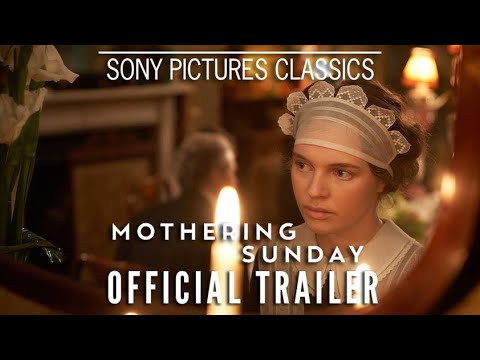
Husson’s artful depiction of the gentle but illicit affair between the aristocratic Paul and the outwardly modest Jane offers some moments of beauty, and Mothering Sunday distinguishes itself from other heritage films with its frank, female-centric depiction of sexuality. Associations with her early experiences with Paul and his comparatively indolent attitude toward sex run through Jane’s mind as she arrives at his estate, and her memories of cleaning goopy, bloody sheets and whispered conversations with Milly (Patsy Ferran), the cook, contain something more than romantic longing for Paul. Sex and social class can be complicated.
But complicated isn’t the same thing as complex, and Mothering Sunday’s other gestures toward class or historical commentary, and even romance, can feel superficial. Alice Birch’s screenplay, adapted from the Graham Swift novel of the same, often plays out what little tension exists in the film a bit too literally, as when Colman’s Lady Niven flips out at the picnic because someone mentions her departed sons. And when the film waxes metaphorical, it feels like it’s reaching for a significance that’s always just out of reach.
The film opens with a story told by Paul about him and his brothers joking that they each owned a leg of their family’s prized horse. “Who owned the fourth leg?” Jane’s voice asks as we watch slow-mo footage of a galloping horse. “Ah, the fourth leg,” Paul replies, his lips captured in close-up. “That’s the question.” The question is positioned to hang over the film, but this romantic epigraph, underlaid by the swell of composer Morgan Kibby’s insistent strings, is so hamfisted that it makes one reluctant to even try to figure out what it even means.
Throughout Mothering Sunday, there’s a sense that that the filmmakers are striving for evocativeness, but they only either achieve vagueness or overcorrect and arrive at literal meanings. And from its Woolfian stream-of-consciousness structure to its depiction of the corporeal messiness of sex, its alterations of the British heritage model don’t feel like much more than minor tweaks. For all of the film’s somberness, its depiction of an era of rigid class divisions and incalculable loss still comes through the hazy, soft-focus goggles of nostalgia.
Since 2001, we've brought you uncompromising, candid takes on the world of film, music, television, video games, theater, and more. Independently owned and operated publications like Slant have been hit hard in recent years, but we’re committed to keeping our content free and accessible—meaning no paywalls or fees.
If you like what we do, please consider subscribing to our Patreon or making a donation.