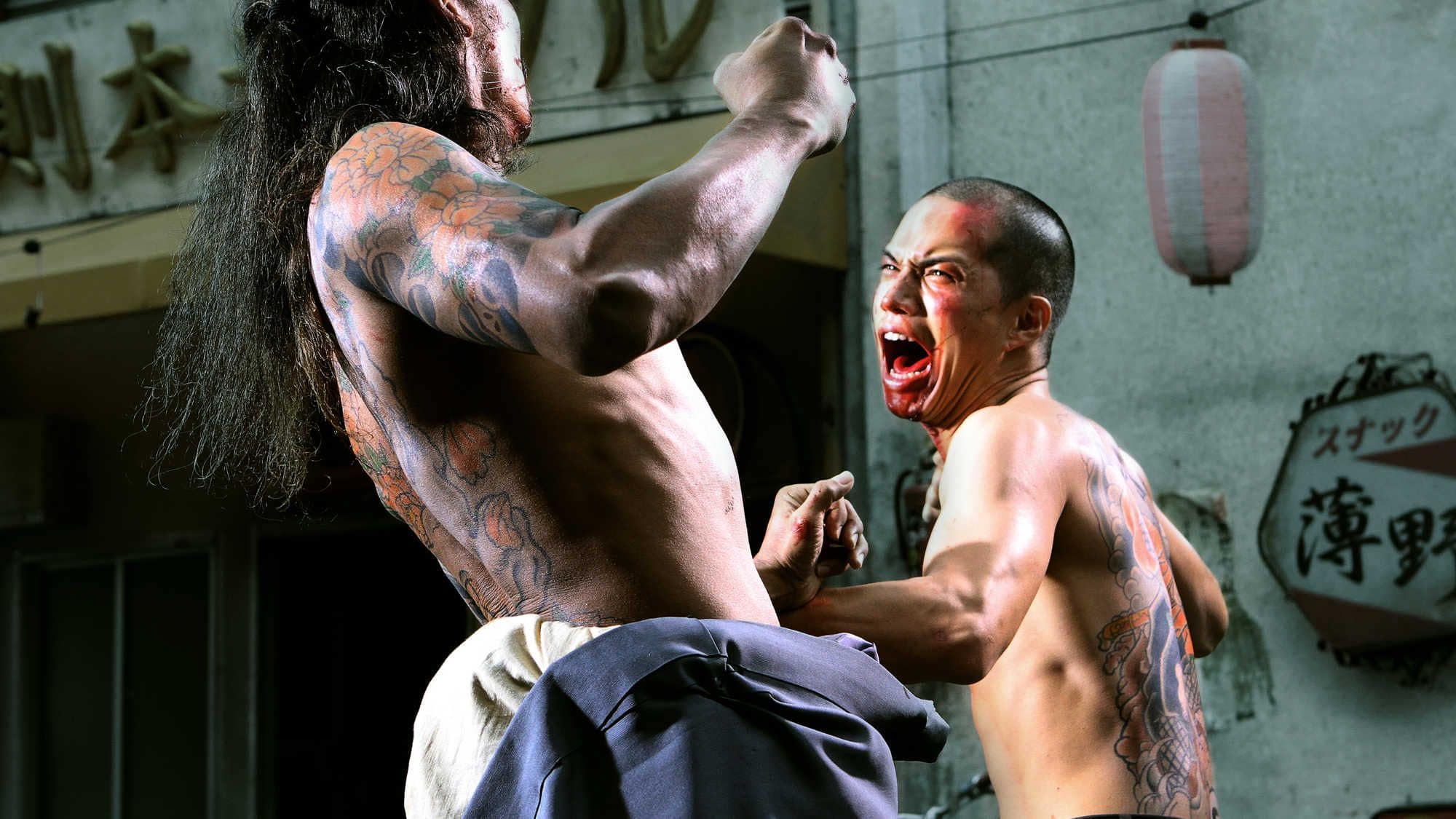
Forget style over substance. Ōbayashi Nobuhiko’s swan song, Labyrinth of Cinema, is style as substance. Part drama, part memoir, part essay on Japan’s imperial and military history, and part elegy for the medium of cinema, this chimera embodies one of its own definitions of film as “reality and fantasy all mixed up.” And clothed as it is in the style of another time, namely one where the new waves were still new and cinema sat at the apex of its cultural cachet, Labyrinth of Cinema fits another of its definitions: film as a time machine. Whether this comes off as a timely reimagining of techniques that have been neglected for too long, or simply old-fashioned, will hang on the temperament of the viewer.
The base-level plot finds teen cinephile Mario (Atsuki Takurō), film history buff Hosuke (Hosoyamada Takahito), and yakuza-wannabe Shigeru (Hosoda Yoshihiko) in the audience at an old movie house for its final screening. The film they’ve gathered to watch begins with a Technicolor musical-type song and tap dance routine featuring their soon-to-be romantic counterparts, Noriko (Yoshida Rei), Kazumu (Narumi Riko), and Kazuko (Yamazaki Hirona).
The three young men find themselves transported into the diegetic worlds of a series of Japanese war films, playing heroes’ roles and forming attachments to the heroines. They’re different characters in each production, but in general they play variations on the draftee archetype, buffeted by the forces of politics and history. And throughout Labyrinth of Cinema, another audience member, the time-traveling Fanta G (Takahashi Yukihiro), muses on the dying pleasures of the silver screen and provides historical context through voiceover.
Manic, maximalist, and bristling with postmodern bells and whistles, Labyrinth of Cinema is exactly what its title suggests. On top of the films within the film, which ricochet back and forth through multiple eras of Japanese history, an all-out assault on the senses keeps us discombobulated with genre switch-ups, aggressively unconventional editing, frames within the frame, and subtitles and intertitles layered on top of each other, including excerpts of poetry by Nakahara Chūya. Stretched over the course of a three-hour runtime, this level of audiovisual density is a taxing proposition, but Ōbayashi never condescends to his audience.
“Happiness is unachievable, a lie,” Fanta G says early on, to which Noriko responds, from inside the musical preceding the war films, “there’s truth in a lie.” Ōbayashi makes the “lies” of cinema, its artifice, conspicuous at every turn, refusing to let us forget that we’re watching a film and not reality. This self-consciousness may be refreshing in the context of contemporary film, but still, it’s ground well-trodden by the films of Ōbayashi’s heyday.
Take the special effects, which not only make zero attempt at realism, but defy viewers to find them convincing. All the characters are played by actors, but the number of actual locations or sets, as opposed backgrounds magicked into existence with green screens, can probably be counted on one hand. At their best, they have the cartoonish quality of Lana and Lilly Wachowski’s Speed Racer or a puppet show, which rely on our imaginations to compensate for a lack of realism. But they’re so omnipresent as to banish any sense of immersion, so that awareness of artifice risks giving way to tedium, instead of making happiness true.
If Ōbayashi’s anti-war stance is anything but subtle, it’s complicated by the implicit link that Labyrinth of Cinema draws between the development of military technology and the film industry as a means of propaganda. A feeling of resignation pervades the film, as the fate of cinema is compared with the dissolution of the samurai class—a tragedy to be mourned, even fought against, but an inevitability all the same. Ōbayashi, then, takes for granted that film is dead already. At the same time, he seems to suggest that new technologies may in the far future end all war, an end achieved, impossibly, in the true lie of Labyrinth of Cinema.
Since 2001, we've brought you uncompromising, candid takes on the world of film, music, television, video games, theater, and more. Independently owned and operated publications like Slant have been hit hard in recent years, but we’re committed to keeping our content free and accessible—meaning no paywalls or fees.
If you like what we do, please consider subscribing to our Patreon or making a donation.