Beth de Araújo’s Josephine opens, tellingly, with a shot that plays out from its eponymous character’s (Mason Reeves) first-person point of view as she struggles to run under a closing garage door and out onto the street. De Araújo’s sophomore feature is a harrowing chronicle of a premature maturation, with much of its compositions fascinatingly keyed to how young Josephine thinks about the world. It’s an immersive, immediate technique that’s effortlessly served by the psychologically driven language of the narrative.
After running out ahead of her father, Damien (Channing Tatum), in San Francisco’s Golden Gate Park, Josephine witnesses a man (Philip Ettinger) rape a woman (Syra McCarthy), previously seen jogging past the father and daughter, near a public restroom. The nature of this act is obvious to adult eyes, yet it takes time for Josephine to realize what’s transpiring before her. This rape is just the first of many instances in de Araújo’s startling film where Josephine’s experience illuminates how much of society’s rules of conduct must be taught to children.
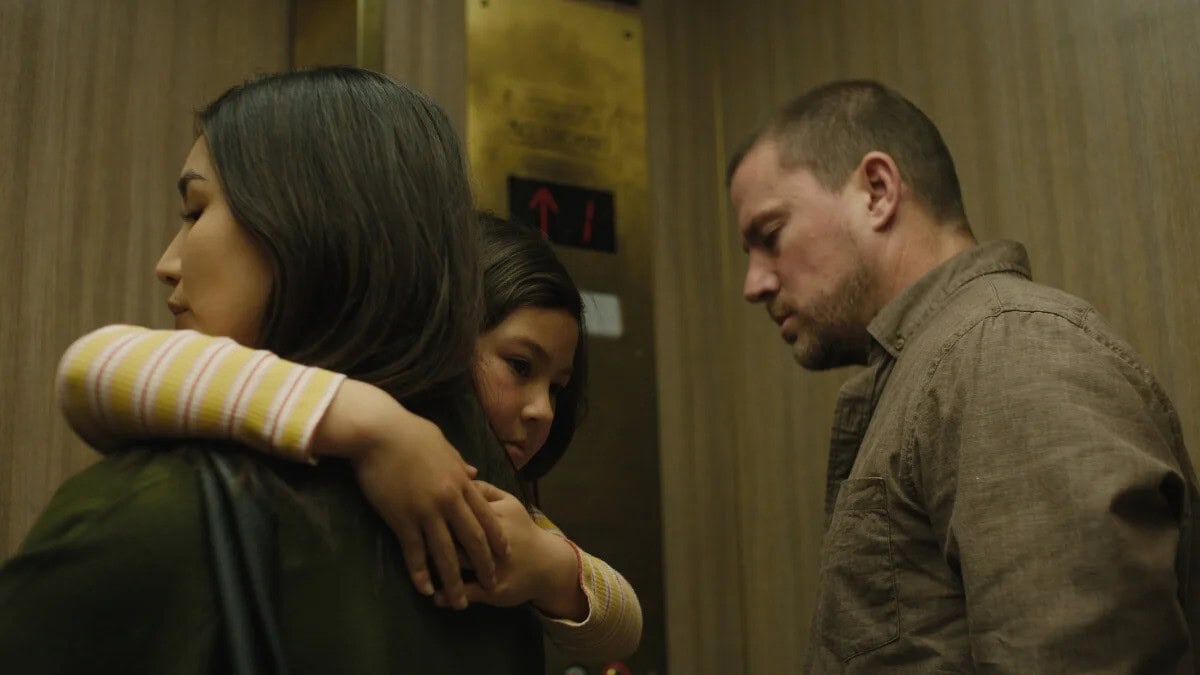
With the veil of their daughter’s ignorance punctured so suddenly, Josephine’s father and mother, Claire (Gemma Chan), rush to meet a set of competing demands. On the one hand, they believe in a duty to punish the assailant to keep their community, and especially young girls like Josephine, safe from harm. But once the surviving Jane Doe victim drops out of the state’s case, the burden of seeing justice served falls on Josephine’s testimony. For a child only faintly aware of what she witnessed, putting her on the stand risks both retraumatizing her and opening up additional lines of questioning around more mature sexual matters.
As if what she saw wasn’t confusing enough, Josephine’s parents approach exposing their daughter to adult topics in different ways. Claire, a professional dancer, wants Josephine to see a therapist, and her ardent belief in doing the right thing comes through in Chan’s measured but moving performance. (The film never spells out what type of trauma Claire might have experienced in her own life, but it’s clear that lessons from her past still resonate profoundly for the character in the present.) By contrast, Damien handles the situation in a way that Josephine is more inclined to understand. The two connect over their love of soccer, and he accordingly adopts a more physical response to her protection, enrolling her in self-defense classes.
Both approaches, though, prove to be as effective as putting a Band-Aid over a bullet wound. Josephine might hear a message that violence is justifiable only when deployed in self-defense, yet her young mind struggles to identify where that line is drawn and begins to imitate the brutal logic of a world she’s ill-equipped to comprehend. Reeves captures each step of this vicious cycle with pinpoint emotional acuity, vividly rendering Josephine’s volatility without displaying a precocious self-awareness about the assault’s toll on her psyche.
As she prepares for her day in court, Josephine lashes out against her classmates and parents alike. Claire and Damien try appealing to her better nature with bromides about fairness and decency, yet both find it increasingly difficult to sugarcoat the brutality that people are capable of. De Araújo’s clearest argument against the intolerable burden placed on survivors of assault by our justice system is in how difficult that proves for anyone to justify or explain to a child.
Ultimately, the biggest mistake Josephine’s parents make is misunderstanding their daughter’s involvement in the crime as more of an onlooker than a survivor in her own right. De Araújo hauntingly visualizes how Josephine carries around the psychic wounds of what she witnessed by depicting the assailant as a spectral presence in her daily life. Whether in her field of vision or inside her mind, the effect of Josephine’s premature exposure to the gruesome reality of sexual violence continues to linger until she has the tools to process its implications.
Josephine demonstrates how small acts of courage, even if not immediately recognized as such, can help people persist through the pain they experience. At a key juncture when Josephine wavers on her path to the witness stand, the camera adopts the child’s perspective as Claire looks her dead in the eyes to issue a sobering note of caution: “If you don’t try, I promise you’ll regret it when you’re older.” An unexpected observation may cause Josephine to see the horrors of humanity before she’s ready for them. Yet the shame of inaction in the face of injustice is another similarly adult concept, and Josephine proves capable of grasping this as well.
Since 2001, we've brought you uncompromising, candid takes on the world of film, music, television, video games, theater, and more. Independently owned and operated publications like Slant have been hit hard in recent years, but we’re committed to keeping our content free and accessible—meaning no paywalls or fees.
If you like what we do, please consider subscribing to our Patreon or making a donation.