Given how many adaptations of Bram Stoker’s Dracula are readily available to viewers, the measure of any given one is less how closely it adheres to the text than how idiosyncratically it stands out from its peers. Luc Besson’s new adaptation leans heavily into the tragic romance angle of the novel, albeit not of the central relationship between its chief human couple but of the one between Dracula (Caleb Landry Jones) and the wife (Zoë Bleu) he lost during his campaigns against the Ottomans when he was still a mortal man.
After swiftly running through a prologue of Dracula, né Vladimir of Wallachia, blaspheming against God for the death of his beloved, the film jumps to the late-19th century, not to the London of Stoker’s novel but to Paris on the eve of its centennial celebration of the Revolution. Otherwise, the basic setup is the same, down to retaining the decidedly un-French name of Jonathan Harker (Ewens Abid) for the lawyer who heads to Dracula’s castle in the Transylvanian mountains to advise him on his impending move to France. Once Harker arrives, the film slows to a crawl when the vampire reveals himself fully to the man and takes him captive less to feast on his blood than to have a captive audience to regale with his life story.
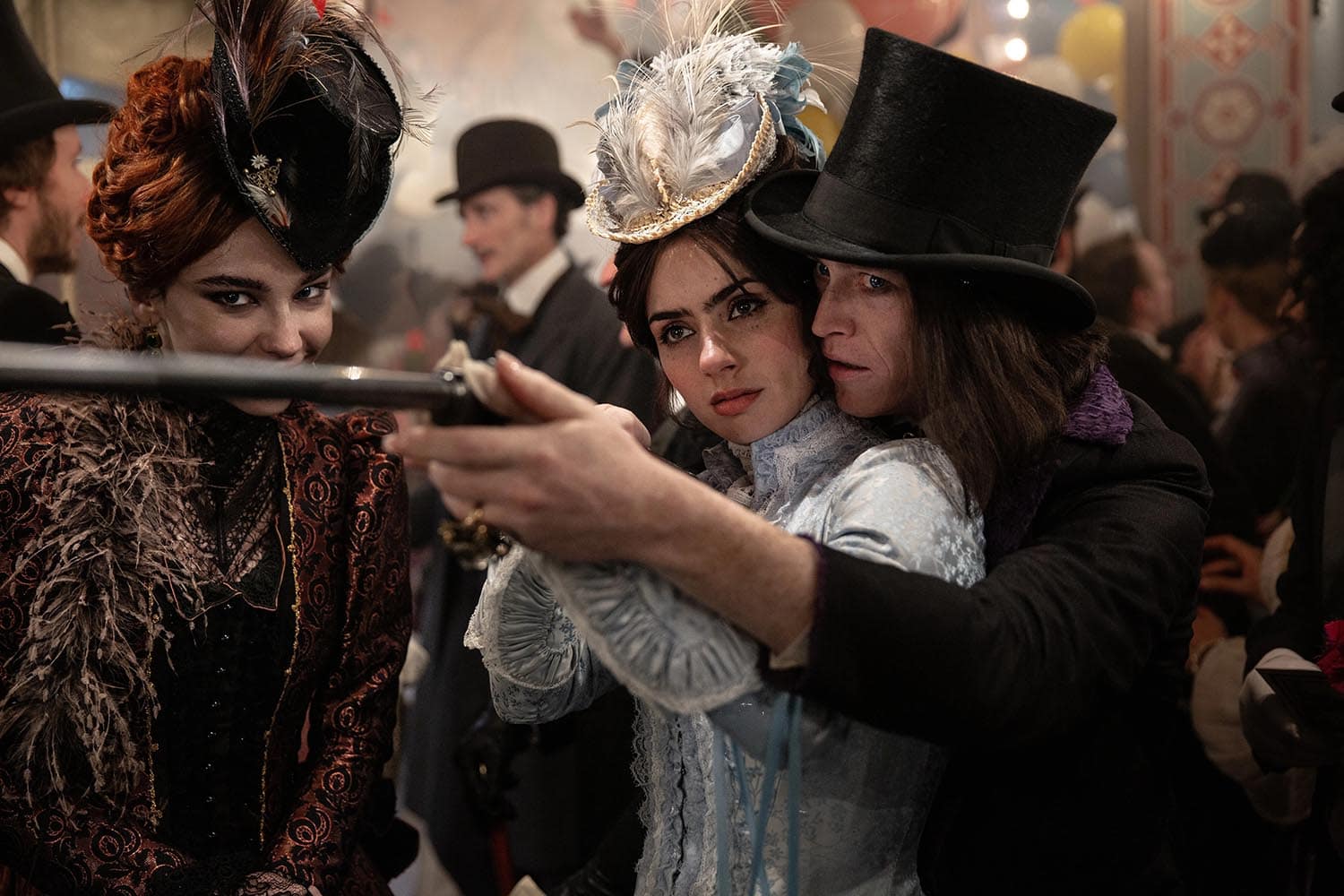
It’s here that the film loses focus, breaking up Dracula’s tale of woe with glimpses at how he’s spent the centuries preying on the courts of Europe. That’s a shift from one of the most potent threads of the novel: that of Dracula as a symbol of old continental nobility literally consuming poor subjects who can be disappeared without a fuss. And Besson stages a montage of goofy, over-the-top scenes of the count tearing up the ballrooms of Versailles and other palaces in feeding frenzies that one must imagine would have spoiled any low profile he needed to keep.
When the film returns to the present, it meanders through the motions of the novel while attempting to add a desperate longing to Dracula’s fixation on Harker’s fiancée, Mina (also Bleu), whom he believes is a reincarnation of his dead wife. But Besson remains a kinetic populist at heart, and though he slows the film’s pace to focus on the vampire’s efforts to bewitch the woman, the camera still has a tendency to dart around for flashy compositions strung together by the occasional burst of rapid editing. The rhythm thus becomes unpredictable and jittery, sapping the material of its intended emotional impact.
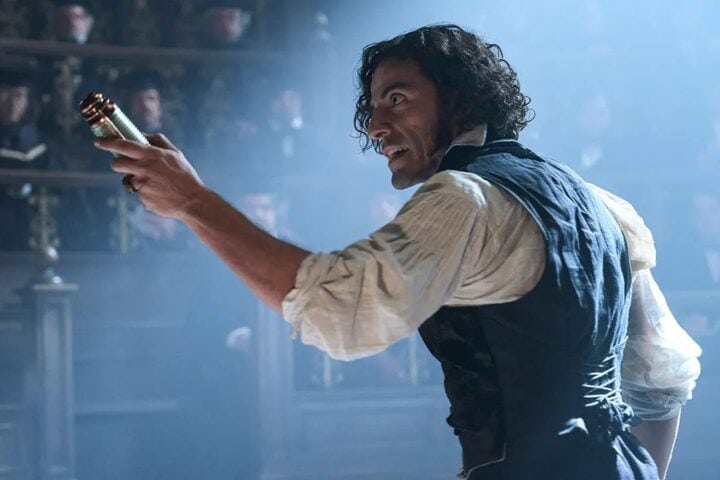
Intriguingly, Bresson and cinematographer Colin Wandersman sidestep the Gothic and expressionistic aesthetics that many filmmakers use to inhabit their vampire movies in favor of a style inspired by the Flemish old master painters like Rubens and van Eyck. Chiaroscuro lighting emphasizes less the pockets of darkness in the frame than the few elements illuminated by yellow candlelight or the occasional shock of white sunbeams bursting through otherwise covered windows. Colors are richly saturated; deep, arterial crimson and purple hues fill the frame well before the bloodletting begins in the form of curtains and aristocratic clothing.
That visual departure from genre convention ultimately marks the only noteworthy addition to the Dracula canon. Otherwise, Besson’s adaptation feels frustratingly inert. Not even a typically scenery-chewing Christoph Waltz as an unnamed priest—don’t call him Van Helsing—linked to a secret, paranormal Catholic order can enliven the proceedings as he brandishes crosses at Dracula and his various undead progeny. Hot off the heels of another high-profile adaptation of Stoker’s novel, Dracula suggests that this vein has perhaps at last been sucked dry.
Since 2001, we've brought you uncompromising, candid takes on the world of film, music, television, video games, theater, and more. Independently owned and operated publications like Slant have been hit hard in recent years, but we’re committed to keeping our content free and accessible—meaning no paywalls or fees.
If you like what we do, please consider subscribing to our Patreon or making a donation.