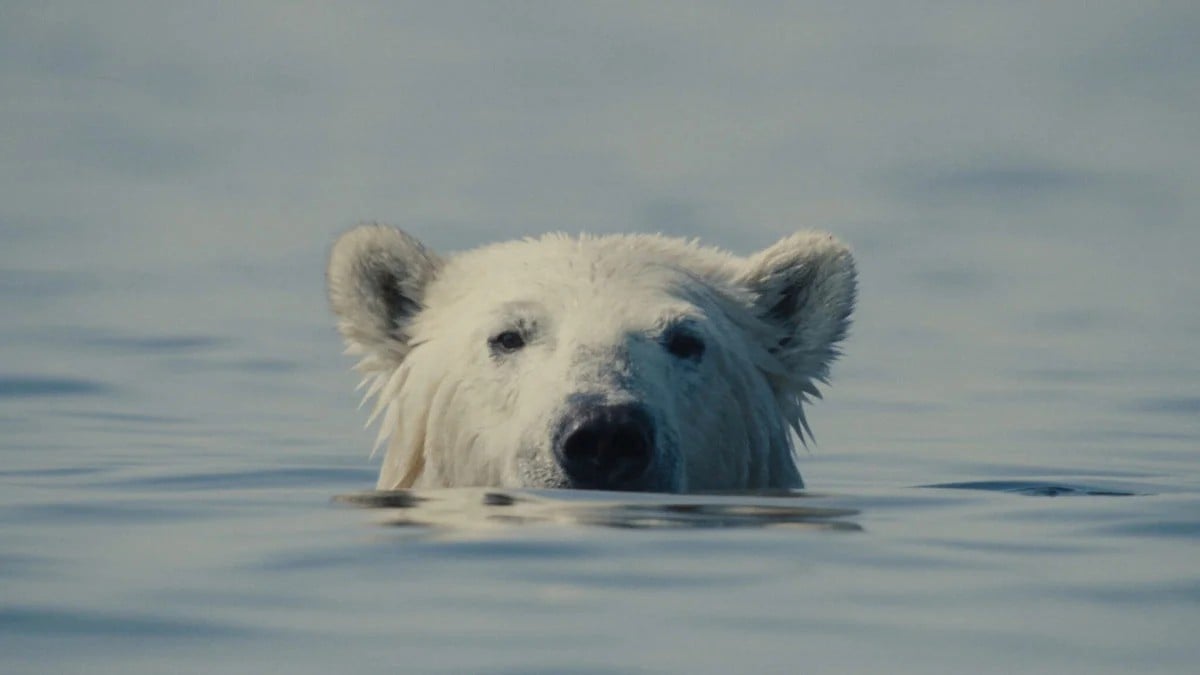
Adapted by Gabriela Osio Vanden and Jack Weisman from their 2021 short documentary of the same name, Nuisance Bear is a film about displacement. It tracks the polar bears of Churchill, Manitoba, who have been forced to live closer and closer to human beings as modernization has pressed further into what was once their territory. Through the narration provided by Mike Tunalaaq Gibbons, an Inuit elder, the film ties the bears’ resilience to the experiences of Churchill’s Inuit population, who have similarly seen the world around them remade by newcomers, with little thought for their needs, rights, or history.
As Nuisance Bear tracks a number of polar bears who roam the landscapes of Churchill, Gibbons tells us how these creatures used to keep their distance from humans, and how this was an arrangement that suited both sides well. Now sightings are constant and problematic, as more and more bears become what Gibbons calls “avinnaarjuk”—a word that roughly translates to the documentary’s title and refers to those bears who’ve lost their fear of humans.
Churchill now claims to be the “Polar Bear Capital of the World,” which is a designation that comes with certain advantages. For one, tourism has boomed in the area, with visitors flocking to see the bears, snapping pictures on their cellphones and cooing while jovial tour guides urge them not to stick their fingers through the bus’s bear-proof grilling. Naturally, having a bunch of half-ton carnivores roaming around also presents a tremendous danger, and the people we encounter in Nuisance Bear have very different ideas about how this should be handled.
Modern-day “bear patrol” guards work tirelessly to keep the animals at bay using an elaborate system of alarms, helicopters, movement trackers, and non-lethal bear traps. The Inuit people, who want to continue protecting themselves from the deadly predators that have been pushed on top of them, would much rather handle the situation the way their forefathers did: with a good, old-fashioned bear hunt. The latter might sound like the much crueler of the two—and the more time we spend watching the bears frolicking through the snow like giant dogs, the harder it is to stomach—but Vanden and Weisman’s film quietly challenges that assumption.
The bear patrol prides itself on its “humane” methods, but it effectively harasses bears simply for moving around the land they’ve always lived on. As we watch guards chasing terrified bears off with hails of fireworks or sedating them so that they wake up miles away, bewildered and with electronic tags stabbed through their ears, you may find yourself doubting that the sentiments driving support for the patrollers’ efforts are truly compassionate.
“A visitor from the past, navigating the maze of the present” is how Gibbons, a native of the Inuit community of Arviat on the western shores of Hudson Bay, describes the bears, and in this moment it’s clear that he’s also describing himself. Forced at a young age to attend a school where even speaking in his native language was a punishable offence, Gibbons knows exactly what it is to be pushed to the margins of your own land. The history of Churchill’s Inuit people is a long, sad story that would require a full documentary of its own to really explore, and the version we get in Nuisance Bear is, while affecting, noticeably truncated.
Conversely, the bears’ half of the story feels needlessly prolonged. We quickly gain a full understanding of their unfair situation and how unlikely it is to improve, and from there we spend the rest of the film watching the animals without learning much more about them. It helps, though, that the nature photography is stunning, fully communicating just what a marvel these giant creatures are. The beauty of the natural landscapes around them is also strikingly captured, and the sight of these pristine lands being carved up and polluted makes for a more poignant environmentalist critique than any argument the film could explicitly make.
Nuisance Bear is at its most powerful when its message has been condensed down into a single image, as in a sequence near the end of the film. A polar bear lounges in the snow, adjusting itself to get more comfortable and snacking on the occasional paw-full of white powder. It’s an image of perfect tranquility, of an animal totally in synch with the world around it. Then a bear patrol truck is seen bumbling awkwardly across the terrain with its horn blaring and LED-clad antenna waving stupidly from its hoods. The whole sequence plays out without a single word from our narrator. There’s such a brazen irony to the fact that, of the two them, the bear is the one being treated as an interloper, that the film doesn’t even feel the need to point it out.
Since 2001, we've brought you uncompromising, candid takes on the world of film, music, television, video games, theater, and more. Independently owned and operated publications like Slant have been hit hard in recent years, but we’re committed to keeping our content free and accessible—meaning no paywalls or fees.
If you like what we do, please consider subscribing to our Patreon or making a donation.