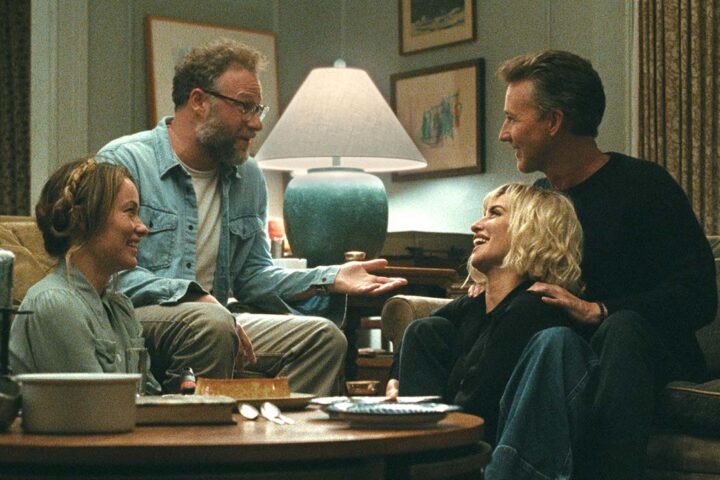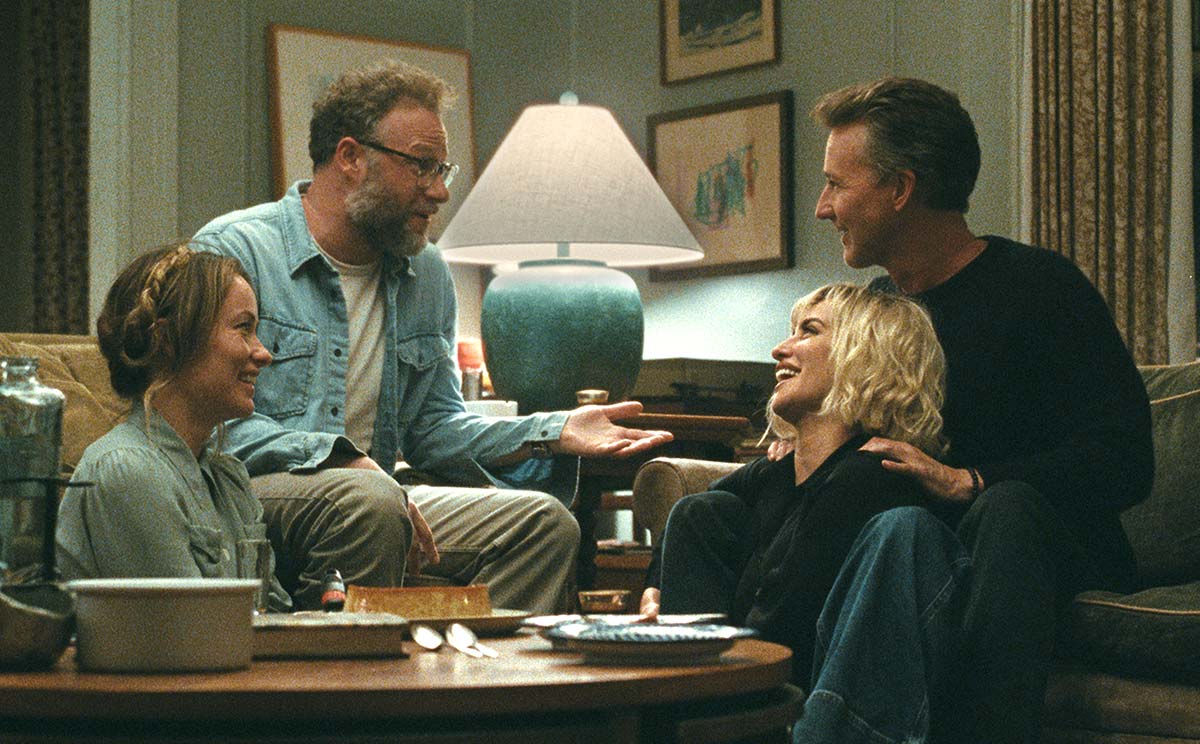
A modern-day spin on Who’s Afraid of Virginia Woolf, Olivia Wilde’s The Invite revolves around Joe (Seth Rogen) and Angela (Wilde), a married couple who no longer enjoy each other’s company. Joe, a math teacher who hates his job, is exhausted and angry at the world, and Angela, a stay-at-home mom, micromanages every aspect of their apartment—and, presumably, every other part of their lives. On a whim, Angela invites their upstairs neighbors over for dinner, and across one very long evening, Hawk (Edward Norton) and Pina’s (Penélope Cruz) company becomes the crucible through which their relationship is put to the test.
Adapted by Will McCormack and Rashida Jones from 2020 Spanish film Sentimental, Wilde’s chamber drama spends much time nimbly revealing the characters’ eccentricities and immersing us in their obsessions. Joe, for one, wants to know why Hawk and Pina have such loud sex upstairs. (While he’s annoyed about being woken up in the night, you also sense that he’s more than a little jealous, as he and Angela haven’t had sex in a very long time.) But since Angela has forbidden him from asking, they continue about the evening exchanging niceties.
As Joe takes Pina into his home office to smoke a joint and Angela takes Hawk on an apartment tour in an early stretch of the film, it’s clear that Joe has strong chemistry with Pina, and Angela has strong chemistry with Hawk. At first, the role this drawn-out sequence plays in the broader narrative is unclear. But as the characters ramble on about this or that, Joe and Angela’s amusing resentments and insecurities build to a revelation regarding the details of Hawk and Pina’s adventurousness in the bedroom—and the living room, and the kitchen—and it’s quickly revealed that the new upstairs neighbors are into more than just each other.
McCormack and Jones’s script does fine work homing in on Joe and Angela’s neuroses, and Wilde and Rogen are deft at making you see how their characters are victims of the pressure to perform emotional labor. The lead-up to their agreeing to Pina and Hawk helping them to renew their sex life is also very funny, but much of our insight into these characters’ lives comes to us via arguments and monologues that drag in noticeable ways.
Sometimes this is motivated by character, as Angela’s manic behavior and Joe’s cynical aggression result in certain conversations being stretched to awkward lengths. Often, though, it feels as though the dialogue is more than enamored of itself. No less indulgent is the incessant presence of Dev “Blood Orange” Hynes’s prickly score or the way The Invite opens with flash frames and film burns as a reel is seemingly loaded into the camera and comes up to speed, calling a little too much attention to the fact that the film was shot on 35mm.
In such moments, Wilde mircromanages her passion project to the point of nearly casting authenticity to the wind. But by the time The Invite burrows into the heart of its main characters and reveals the scope of their regrets and longings, it’s hard to argue that it doesn’t strike a chord of genuine emotion. For Wilde, this film about the troubled marriage between a neurotic and a cynic is clearly personal, and by the time it reaches its finale, however wonkily, we can see that beneath its indulgences lies something surprisingly well-observed and sincerely felt.
Since 2001, we've brought you uncompromising, candid takes on the world of film, music, television, video games, theater, and more. Independently owned and operated publications like Slant have been hit hard in recent years, but we’re committed to keeping our content free and accessible—meaning no paywalls or fees.
If you like what we do, please consider subscribing to our Patreon or making a donation.