Sophie Hyde’s Jimpa is refreshingly one of the first mainstream films to make a non-binary character the protagonist of its story. But this isn’t the nuanced portrait of gender non-conformity that you may be hoping for. The dysfunction of the family at the film’s center is revealed slowly, and the characters aren’t saddled with obvious traumas, but Jimpa’s exploration, if you can call it that, of non-binary identity ultimately proves superficial.
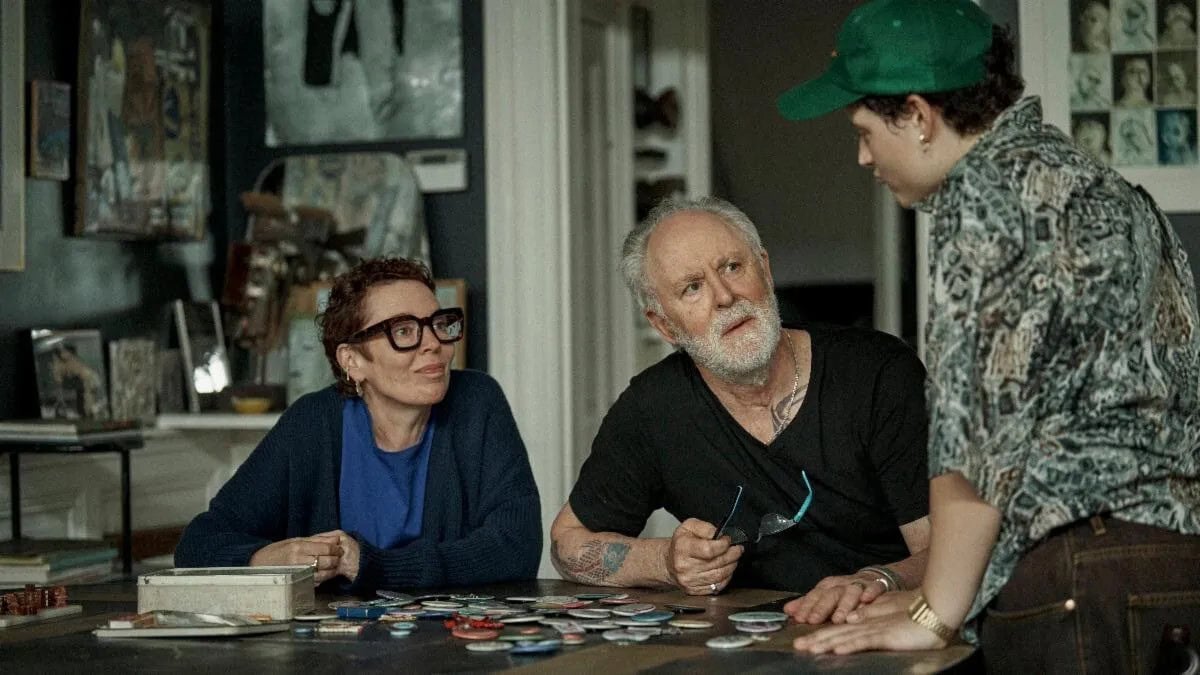
Hannah (Olivia Colman) travels to Amsterdam to visit her father, Jim, a.k.a. Jimpa (John Lithgow), alongside her teenage child, Frances (Aud Mason-Hyde). The child is a self-described “openly trans non-binary queer” person, their grandfather is gay, and they happen to be in, arguably, the most progressive city in the world. As such, it’s only natural that Frances decides to stay with Jimpa for a year in order to find “the best version” of themselves.
By contrast, Hannah is overcome with anxiety and uses the trip, as well as Frances’s yearning for queerer pastures, to work through childhood wounds—namely, the way her parents’ relationship was reconfigured upon her birth, which coincided with Jimpa coming out as gay. Hannah felt this as a sort of abandonment that left a taste of betrayal in her mouth. Once liberated from the closet, Jimpa was apparently more devoted to his pleasures than to his loved ones.
Frances mostly functions as a vessel for explaining entries in the so-called woke glossary to those around them, especially Jimpa, who turns out to be something closer to a bitchy queen clinging on to old binary notions than the figure of queer deliverance that Frances had imagined. But the script, by Hyde and Matthew Cormack, isn’t interested in commenting on the gap between generations of sexually marginalized people—how Jimpa’s lacked words to account for sexuality’s many nuances and Frances’s has a plethora of them. The film is mostly concerned with laughing at just how wide the gap is between those generations.
Hyde and Cormack see non-binary solely as a term. Which is to say, they don’t see the capaciousness of its meaning. This is decidedly at odds with what Amsterdam’s vibrant queerness, in the most anti-identity sense of the word, could have allowed for: a more complex awakening in Frances or a transformative relationship between Frances and Jimpa, where characters and audience could actually learn something they don’t already know.
Since 2001, we've brought you uncompromising, candid takes on the world of film, music, television, video games, theater, and more. Independently owned and operated publications like Slant have been hit hard in recent years, but we’re committed to keeping our content free and accessible—meaning no paywalls or fees.
If you like what we do, please consider subscribing to our Patreon or making a donation.