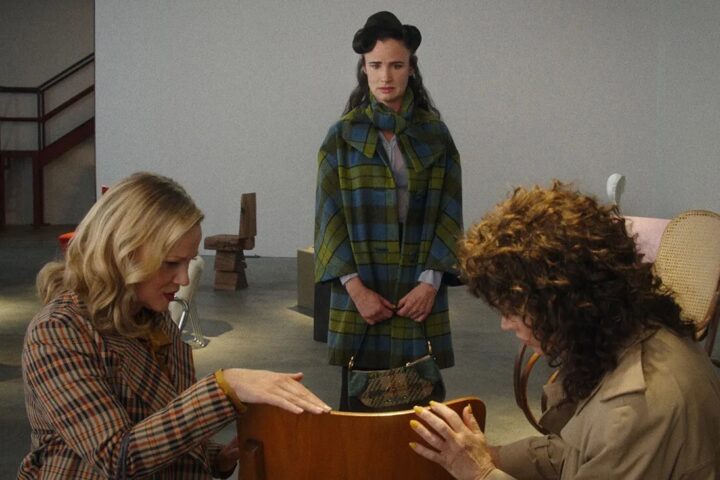
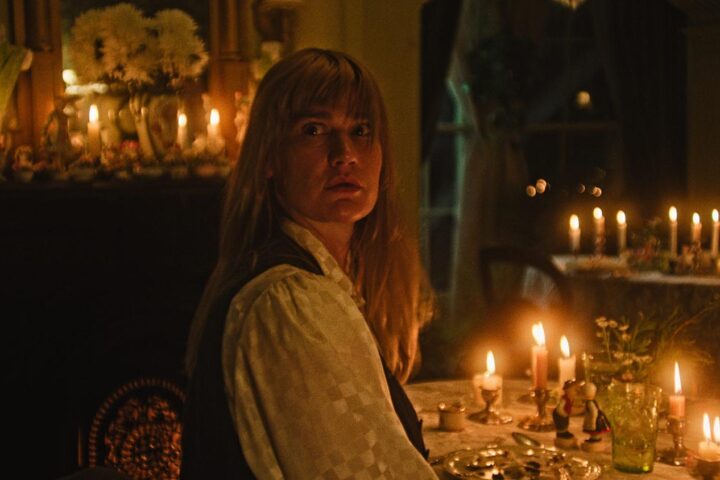
British-Nigerian filmmaker Akinola Davies Jr. has spent most of his life knowing his father as little more than a memory. The man’s untimely passing looms as a structuring absence in Davies Jr.’s feature-length directorial debut, My Father’s Shadow, which the filmmaker co-wrote with his brother, Wale Davies. The film is a portrait of a man that the brothers pieced together from secondhand stories passed down through friends and family.
The film, with depicts a trip that a father (Sope Dirisu) takes to Lagos with his young sons (Chibuike Marvelous Egbo and Godwin Egbo), imagines a day that Davies Jr. and his brother never got to spend with their father. The narrative conceit allows them to recreate this unknowable figure and explore his humanity with a fullness not permitted to them in life.
My Father’s Shadow also extends beyond their own experiences. The family outing to the big city occurs on June 12, 1993, a day on which an annulled Nigerian election thwarted the country’s democratic transition out of military dictatorship. Davies Jr. uses the national unrest as more than just a backdrop to the event. It’s a macro-level echo of the themes of legacy and heritage explored on a micro level through the wisdom a father imparts to his sons.
I spoke with Davies Jr. last fall while he was in New York to promote My Father’s Shadow. Our conversation covered what it means for him to carry his father’s name, how he worked with the film’s child actors, and being drawn to masculine imperfection.
You carry your father’s name, and Remi carries the name of his uncle, who died when his dad was still young. What does it mean to inherit a name like that?
In Africa, our names are the fuel that propels us towards our destiny. I think our parents are very intentional in how they choose names, especially in a Yoruba context. Almost every family member gets to give you a name, but Akinola means “brave and wealthy” or “wealth and valor,” depending on how you want to look at it. I think it’s a name that I’ve had to rise to the occasion to, because I can’t say I’ve always been brave or wealthy in terms of superficiality and culture. But as an adult, you grow into your name and revere it in a certain way. Being named after your dad is no easy feat, considering everyone speaks about how much of a titan he was.
Is that idea of giving someone the name of a dead person to relinquish them from your dreams something specific to the culture that you grew up in, or just something that’s unique to the character? It struck me because my middle name comes from my dad’s brother, who died before I was born, and I had never thought about what it meant for either of them.
I think you even asking that question is a testament to how memory works, because sometimes you don’t even know. If I’m fortunate to have kids, I want their middle name to be my best friend who passed away a long time ago. I think it’s how memory works, passing an intention from someone you love into someone you equally love. It has not a nostalgic and sentimental intention. I think it’s a beautiful gesture, having someone’s middle name and not even realizing how much it meant to the person who named you. It’s an Easter egg for people who do that.
There’s a motif running through the film of the natural world, in particular the animal kingdom, and how they’re caring for the dead who come before them. How did you develop and incorporate that into the film?
I would say a lot of luck, but with an intention of understanding that we’re shooting something from a child’s perspective, and children are incredibly curious. They don’t really attach things with a certain level of judgment. They ask questions that might not be PC. And when the camera is low, it enables you to look down and focus on the minutiae, which is something I think children do in earnest. With framing trees and certain aspects of nature and birds, it’s just honoring the character of a location, trying to make it feel like more of a real place than just a set. A lot of that is just being aware and trying to be present where you are.
We are getting some shots at a child’s-eye level and see certain scenes that they’re just overhearing, but it’s not entirely from their perspective. When were you leaning in, and when did you want to take a step back?
During the development and construction of this film, we knew we wanted to be at their level. We knew we’d only be able to let the audience know as much as the children needed to know. But, equally, we needed a little bit more, and that was the technique of embellishing some other aspects in Folarin’s story. It’s not consummately his perspective in the film; it’s definitely the boys, but we needed to be able to extract a lot of information from him as he’s moving through adult spaces. As a child, if you’re going somewhere with your parents, you don’t necessarily tune into those conversations. They still happen, and you don’t know the context of a lot of those things. But we thought we really needed to tell you about his politics, how he operates, how he moves in terms of getting his wages, or how he works with a female who’s interested in him. We needed to mask things with the nuance of what it means to be a man in that context as well.
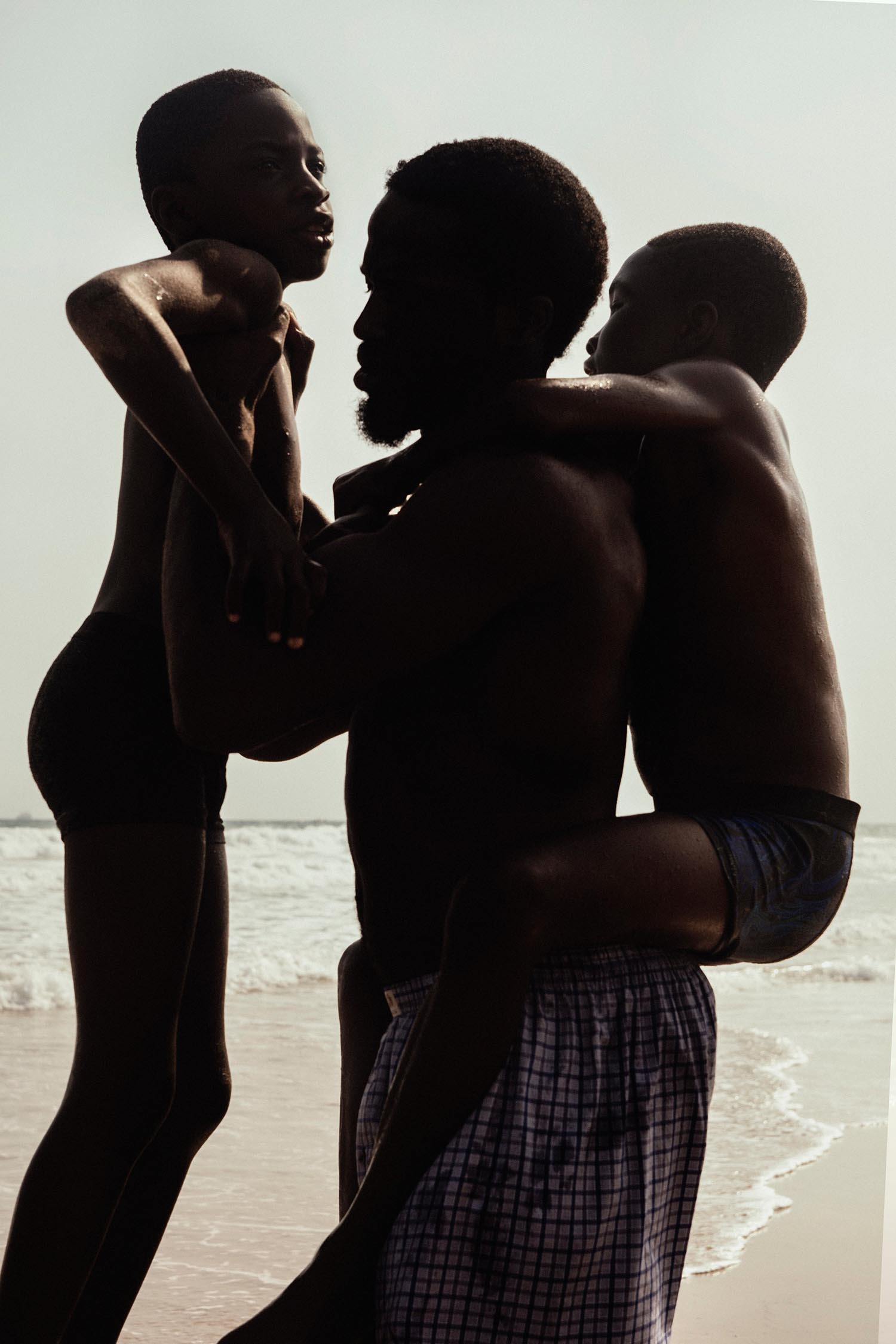
How were you calibrating your own perspective from outside the film? It’s drawing on a lot of autobiographical details from your childhood, but now, you’re closer in age to Folarin and might have some more insight into him as well.
I thought I would be able to be completely subjective about what we were making. I knew very quickly in the first week that it would not be possible after the funeral scene. It was really meta going through a process of filming something that reminded you of a funeral for a father that you don’t remember and weren’t able to attend in that level of presence. I remember breaking down after that first weekend, but [I have] a lot of gratitude to the whole cast and crew. I’m really lucky that I have a lot of amazing collaborators and a very good therapist who’s come in clutch a few times.
I also have to give a lot of credit to our editor, Omar Guzmán, who worked on Tótem with Lila Áviles, which dealt with grief. There was a shorthand, and being able to learn from someone who has a lot of experience helps us build out what we have was really important. It hasn’t been easy, I have to admit, but everyone at every stage has been very invested. Hopefully, as a director, I’m someone who creates a framework and allows everyone to pour in. Everyone’s poured in in a very generous way. Challenges have been met with a certain level of respect and understanding of the context, sometimes too much, but I think it all serves to show that everybody was really invested and loved the story we’re telling.
When you’re working with child actors, how do you balance the nature of letting them be spontaneous and bringing that childlike energy while still getting what you need from that day’s shoot?
I would say 70% of the job is in the casting. If you cast actors that you believe are those characters, then you don’t have to direct as much. I think it’s harder with children under 10, but the older brother in the film, Chibuike Marvelous Egbo, was really locked in. He knew what he was doing and was completely professional. He’s trying to learn his craft and be technical. No notes, effectively. With the younger brother, Godwin, it’s a lot more challenging to begin with because the continuity is not something that’s in the back of his head. He’s just trying to remember his lines, get through them, and act them out.
Initially, that was quite challenging, but we allowed them to be kids and bring their character and their charisma into the roles. Once I gave them more responsibility and stopped trying to micromanage them, we got the performances we have. Ultimately, I think you have to create a structure around children in which they feel safe, able to play, and able to make mistakes. They don’t feel like they’re going to get chastised for not getting something right.
There’s a thematic irony that the brothers don’t fully understand what’s going on around them. Was that element helpful from a practical standpoint as well?
They didn’t need to know the political context. They didn’t really need to know a lot of the heavy emotional stuff of it being a story about grief. They just needed to know their father isn’t always present. In the working-class context, they already have that in terms of their father going to provide for the family, so their mother is always present. I think they already understood those things. We didn’t need to get into too much depth of what they’re experiencing and what they’re feeling; we just needed them to know what they needed to know for a particular scene.
How did you come to fold archival material into the film’s edit?
I had been working with Adam Curtis, a mercurial archivist and documentary filmmaker. I had all this footage showing Nigeria in that period of time that just so happened to come in handy for My Father’s Shadow. I was showing Sope, our production designers, and our costume designer, so they could have a look and see what the world looked like then. Later on in the edit, when we needed something that carried us over the line, I showed that footage to Omar. He was like, “Oh, this could really work in moments.” I hadn’t necessarily envisaged us using it in the film, but I think it’s really effective in the moments of tension to build things out. It’s a credit to the archive that exists and the people who have made it, and just working with a brilliant editor who could find the perfect bits to put in the film, which, I have to admit, did not come easily.

What have you taken away from the relationship between cinema and memory that you explore here?
The archive is a really wonderful place to draw from, because in many instances and cultures, history hasn’t been afforded to everyone. It’s been closed off and written [from] a particular point of view. Delving back into the archive allows you to re-establish actual history or create mythologies of your own. Working with the archive means there’s a weight to it, because ultimately, people went through that, for good or for worse. It’s a good platform to tell stories from. In our next story, we definitely want to reference a lot of visual archive, memory archive, and interviews we’re doing ourselves to get a more well-rounded picture.
Why end the film where you do, harshly breaking from the end of the day and cutting immediately to the end of a life?
I don’t remember a lot of films where you see how people from sub-Saharan Africa genuinely grieve, so I think there’s cause to say that it needed to be in there. Equally, I think with life, there are no finite outcomes. Whether you know the person who passed or not, there are always questions. You can’t get a clean picture. We wanted things to feel as realistic as they would be in terms of what it’s like to be Nigerian, to be Black, to be African. We don’t get the entirety of these stories, so we wanted to lean into that. But we wanted to celebrate that idea of grief and have it as a communal thing together, even though it’s quite a sad moment in the film. We wanted to share that with everyone as well.
Engaging with this imaginary version of your father and the ideals that he represents around providing strength and protection is one very specific, time-bound version of what it means to be a man. Having a little bit of distance from that time, but also being closer to that age in your life, how did making this film make you rethink the nature of being a man?
Wow, real easy one there! I would say a lot, actually. My brother was fortunate to become a father during the process of developing and making this film, so he probably has a lot more to say about it. I don’t have the privilege yet, but this story is our version of masculinity. It’s flawed, it’s imperfect, but it doesn’t try to shy away from those imperfections. If anything, it tries to confront them. I think we owe it to ourselves, to the women in our lives, and to our family to speak on the mess that we make at times. Equally, it’s important to show that, beyond everything I’ve just said, there is an archetype of a soft, empathetic father. It’s not the masculine stereotype, whilst it’s probably quite prevalent among a lot of people. There’s always been a counterweight, whether we choose to admit it or not. Similar to grieving, we wanted to show the alternative of moving away from stereotypes and just moving toward something that felt a lot more grounded. Hopefully, that’s what we lean into in Sope Dirisu’s performance.
At the root of the project is to get to know your father by spending a day with him. What did you learn about him and yourself from this journey?
I learned that no matter what happens, no one can take away this one memory that my brother and I think we have. I think I probably learned I’m probably more similar to him in personality than I’d attested to. Even beyond that, more so than anything about him, I think I learned that our mother has done an incredible job of encasing his memory in something that’s positive for us. As I said, he’s definitely a flawed man. But I think the fact that we, at our ages, decided that our first offering in terms of film is to honor his legacy speaks more to the job our mother has done than the job that his absence has done. She enabled us to remain curious about him and not shut him off to us, which in many instances could be the case. The apple doesn’t fall far from the tree, and my siblings and I probably have a lot more similarity [to him] than we care to think. Certainly, our father is very nuanced in this. He’s meant to be imperfect and flawed, and hopefully, we arrive with some grace when it’s deserved.
Since 2001, we've brought you uncompromising, candid takes on the world of film, music, television, video games, theater, and more. Independently owned and operated publications like Slant have been hit hard in recent years, but we’re committed to keeping our content free and accessible—meaning no paywalls or fees.
If you like what we do, please consider subscribing to our Patreon or making a donation.