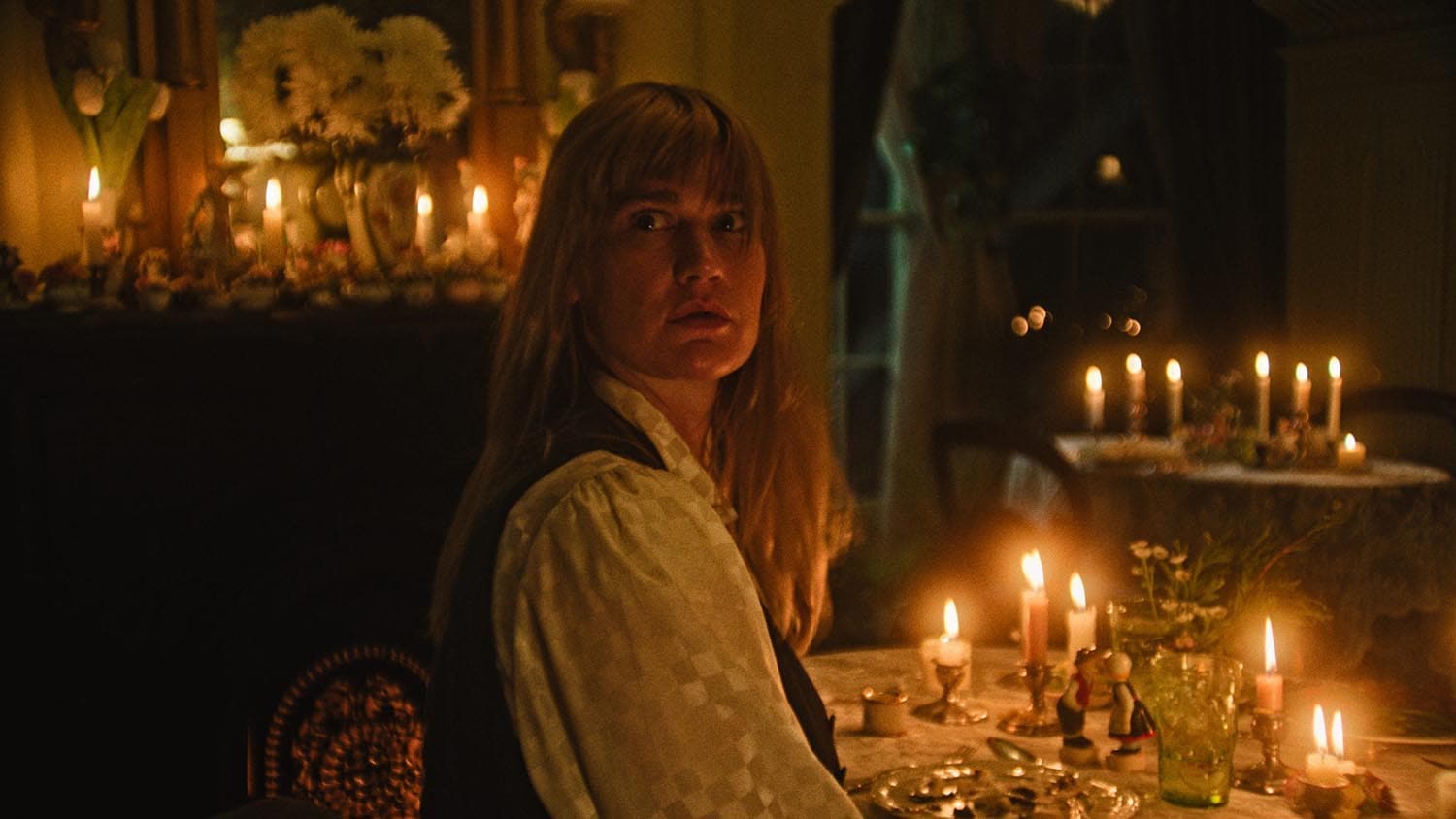
From the moment Diana (Grace Glowicki), a woman with severe memory loss, arrives with her husband, Homer (Ben Petrie), at “the trauma place,” a mansion nestled deep in the woods, there’s little doubt that she’ll learn some horrible truth before the credits roll on Honey Bunch. In fact, you may find yourself appreciating the transparency with which directors Madeleine Sims-Fewer and Dusty Mancinelli approach the material, as you’re right to believe that nothing good can happen in a place with a hedge maze shaped like an eyeball.
The film is all slow zooms and hallucinations, reflecting the fragility of Diana’s mental state in the wake of an accident. She walks with a cane and sees things that can’t possibly be true, like Homer leaving the dining area only to return immediately in his underwear, or a yellow-skinned figure doubled over in the shadows, vomiting. Homer seems previously acquainted with the facility’s head caregiver, Farah (Kate Dickie), who administers the flashing lights meant to stimulate Diana’s memory. And when another head trauma patient (India Brown) arrives, her father (Jason Isaacs) mutters to Homer about Diana, “You’ve got to tell her.”
But like Sims-Fewer and Mancinelli’s previous film, Violation, Honey Bunch sets out to throw a wrench into what might have easily been a straightforward story trajectory. The flashbacks to Diana and Homer’s relationship are disagreements about the nature of love and devotion; the pair may be philosophically misaligned, but we see nothing that seems to justify the constant foreboding. By the time Diana takes drastic action, the film hasn’t exactly validated her fears.
Honey Bunch plays a dangerous game, leading us to question the filmmakers’ command of their craft in a way that doesn’t quite feel intentional. Though Glowicki and Petrie (who are a real-life couple and a filmmaking duo in their own right) give lived-in performances, much of the dialogue is stilted and artificial in its cleverness. The plotting is also sloppy, with not one but two instances of Diana stumbling upon a conveniently explanatory document.
Yet Honey Bunch ends in a much stranger and thornier place than you might expect from a gaslight thriller. It builds toward the rare twist that complicates rather than simplifies our perception of the characters and the setting, and the climax is an unexpectedly tender spectacle of body horror. Sims-Fewer and Mancinelli recognize that horror is uncertainty, and rather than fitting the characters into predictable roles as victim and victimizer, they’ve crafted a film that’s all the more unsettling for how it transcends such binaries.
Since 2001, we've brought you uncompromising, candid takes on the world of film, music, television, video games, theater, and more. Independently owned and operated publications like Slant have been hit hard in recent years, but we’re committed to keeping our content free and accessible—meaning no paywalls or fees.
If you like what we do, please consider subscribing to our Patreon or making a donation.