

Key to understanding what you’re getting from Emerald Fennell’s Wuthering Heights is recognizing how intentional those scare quotes around the title on the poster actually are. This take on Emily Brontë’s Gothic novel is less an adaptation of the story as it exists on the page than of how it haunts our cultural memory. That is, not as a tale of generational trauma and doomed obsession, but as a kinky, heavily stylized, bodice-ripping romance that provides Fennell a canvas on which to flaunt her aesthetic and thematic intentions. Like a particularly impressive aspic, Wuthering Heights is tantalizing to behold but not so easy to swallow.
When Mr. Earnshaw (Martin Clunes), in an act of rare benevolence, brings home an illiterate street urchin (Owen Cooper) to care for and clothe, his headstrong daughter, Cathy (Charlotte Mellington), is instantly besotted. Naming him Heathcliff and promising to pinch him if he misbehaves, Cathy initially views the boy as a pet more than a companion, but before long the two adolescents become devoted friends despite the difference in their stations.
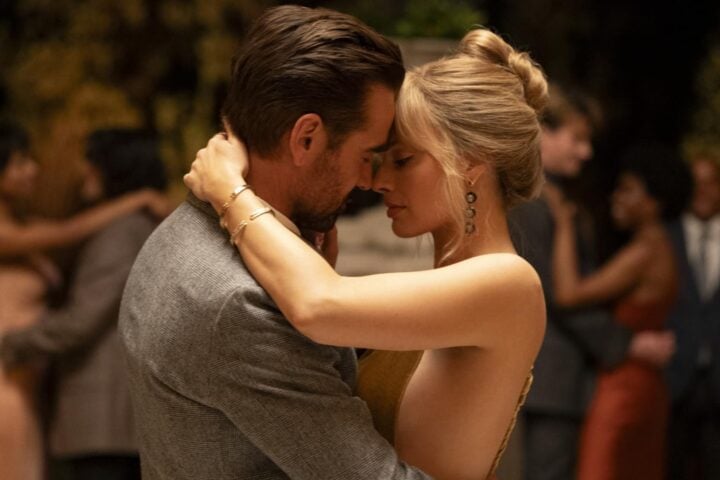
As the two come of age, though, this divide becomes more pronounced, with Cathy (now played by Margot Robbie) pursuing the luxury and comfort of a marriage to the wealthy Edgar Linton (Shazad Latif) and forswearing the devotion of the brooding, penniless Heathcliff (now played by Jacob Elordi). When Heathcliff returns five years after Cathy’s marriage to Linton, having elevated himself from lowly servant to moneyed dandy, the only thing more powerful than her reawakened desire for him is the forsaken man’s thirst for revenge.
Over a black screen, our first sensate experience of Fennell’s adaptation is the sound of creaking and grunting—the noisy expiration of a hanging man made indistinguishable from the thrusts and pants of the many orgasms one imagines he had in his curtailed life. This opening sequence, with its post-death boners and throngs of horny onlookers (including one randy in-spite-of-herself nun), announces a film that upends the Gothic tradition of unconsummated yearning for a full-blown, almost Ken Russell-esque celebration of sex and death.
The film’s world is a tactile feast of goopy eroticized forms and textures from runny eggs to sticky mounds of dough to literal snail trails glistening across windowpanes. This rooting around in prurience befits an adaptation that has little interest in respecting its iconic source material, given how it underlines things that Bronte only alludes to.

Here, the characters proclaim loudly what they left unsaid on the page, and Cathy and Heathcliff consummate their love for one another many times cover. Midway through the film, when Cathy utters, “It would degrade me to marry Heathcliff,” it’s hard how to imagine how that could possibly be the case. Robbie is faintly ridiculous as the incorrigible Cathy, pulling faces in the film’s early going like a clumsy rom-com heroine, but she comports herself far better playing Cathy as a wilting flower as the story lumbers toward its tragic conclusion.
Fennell has been criticized for the casting of Elordi as another example of whitewashing a character for whom there’s contemporary scholarship to suggest may be non-white, yet the filmmaker’s total disinterest in Heathcliff’s interiority and the conditions that mark him as a marginalized other, at least in this case, serve to make his race immaterial. This is notable, as most screen versions of Wuthering Heights align themselves with Heathcliff’s outsider perspective, but Fennell’s adaptation is Cathy’s show. More interesting still, Elordi’s take on the famously feral and villainous antihero is more kicked puppy than mad dog, and Fennell saves her ire for the woman on which she centers the story.
The film delights in seeing women corseted, bridled, crawling like beasts or with masculine hands placed over their faces. Fennell seems to be prodding us with the imagery of erotic submission that was once the purview of Harlequin romances but has now gone mainstream in the wake of Fifty Shades of Grey and the dawn of BookTok. But there’s also a timeless, confessional quality to her overheated assertion that as much as women desire kindness, comfort, and fancy things, they also yearn to feel the rough hands of men with gold teeth.
Yet the film’s flirtations with a deeper rumination on the lot of women who feel they have to choose wealth and status in a world that devalues, dehumanizes, and objectifies them are basically just foreplay. (A room papered in the plush pinks of Cathy’s skin, complete with birthmarks and blue veins, is a recurrent image in search of a thesis.) Fennell stops short of offering a truly penetrating message, turning Cathy’s desire for Linton into a clear-cut decision between love and vanity. Ultimately, Cathy rejects Heathcliff because she’s selfish and materialistic, not because she’s a 19th-century woman with limited prospects.
The way Fennell seemingly sees it, patriarchy is an annoyance, racial difference as a distraction, and love is simply a matter of choice. As for wealth, it’s the most suffocating of prisons. That’s a message that’s hard to take seriously in our current socio-historical moment, and doubly so given how Fennell is enamored with that particular cage and how it sparkles.
Since 2001, we've brought you uncompromising, candid takes on the world of film, music, television, video games, theater, and more. Independently owned and operated publications like Slant have been hit hard in recent years, but we’re committed to keeping our content free and accessible—meaning no paywalls or fees.
If you like what we do, please consider subscribing to our Patreon or making a donation.


Why use the title Wuthering Heights when this film has little to do with the novel? Make a new film instead. Emily Bronte’s novel is unforgivingly and brutally romantic. The 1939 Merle Oberon/Laurence Olivier film version does a respectable job of staying close to the spirit of the novel. A closer version to the novel is the Spanish director Luis Bunuel 1954 version with a magnificently dangerous Heathcliff. The final scene at Catherine’s coffin will haunt you forever. It sounds like this current film is for kindergarten.