Writer-director Amanda Kramer’s body-swap comedy By Design has little concern for subtlety or ambiguity. Every element, from the sets and costumes to the mise-en-scène and freaky dance sequences, is fastidiously curated, composed, and choreographed to within an inch of its life. Just as in Kramer’s Please Baby Please, artifice is the order of the day. This is life as it appears in advertising, a vacuum-sealed wish-fulfilment dream.
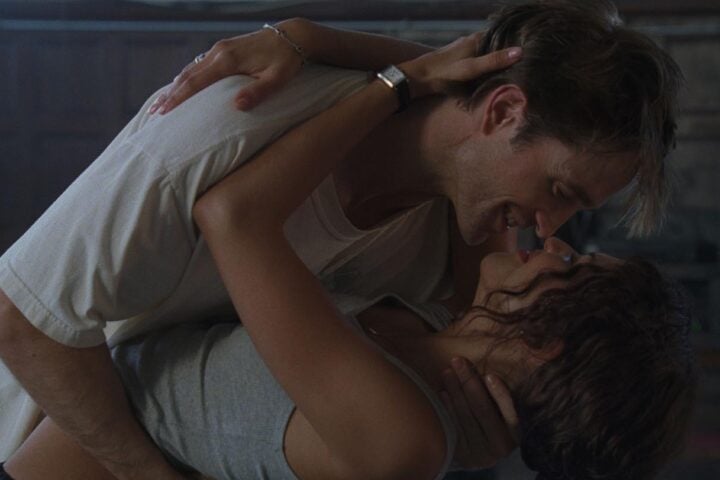
Camille (Juliette Lewis) longs for a life of the mind, yet envies her superficial, materialist friends Lisa (Samantha Mathis) and Irene (Robin Tunney). After one of their gossip-fueled lunches, they go shopping and Camille encounters an incredibly expensive golden brown chair that she simply must have. Returning the next day to purchase it, she learns that it’s already been sold to Marta (Alisa Torres) as a parting gift to her pianist ex-boyfriend, Olivier (Mamoudou Athie), and in a fit of frustrated desire, her personality mysteriously infuses the chair. Once the ensouled article of furniture is delivered to him, Olivier falls promptly in love with it.
Up until the climactic encounter between Olivier and Camille’s actual body, Lewis wrings a surprising pathos from the near-zero-degree acting demanded by her role, draping her body in poses of artful languor, an expression of anguish engraved on her face. As if nothing were amiss, others project their idea of Camille onto her catatonic form, calling her a “good listener.” Think Dougie Jones from Twin Peaks: The Return, only taken to a more absurd extreme.
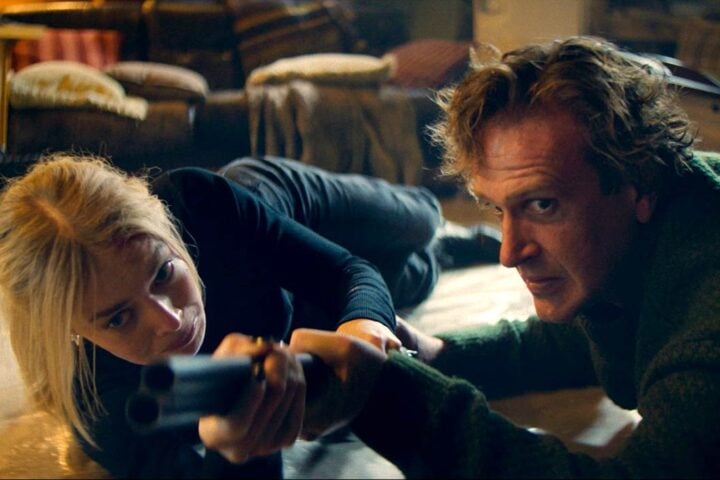
Lest this premise puzzle the audience for even a second, in swoops the intrusive voiceover narration to state most of By Design’s high-minded concepts outright, ensuring that no subtext is left implicit. Camille wants nothing more (or less) than to become a literal object of desire. On some level, as Kramer’s script is at pains to show, our objectification is something that we, as consumers, ardently pursue. At the same time, the filmmaker identifies a strange power in passivity. When a stalker (Clifton Collins Jr.) breaks into Camille’s apartment, her utter lack of response, let alone resistance, not only saves her but indirectly kills her would-be attacker.
One area where ambiguity does reign is in the setting. The costumes and interior décors are such a hodgepodge that By Design floats in a nebulous postmodern non-era. All we can surmise for sure is that it takes place in a U.S. city where capitalism runs amok, an interesting extrapolation from Please Baby Please, which wasn’t so much set in the ’50s as a daydream of the ’50s. By contrast to the period specificity of Kramer’s previous film, the costumes here are too temporally diffuse to excite any nostalgia for a supposedly “simpler time.” The suffocating absence of history feels more like an intentional part of the filmmaker’s critique.
If the film also treats us as a piece of furniture, that’s probably by design. Maybe we’re meant to feel bludgeoned over the head with redundant voiceover, so that we recognize the learned passivity that comes with spending ever greater portions of our lives in the audience role, as slop buckets for content. By forcing us to identify with its largely comatose protagonist, By Design arouses resentment in order to shake us out of torpor. What we’re supposed to do once we snap out of it, though, is something that By Design leaves open just a crack to interpretation.
Since 2001, we've brought you uncompromising, candid takes on the world of film, music, television, video games, theater, and more. Independently owned and operated publications like Slant have been hit hard in recent years, but we’re committed to keeping our content free and accessible—meaning no paywalls or fees.
If you like what we do, please consider subscribing to our Patreon or making a donation.