This year’s International Film Festival Rotterdam (IFFR) didn’t lack for at once poetic and political works of art. One highlight was Ivo Ferreira’s Projecto Global, a fictionalized depiction of an armed resistance by the FP-25 (Forças Populares 25 de Abril) set in the years after the Carnation Revolution, which ousted a dictatorship in Portugal.
The members of the FP-25 aimed to continue the revolutionary goals of the Carnation Revolution through killings and robberies. A variety of characters in positions of (abuse of) power remind the FP-25 resistance that the dictatorship is finished, and that the revolutionary struggle should be as well. Though their actions qualify as terrorism, the film isn’t concerned with you recognizing them as such. This isn’t a facile exercise in finger-wagging, virtue-signaling, or commiseration. For Ferreira, a post-dictatorship isn’t a question of sides, because the way he sees it, there’s no such thing as the end of a dictatorship.
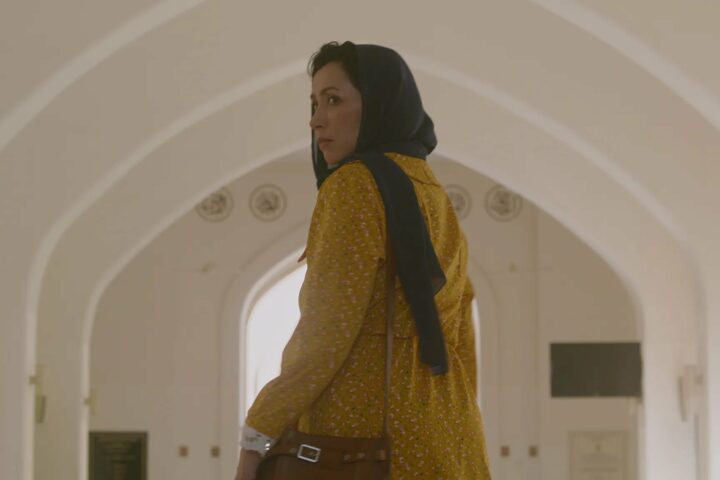
Project Global’s enrapturing aesthetic rigor makes it easy to lose sight of the weight of its political denunciation, given how subtle it is by comparison. Just as spellbinding as the composition of the filmic space and the balletic way the camera captures it is the face of actress Jani Zhao. She plays Rosa, a prominent figure in the terrorist organization whose commitment to the armed struggle is so fierce that not even maternal love, or death itself, can stop her.
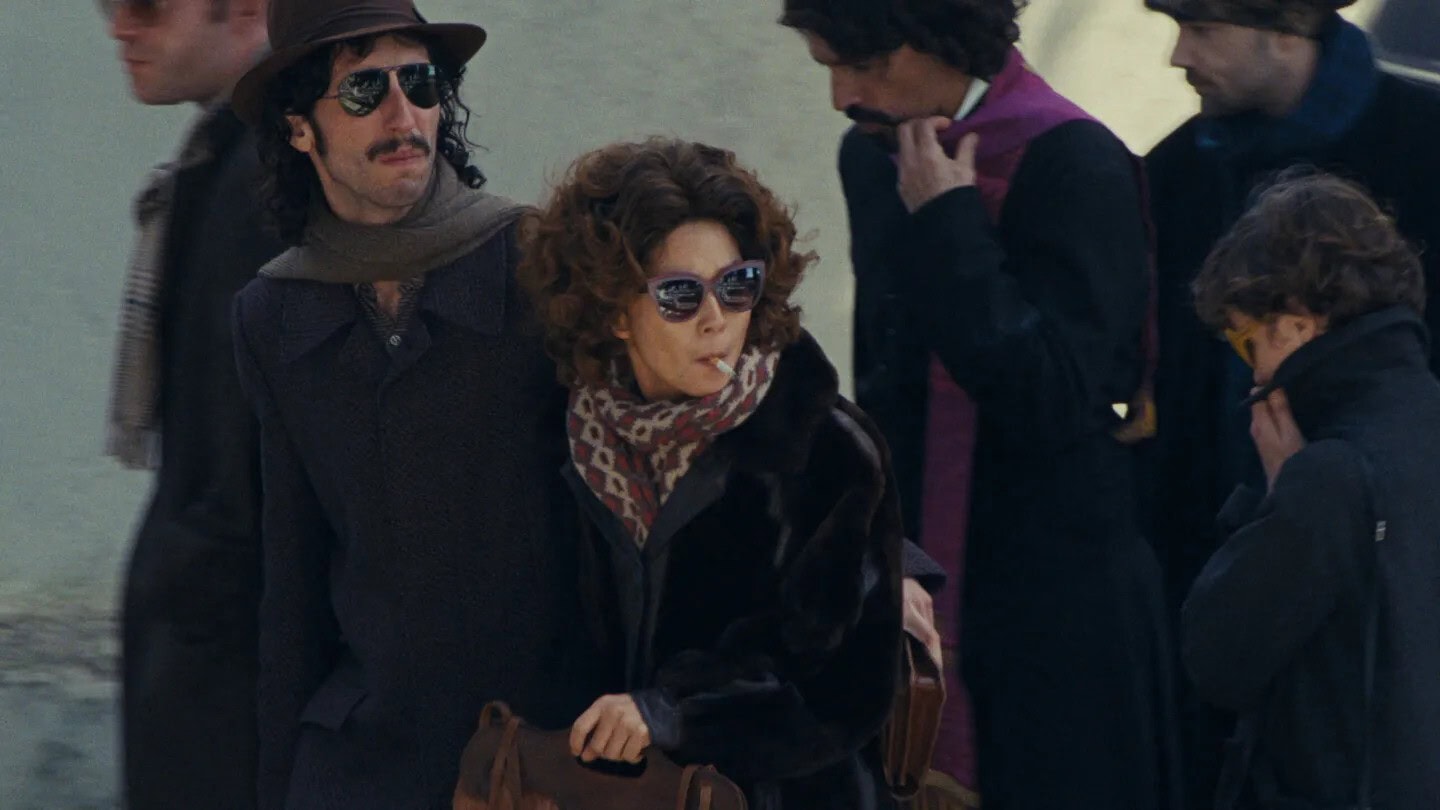
The play between visibility and invisibility largely defines the group action, as the resistance fighters try to present as ordinary citizens in the lead up to and in the aftermath of their violent interventions, such as robbing a bank or attending a comrade’s funeral. Zhao’s Asian-ness, then, adds an almost surreal quality to this enterprise, as she seems to be the only Asian person in the movement, if not all of Lisbon as it’s depicted here. How could Rosa stand a chance of disappearing in the crowd, or pass for someone other than herself, despite her many guises?
Ferreira’s treatment of Zhao’s imposing presence takes a Lynchian quality that reaches its apex toward the end of Project Global, when the filmmaker pulls off a masterful sleight of hand that reminds us to be wary of what you (don’t) see. It turns out that the racialized mark that would make Rosa a target doesn’t stand a chance in the face of her convictions, her wit, and her intelligence. Ferreira translates this beautifully in a bait-and-switch sequence involving a headscarf and a carwash that’s as powerful as it is poetic.
The poetry in the film is never really derived from character psychology, but from how the scenes are choreographed, the way a character, say, becomes another as if by magic, a bank becomes a prison in a robbery gone wrong, and a lover becomes a threat upon the revelation that they’re a cop. The deceiving simplicity of a gesture is particularly striking in a scene when the otherwise bare-faced Rosa puts lipstick on for the first time—not in the name of a man, but of the revolution. In this sense, Projecto Global bears a kinship with Kleber Mendonça Filho’s The Secret Agent, another recent film about the paranoia that structures daily life under dictatorships, where the smallest gesture or supposedly minor detail (linguistic, sartorial, archival) reveals how something deadly can operate in plain sight.
Unlike Ferreira’s film, Łukasz Ronduda’s Tell Me What You Feel is all about the human psyche—its unwieldiness, its exploitation, and the improbable task of trying to link psychic lives together. It seems it’s possible to achieve the latter when Maria (Izabella Dudziak) meets Patrick (Jan Sałasiński) in Warsaw. She’s an artist from a privileged background running an art project called “Tear Dealer,” where she pays for poor people’s tears, collecting them in vials. He’s an androgynous daydreamer from a poor and rural background making experimental drawings no one wants to buy and working at a movie theatre to make ends meet. It’s art and trauma that brings the two together. They laugh, make love, take baths together, and engage in role-playing games where they wear each other’s clothes and pretend to be one another.

With Tell Me What You Feel, Ronduda crafts an immersive emotional world—that of the frisson that carries forward the early stages of love, when the red flags that inevitably end up making relationships crumble remain outside of lovers’ fields of vision. But they’re very much there, and they pop up in the sharpest ways. Here they specifically take mostly the shape of class difference. As soon as Maria and Patrick leave their bubble of artistic-cum-romantic play, where she entices him into addressing his traumas in the name of intimacy, they realize everything conspires against their togetherness. For while their respective parents are strangers to their desires, they’re the ones who Maria and Patrick ultimately pledge allegiance to.
Maria’s rich parents don’t accept Patrick’s country-bumpkin roots and Patrick’s parents feel humiliated by both Maria’s status (she pulls up at their farm in a Mercedes) and daunted by Patrick’s self-ethnographic practice. Tell Me What You Want is a poignant account of love and art’s deceivingly seductive status as panacea to the irreducible gap between the self and others, whoever they are. Because we love images, or idealizations of people, not the people themselves.
Even parent-child love, Ronduda suggests, is conditional, considering Patrick’s parents’ disregard for their son and hyper-investment in his dead twin sister. This is what the several shots of the outdoor altar the parents build for their dead daughter seems to say, as the girl’s dresses hang above a lit candle: we cannot actually love what we actually have.
In director Philip Yung’s Hong Kong-set Cyclone, unlikely love also brings characters from two different worlds together: Cyclone (Yuqiao Liu), a trans sex worker from mainland China, and Bian (Edwynn Li), a hustler. Yung paints a sensitive portrait of the impossible position that trans women often find themselves in, driven to get “the operation” all while being asked to perform sexually with their penis—in Cyclone’s case, against her will.
This is the rare film depicting the romantic relationship between a trans woman and a straight man but also rare in how it pays attention to the complexities of being a woman with a penis while dating a man whose impenetrability is taken for granted until the fantasy of that impenetrability breaks down. Apart from Saim Sadiq’s Joyland, it’s difficult to think of another film that similarly refuses to reduce a trans woman to her relationship to her own transness, making room for how men are so often sexually, if not romantically, implicated in that orbit.
In Yung’s film, the sexual and gender roles seem initially clear down to the division of labor: She bottoms while he tops, and she sells her body while he sells narcotics. That’s until Bian starts asking Cyclone to penetrate him, which only adds insult to injury in a romance that’s by then threatened by the couple’s material and legal vulnerabilities.
In one heart-wrenching scene between the lovers, Cyclone is coughing while arguing with Bian, who tells her, “You wear all this to look like a woman but you cough like a man.” There would have been enough drama here to last the entire film. Instead, Yung insists on flashbacks that set out to explain Cyclone’s traumas. This means leaving the figure of the trans woman as (not) worthy of love and returning to her medicalization. Unfortunately, by the end, Cyclone becomes something like conversion therapy gore porn. An overtly literal violence takes over the screen, as if its viciousness hadn’t already made itself known, in smaller but much more affecting ways—in Cyclone’s melancholy eyes, her resignation, her coughing, her waiting.
International Film Festival Rotterdam runs from January 29—February 8.
Since 2001, we've brought you uncompromising, candid takes on the world of film, music, television, video games, theater, and more. Independently owned and operated publications like Slant have been hit hard in recent years, but we’re committed to keeping our content free and accessible—meaning no paywalls or fees.
If you like what we do, please consider subscribing to our Patreon or making a donation.