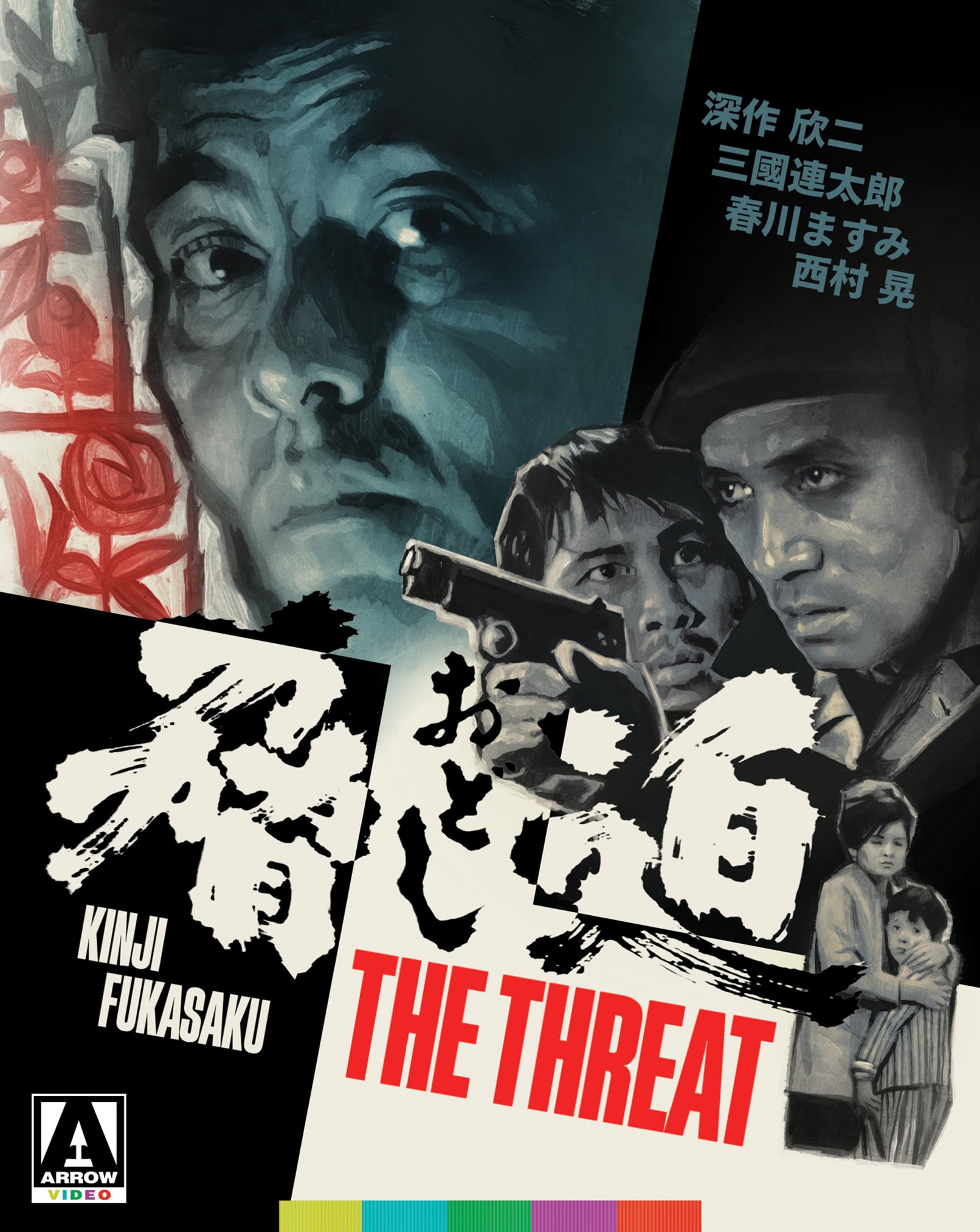
 When two criminals—Kawanishi (Nishimura Kō) and Sabu (Murota Hideo)—first force their way into Misawa’s (Mikuni Rentarō) home, the middle-class salaryman bolts up from his bathtub, standing before his assailants nude and covered in bubbles. This darkly humorous moment lends a bit of levity to the first of many chaotic sequences in Fukasaku Kinji’s The Threat, but more importantly, it speaks to the near-comical, childlike vulnerability of the film’s kowtowing protagonist, who goes from finding an equally spineless underling at work who’s willing to marry his boss’s mistress to complying with every order given by his captors without resistance.
What follows is a remarkably tense and claustrophobic home invasion thriller, in which Misawa becomes the middleman between Kawanishi and a wealthy man, Sakata (Mitsuda Ken), whose infant he and the younger, more impulsive Sabu kidnapped before breaking into Misawa’s house. But coursing just beneath the surface of the film’s genre thrills is a stark and cutting commentary of a supposedly remade Japan in the midst of its post-war economic miracle.
Misawa has bought into promises of that miracle. And all he had to do was trade his personal agency for unquestioned loyalty toward his corporate executives and his home could be filled with all the newest products, be it a pair of TVs, a rice cooker for his wife (Harukawa Masumi), or a Mickey Mouse clock for his son, Masao (Hozumi Pepe). Of course, as Kawanishi correctly surmises, everything, including the home, has been bought on credit, leaving Misawa perpetually stuck in the rat race simply to retain the lifestyle he and his family now enjoy.
Kawanishi sees Misawa for what he is, telling Sabu that their victim is used to being a robot, and that “it’s a role that suits him well.” Misawa is a man used to, and perhaps conditioned to, following orders, making him the perfect stooge for the pair of kidnappers to use for their own means. Even when Misawa returns home with Kawanishi, after scoping out the drop sight where Sakata will leave the money, and finds his wife having just fought off an attempted rape by Sabu, he takes his frustrations out not on his captors, but on his already traumatized wife.
As Misawa goes on to rape his wife, in a flailing, horrific attempt to reclaim some sense of masculine authority, The Threat inevitably brings to mind Straw Dogs. Indeed, the depiction of Misawa’s emasculation up to now reaches a boiling point that leads him into similarly queasy, shocking terrain as Dustin Hoffman’s David in Sam Peckinpah’s classic. But where Peckinpah’s slow-burning film sits uncomfortably with its protagonist’s shattered masculinity, Fukasaku’s relentlessly propulsive work has other targets in its crosshairs as well.
The screenplay’s righteous indignation extends to Japanese society at large, and its anger is fully entrenched in the film’s vigorous aesthetic. Dizzying handheld camerawork, unsettling close-ups, quick cuts, and disorienting camera angles are par for the course here. Through this forceful visual style, Fukasaku excoriates the vision that Japan had of itself at this time, conveying that beneath its newfound prosperity lies both a sniveling cowardice and merciless brutality very much at play in a society that falsely presents itself as fully rehabilitated.
Image/Sound
Arrow Video’s high-definition transfer looks fantastic, boasting a crisp image abundant in beautiful colors and strong detail. There are no signs of blurring even during scenes with the most chaotic handheld camerawork. Black levels are quite strong and stable, while grain is tight and even. There are a few brief signs of very minor damage, but this is otherwise a very strong presentation of the film. The uncompressed mono audio is also solid, nicely balancing the near-constant noises from various scuffles with the dialogue.
Extras
In a new commentary track, Japanese film expert Tom Mes touches on everything from how director and actor contracts worked with the big five Japanese studios through the 1960s to Fukasaku Kinji’s massive contributions to the yakuza genre. In a particularly interesting stretch, he goes to great lengths to explain why The Threat isn’t a yakuza film before delving into the differences between that genre and non-yakuza films with gangsters in them.
Critic Mark Schilling’s 20-minute interview isn’t quite as sharply observant, but he does a fine job contextualizing Fukasaku’s early work and drawing connections between him and Kurosawa Akira, as well as to less renown artists like Katō Tai and Ishii Teruo. Also included are a slipcase, foldout poster, and a 20-page booklet with an essay by Hayley Scanlon that offers deft analysis of the film’s themes of economic security and masculinity in 1960s Japan.
Overall
Arrow Video’s release of Fukasaku Kinji’s The Threat provides an essential glimpse into the early work of a genre master already fully in control of his craft.
Since 2001, we've brought you uncompromising, candid takes on the world of film, music, television, video games, theater, and more. Independently owned and operated publications like Slant have been hit hard in recent years, but we’re committed to keeping our content free and accessible—meaning no paywalls or fees.
If you like what we do, please consider subscribing to our Patreon or making a donation.