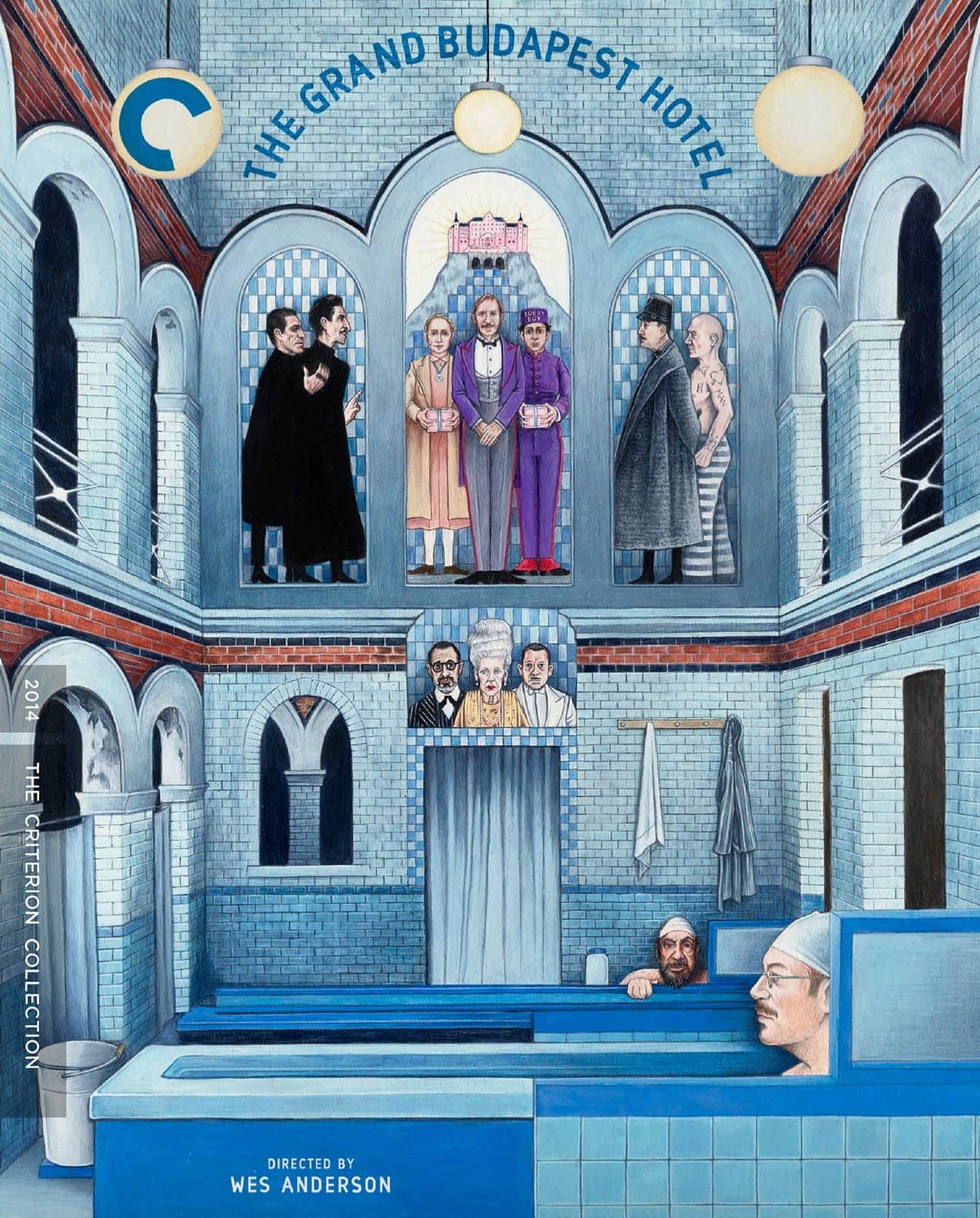
 There’s a joke that runs through Wes Anderson’s The Grand Budapest Hotel like a thin, fine wire. It usually, but not always, involves Monsieur Gustav H. (Ralph Fiennes), the devoted concierge of the titular hotel in the mountains of Zubrowka, a fictional country that’s ravaged by war in ways that recall the scourges that devastated Europe during the 1930s. Ludicrously soon after a fresh calamity or inconvenience, someone will attempt to sentimentalize or commemorate the transpired event with a poetic stanza, only to be dashed, with amusingly flippant suddenness, by the immediate realities of the situation at hand. An ode to man’s foible might inadvertently end with a resigned “Ah, fuck it.”
The film’s meanings reside in the various permutations of that joke. Like a few of Jean Renoir’s heroes, the characters scramble to maintain a degree of compassion and stately civility in the midst of the unfathomable rise of a fascist regime (the SS here is the ZZ). Informed by the writing of Stefan Zweig, The Grand Budapest Hotel’s plot is misleadingly delightful, with chases and dastardly villains and elegant buffoonery. Gustav inherits a priceless portrait, Boy with Apple, from a deceased lover, Madame D. (Tilda Swinton), and must do battle with her corrupt relatives, who frame him for the woman’s murder and set him scrambling about Eastern Europe setting things right. In the midst of this adventure, Gustav plays matchmaker to protégé Zero (Tony Revolori) and a brilliant pastry chef, Agatha (Saoirse Ronan), and their romance is revealed to be the heart of the story, the source of the film’s unshakable poignancy.
The film is structured as a tribute to an act of kindness that ripples like a pond that’s been breached by a tossed stone, to a gesture that speaks louder than any of Gustav’s more conscious attempts to control the scope of his legacy. The man presents himself as a foppish dandy, but underneath those pretensions, which are probably assumed to cover his shame over his own humble origins, beats the heart of a romantic hero. He never treats Zero, a refugee of a country already quashed by the fascist regime, as anything but a gentleman and a co-conspirator, and that sense of acceptance empowers the latter to win Agatha and cement the beginnings of his new adult life. This act of kindness is paid forward by an aging Zero (now F. Murray Abraham) in the 1960s to a writer (Jude Law) who ponders the mysterious old man sitting in the dilapidated old hotel. That gesture is remembered by the writer (now Tom Wilkinson) in an interview recorded years later, which itself appears in a book read by a young woman in the present, who happens to bear an uncanny resemblance to Agatha. That young woman, we’re to assume, is paying homage to a writer who recorded her family’s legacy.
But you have to parse the screen for much of this information, as Anderson has grown into a nearly abstract sentimental formalist who obsessively imbues every image with implicative remorse and heartbreak. The Grand Budapest Hotel is the most obvious marvel: a great pink dream palace that suggests one of Agatha’s cakes if she had lived long enough to pay homage to the mythical cinematic realms of Marienbad and the Overlook. Anderson cannily uses aspect ratios to affirm his vision of the past as a place of vanishing warmth and harmony: The ’30s segments are shot in the almost square Academy ratio, which mirrors the films of that era while subtly bringing the actors closer together in a communal frame, while the other timelines are shot in wider aspect ratios, and the actors are often positioned at opposite ends of a frame that emphasizes the lonely chasms between them, or the atmospheres that dwarf them. These ratios are loaded with frames within frames and boxes within boxes, which serve as a visual parallel to the nesting narratives of The Grand Budapest Hotel.
The remarkable editing accentuates this bemused alienation. The usual fragile, graceful Anderson punchlines are interrupted with surprisingly crude and violent shards of incident that echo the chaos that his heroes are desperately attempting to ward off with their belabored protocol. Jokes hit you and intensify upon retrospection; the humor burns away, leaving only despair. A bad guy finds that Gustav has taken Boy with Apple and replaced it with a sexually explicit painting that resembles a Schiele, which the villain breaks apart in a frustrated action that reflects the abuse of the stolen and lost art associated with the Holocaust. Agatha pointedly isn’t introduced until late in the film, when half of her story has seemingly already been told off screen—a structural quirk that deepens upon your realization of her fate and Zero’s crushing inability to face his memory of her. The film’s most heartbreaking touch is a blink-and-miss one: of the elderly Zero and the writer having their desert, which has clearly been modeled after Agatha’s beautiful little cakes from decades ago.
Anderson’s mise-en-scène, which abounds in a hall-of-mirrors reflexivity that will probably take a dozen viewings to fully unpack, corresponds to an evolving point of view. All of his films explore the futility of a certain kind of egocentric fussiness as embodied by a quest for perfection of art, and, until now, they’ve criticized those quests as evasions of the messiness of humanity. The Grand Budapest Hotel also understands this striving for control as an illustration of a grand optimism. The beauty of Gustav’s elaborate customs, or of the Grand Budapest Hotel’s opulence, or of Agatha’s cakes, is that they embody art that exists for its own sake, as affirmation of the wealth of mystery, imagination, and decency that life can contain. Gustav is willing to die for his aesthetics, which are intricately tied to his good manners and commitment to craft even in the face of disaster or ascendant fascism, and he thusly reveals himself to be an Anderson hero that’s moved away from self-absorption toward transcendence.
Image/Sound
This transfer is sourced from a 2K master supervised by Wes Anderson, which is the same master that was used for the 2014 20th Century Fox Blu-ray. Like that earlier edition, this transfer has a stunning image, with ravishing colors and an extraordinary depth of field. There’s intentional softness here and there, but this transfer allows the film to virtually explode off the screen, suggesting a moving pop-up book. And such clarity allows one to pour over the minute details of the frames, from the clothing to the props to the positioning of actors, all of which offer new nuances with every viewing, expanding the film’s meaning and the relationships between the characters. The English DTS-HD Master Audio 5.1 track also boasts superb clarity and richness, delicately balancing the many subtle diegetic noises with blasts of bombastic violence with Alexandre Desplat’s playful, melancholic score.
Extras
This vast supplements package offers a detailed portrait of Anderson’s filmmaking process. In the visual essay “Wes Anderson Takes the 4:3 Challenge,” film scholar David Bordwell offers the greatest description of Anderson’s aesthetic that I’ve encountered, which he defines as following the tradition of a kind “planimetric” style that has also been utilized by directors such as Jean-Luc Godard. Per Bordwell, Anderson’s images often involve backgrounds that run perpendicular to the camera, with the actors “strung across the frame like clothes on a line” while their faces or profiles are usually positioned so as to directly face the viewer.
Such a bold and confrontational aesthetic shatters the insinuating over-the-shoulder camera positioning that so many of us take for granted as a sign of “realism,” explaining in part why some audiences are so resistant to Anderson’s productions. In the case of The Grand Budapest Hotel, Bordwell also discusses the film’s alternating aspect ratios and how Anderson ingeniously modulates the planimetric approach to accommodate them. In the package’s second visual essay, critic Matt Zoller Seitz complements Bordwell’s piece with a beautiful discussion of the moral power of The Grand Budapest Hotel, examining how the despair of Anderson’s films gradually arise out of the jokes and intricately realized atmospheres.
Meanwhile, “Visiting The Grand Budapest Hotel” and “The Making of The Grand Budapest Hotel” both include vivid footage of the film’s making, showing Anderson working with actors, producers, and various technicians to get the timing right on various scenes, as well as coordinating the intersections between real locations, miniatures, and sets. As one would expect given the final film, this appears to be a vast production, which Anderson seems to lead with understated finesse. A new audio commentary with Anderson, actor Jeff Goldblum, special photography director Roman Coppola, and critic Kent Jones also further elaborates on location scouting, a wide range of influences on the film, how Anderson likes to cultivate a family of collaborators, and, per Goldblum, the work of Philip Kaufman. Rounding out this set are trailers, featurettes ported over from the 2014 Fox Blu-ray, animatronic storyboards, and a booklet with an erudite essay by critic Richard Brody, originally written for The New Yorker, and goodies like a mini-poster and a newspaper mock-up that appears in the film.
Overall
Criterion outfits The Grand Budapest Hotel with a stunning collection of supplements, perhaps definitively contextualizing the moral urgency of the film’s intricate aesthetic.
Since 2001, we've brought you uncompromising, candid takes on the world of film, music, television, video games, theater, and more. Independently owned and operated publications like Slant have been hit hard in recent years, but we’re committed to keeping our content free and accessible—meaning no paywalls or fees.
If you like what we do, please consider subscribing to our Patreon or making a donation.