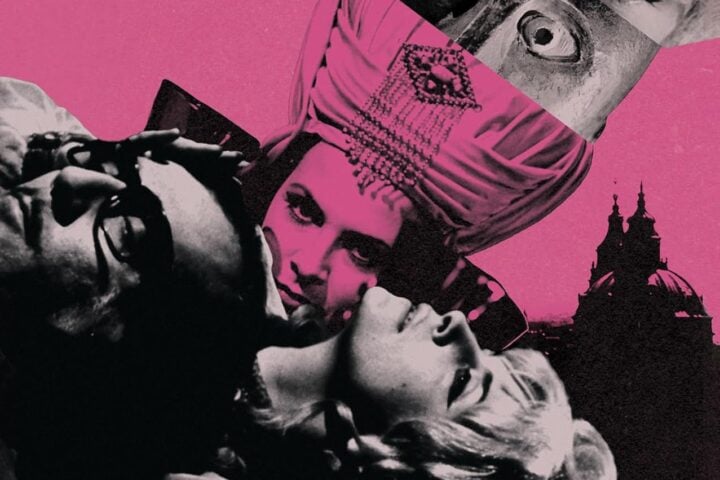
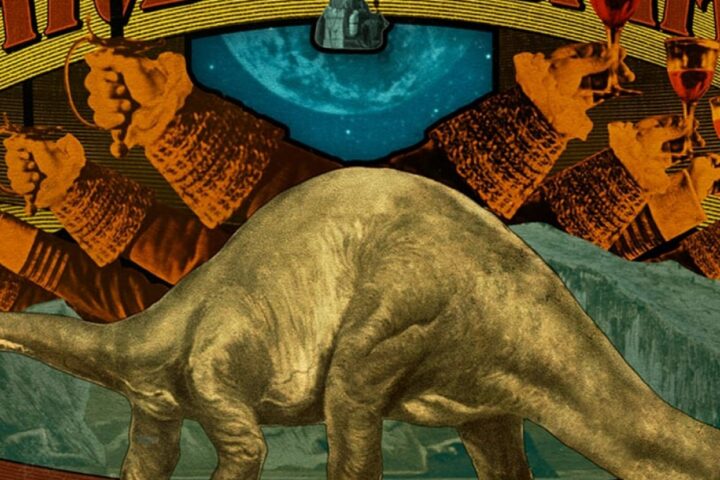
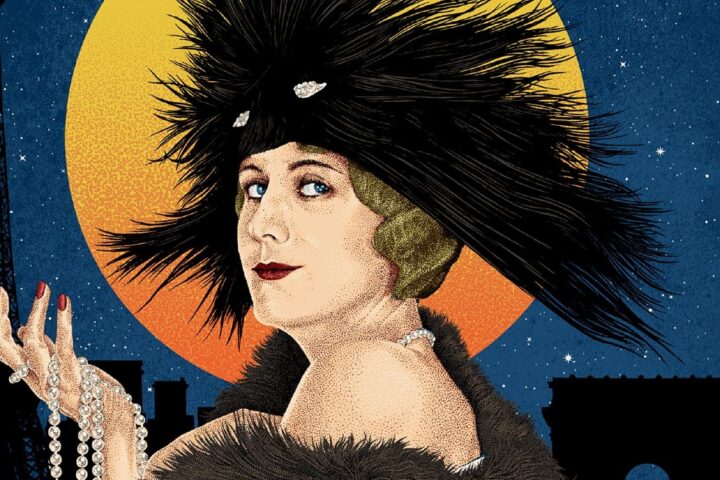
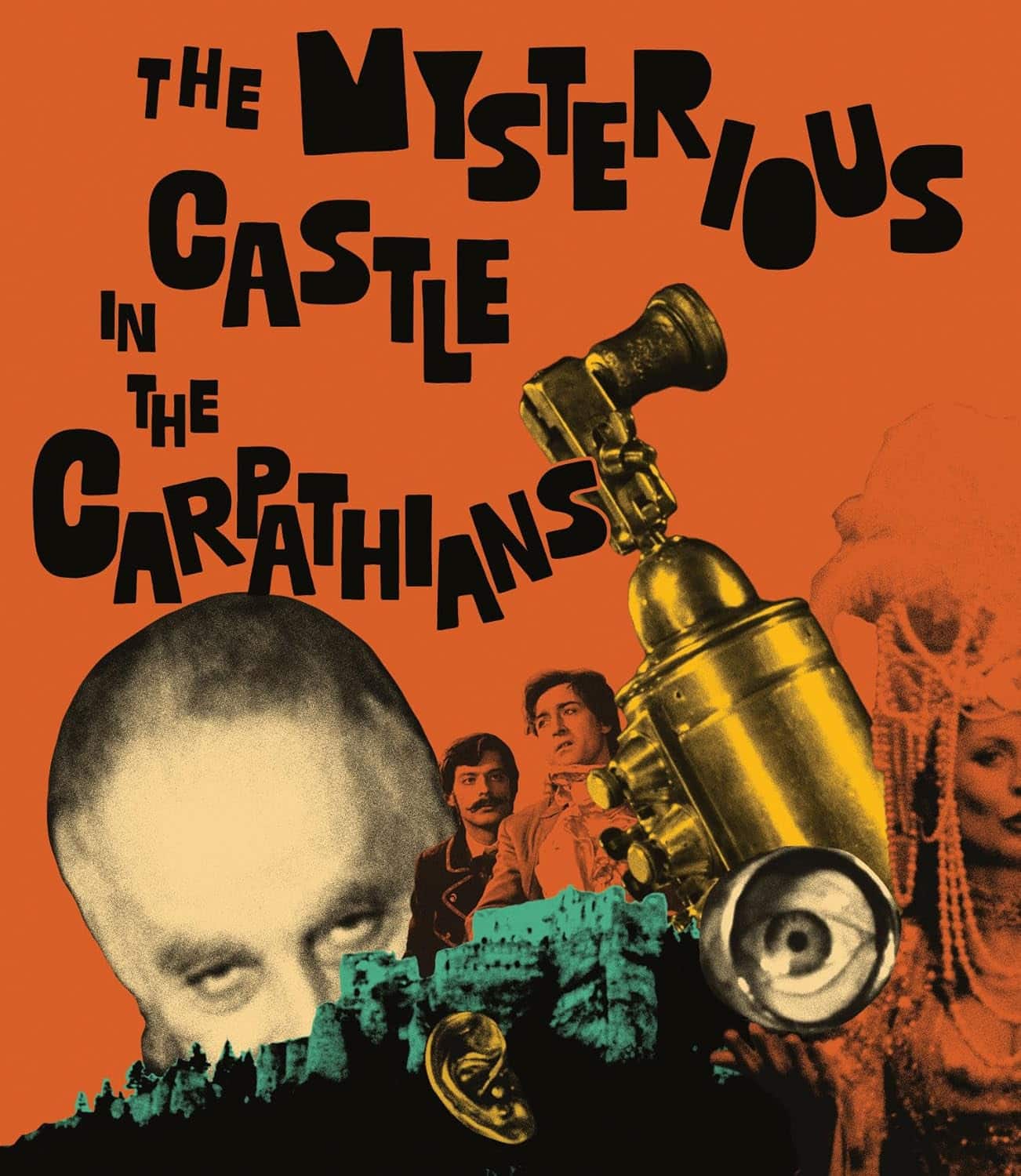
 Between 1964 and 1981, Oldřich Lipský and Jiří Brdečka collaborated on a loose trilogy of films, each of which paid loving, yet subversive, homage to a strain of pop culture that would’ve been seen as hopelessly disreputable by the Communist authorities in the former Czechoslovakia. Lemonade Joe is a tribute to the John Ford western, while Adela Has Not Had Supper Yet tinkers with the conventions of the private eye film. And Mysterious Castle in the Carpathians delivers a hilarious and surreal steampunk riff on a lesser known Jules Verne novel, in which the French writer filters the trappings of gothic fiction through his “scientific-technical” worldview.
The comedic sensibility behind Mysterious Castle bears comparison to a number of other films and filmmakers. Its sense of anarchy and unpredictability brings to mind the work of the Marx Brothers, while the delight that it takes in in absurdism and abstruse wordplay (only some of which makes it through in translation) is reminiscent of Monty Python. And the deployment of an episodic shaggy-dog plot prone to devolve into surreal set pieces definitely shows the influence of the late-period comedies of Luis Buñuel. For the sheer superfluity of its sight and sound gags, Mysterious Castle unquestionably rewards multiple viewings.
On the road to West Werewolfston, a Romanian hamlet situated high in the Carpathian mountains, itinerant opera singer Count Felix Teleke of Tölökö (Michal Dočolomanský) and his redoubtable manservant Ignác (Vlastimil Brodský) encounter a young forester, Vilja Dézi (Jan Hartl), buried up to his eyeballs in a pile of fallen leaves. The film’s first half then unfolds in the village, as the count makes the acquaintance of its population of oddballs and eccentrics who speak a strange patois that the subtitles render as a sort of pidgin Cockney.
Vija, it turns out, has had a strange experience at the nearby Devil Castle, a ruinous pile that’s supposedly occupied by vengeful ghosts. The film cleverly puts us in the know of events long before the characters, such as our knowing from the opening credits that the castle is occupied, and that it’s filled with amusingly anachronistic steampunk technology, such as closed-circuit TV and advanced listening devices. One of the best gags posits the invention of quadrophonic sound by surrounding the listener with four gramophones playing simultaneously.
When Count Felix and Vilja investigate the odd occurrences at the castle, they soon run afoul of its current tenants. The lord of the manor is Baron Robert de Gorc (Miloš Kopecký), a bearded baddie with an abiding love for gadgets, and an absolute fixation on a prima donna, the sardonically named Salsa Verde (Evelyna Steimarová), to whom the count was once engaged, and whom the baron has seemingly abducted against her will.

Devil Castle even has its own resident mad scientist, Professor Orfanik (Rudolf Hrušínský), inventor extraordinaire and designer of customized explosives. Mysterious Castle lavishes a lot of attention on his wonderful creations, which were provided for the film by the great Czech animator Jan Švankmajer, whose influence you can really feel in one gag where Orfanik’s prosthetic hand deploys a number of tools and utensils in rapid succession.
Beneath all the japery, there are some serious matters that are being sent up. Through the self-absorbed Count Felix, with his endless flow of highfalutin verbiage and blithe dismissal of the lower classes, not to mention his penchant for operatic screeches that can quite literally shatter glass, the film sends up high culture at its most pompous and insulated. Meanwhile, Baron Gorc and Professor Orfanik lampoon the crass materialism and blind faith in technological progress that characterize modernity. (In a no less pointed bit of characterization, Baron Gorc funds his technophilia by owning factories that mass-produce counterfeit checks.)
But the most bittersweet aspect of Mysterious Castle has to do with very medium of film itself, touching on what critic Walter Benjamin called “the work of art in the age of mechanical reproduction.” As it turns out, Salsa Verde passed away months before. All Baron Gorc has left to fuel his obsession with the singer is a reel or two of film footage and a high-fidelity recording of her final performance. The image of Salsa Verde that Vilja and Count Felix witness on several occasions is nothing more than a ghost in the machine.
Like any good satire, the film delivers on more levels than the one-to-one equivalency of simple analogy. It works as an open-ended metaphor for aspects of modern society, whether capitalist or communist, that seek to stifle human imagination and curtail personal freedom. All of this drollery is delivered with wit, panache, and more than a little visual flair.
Image/Sound
The HD transfer of Mysterious Castle of the Carpathians, sourced from original 35mm film and sound elements, looks spectacular. Colors are deep and rich, and they especially pop in some densely colored filter shots. Black levels appear agreeably uncrushed. Fine details of the sumptuous and elaborate set and costume design stand out in stark contrast. The Czech LPCM mono mix sounds excellent, nicely putting across the strains of La Traviata and other operatic works featured in the film, as well as Luboš Fišer’s rich orchestral score.
Extras
All of the bonus materials included on this release revolve around co-writer Jiří Brdečka, who was an accomplished film animator in his own right. The fascinating feature-length documentary Universum Brdečka provides a lovingly detailed and insightful deep dive into his life and career, with daughter Tereza Brdečková serving as our tour guide. On display throughout are a wealth of photographs, documents, and other memorabilia.
Brdečková also features in two other supplements. The first is an on-camera interview with Deaf Crocodile co-founder Dennis Bartok that touches on memories of her father and the artistic milieu he moved in, and the second is an engaging audio commentary conducted in tandem with Czech film expert Irena Kovarova that delves into the trilogy of films Brdečka collaborated on with director Oldřich Lipský, the style of comedy evinced in the films, and the contributions of cast and crew, especially the props designed by Jan Švankmajer. Also included on the disc are two animated short films from Brdečka: “Love and the Dirigible,” from 1948, and “Prince Copperslick” (a.k.a. “Prince Měděnec’s Thirteenth Chamber”), from 1980.
Overall
Surreal and slyly subversive, The Mysterious Castle in the Carpathians sets its satirical sights on some serious matters, and it’s now available for the first time to American audiences.
Since 2001, we've brought you uncompromising, candid takes on the world of film, music, television, video games, theater, and more. Independently owned and operated publications like Slant have been hit hard in recent years, but we’re committed to keeping our content free and accessible—meaning no paywalls or fees.
If you like what we do, please consider subscribing to our Patreon or making a donation.