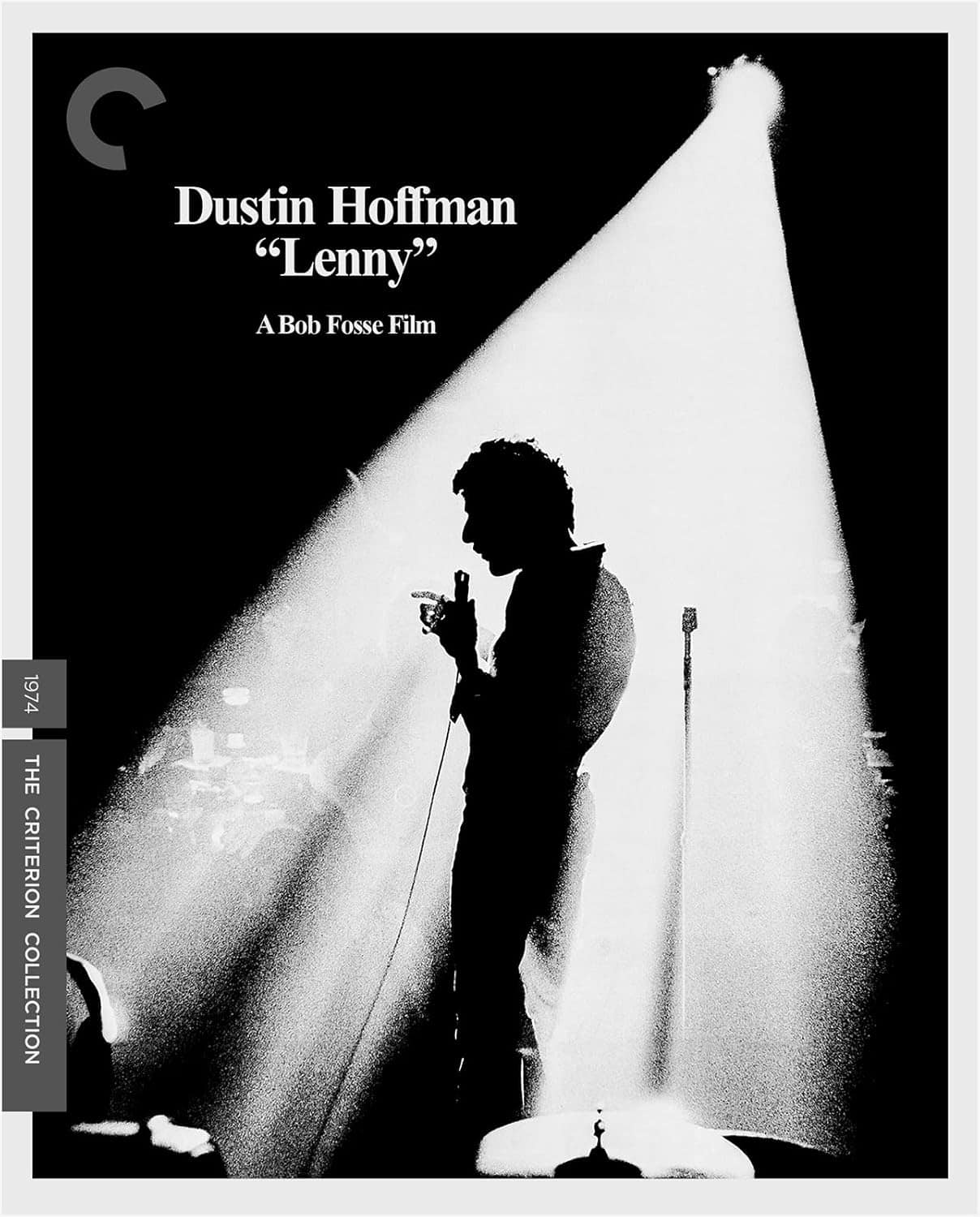
 Stark and increasingly tragic, Bob Fosse’s 1974 biopic Lenny traces the life and career of pioneering and controversial stand-up comedian Lenny Bruce (Dustin Hoffman) from the early 1950s to his death from an overdose in 1966 at the age of 40. The film owes a clear structural debt to Citizen Kane as it carries along its storyline through the testimonials of the three people who knew Bruce best: his wife, Honey (Valerie Perrine), mother, Sally Marr (Jan Miner), and agent, Artie Silver (Stanley Beck). The oral history aspect of the film is underscored from the very first shot, a slow fade-in on an extreme close-up on Honey’s mouth as she begins to tell her tale.
Periodic cuts to these testimonials provide Fosse with an audio cameo as the implacable voice of the interviewer, a role he would take up again in Star 80, the even more downbeat portrait of doomed actress Dorothy Stratten. Bruce Surtees’s high-contrast monochrome cinematography further adds a newsreel quality to the proceedings. At the same time, Fosse injects Felliniesque flourishes, especially in the frequent crowd reaction shots, where he invariably picks out a series of grotesques and other oddities, evidenced in one cutaway to a dwarf taking his seat next to a very large woman, an almost carnivalesque embellishment.
Lenny jumps around in time as often as it changes perspective. A late performance from a bearded, increasingly frazzled Bruce acts as a sort of frame, charting his evolution as a comedian from telling so-called “gags with whiskers” between striptease acts to success as a social satirist in trendy nightclubs and finally to regaling audiences with lengthy extracts from his mounting legal trials on obscenity charges. The film successfully mounts an argument for Bruce as a free-speech martyr, though it never lets him off the hook for his occasional sexual hypocrisies (which he himself often skewers in his act) and his self-destructive spiral into abject drug addiction.
Bruce’s descent into drug-addled incoherence comes to a head in a bravura set piece. In a seven-minute single take, shot from the nosebleeds of a swanky nightclub, Bruce takes the stage clearly loaded, wearing a trench coat and one sock, and proceeds to bomb in spectacular fashion, reduced in the end to hectoring his audience and admitting he isn’t particularly funny, before he stumbles off stage, where he’s promptly arrested while hurling into a toilet.
This existential nadir is followed immediately by a brief shot of Bruce’s dead body, an example of intellectual montage that relentlessly signifies that he has died both on stage and for real. It’s a particularly brutal instance of Alan Heim’s incisive cutting. The rapid-fire editing gives Fosse’s film a vigorous forward thrust, akin to the driving rhythm sections of the jazz combos that accompany Bruce’s act. The scene’s feeling of finality is increased by subsequent shots of the interviewer’s recording equipment being switched off. All that’s left is to recreate the notorious postmortem photo of Bruce dead on his bathroom floor.
Lenny marks Fosse’s emergence as an auteur director. It’s clear from the trajectory of the film that his interest in the material is strongest when it dwells on the seamier and more down-market elements, which echo his own troubling experiences early in his career. The experience of editing the film while also tirelessly working on the stage production of Chicago then feeds into the thinly disguised portrait of himself in All That Jazz. Lenny also exhibits the same unabashed interest in the seamy underbelly of showbiz success that feeds into the aforementioned Dorothy Stratten biopic Star 80. In the end, Lenny is almost as much about its maker as it is about the ostensible subject of its inquiry.
Image/Sound
The 20160p UHD presentation of Lenny, sourced from the original 35mm camera negative, admirably captures Bruce Surtees’s brooding monochrome cinematography. Blacks look deep and dark. Fine details of costume and set designs stand out quite legibly. Audio comes in an LPCM mono mix that cleanly and clearly delivers the dialogue and nicely conveys composer Ralph Burn’s cool jazz score as well as several classic Miles Davis needle drops.
Extras
A lively and informative commentary track from filmmaker Nick Redman and film historian Julie Kirgo has been ported over from the 2015 Twilight Time Blu-ray release. They relate a lot of well-researched and often fascinating insights into the lives and careers of both biopic subject Lenny Bruce and director Bob Fosse. In an interview filmed in 2023, editor Alan Heim talks about meeting Fosse for the TV special Liza with a Z, working on all of Bob Fosse’s subsequent films, his cameo in All That Jazz, and specific decisions that were made when putting together Lenny. In a very brief archival French TV show from 1974, a French-dubbed Dustin Hoffman and Valerie Perrine opine about their real-life counterparts and what went into preparing their roles. Lastly, the enclosed booklet contains a perspicacious essay by critic Mark Harris on Fosse’s take on the biopic and a 1975 interview with Bob Fosse.
Overall
Bob Fosse’s Lenny is gritty and downbeat, as well as riveting to behold in its high-contrast monochromatic glory, which is all the more evident in Criterion’s new UHD presentation.
Since 2001, we've brought you uncompromising, candid takes on the world of film, music, television, video games, theater, and more. Independently owned and operated publications like Slant have been hit hard in recent years, but we’re committed to keeping our content free and accessible—meaning no paywalls or fees.
If you like what we do, please consider subscribing to our Patreon or making a donation.