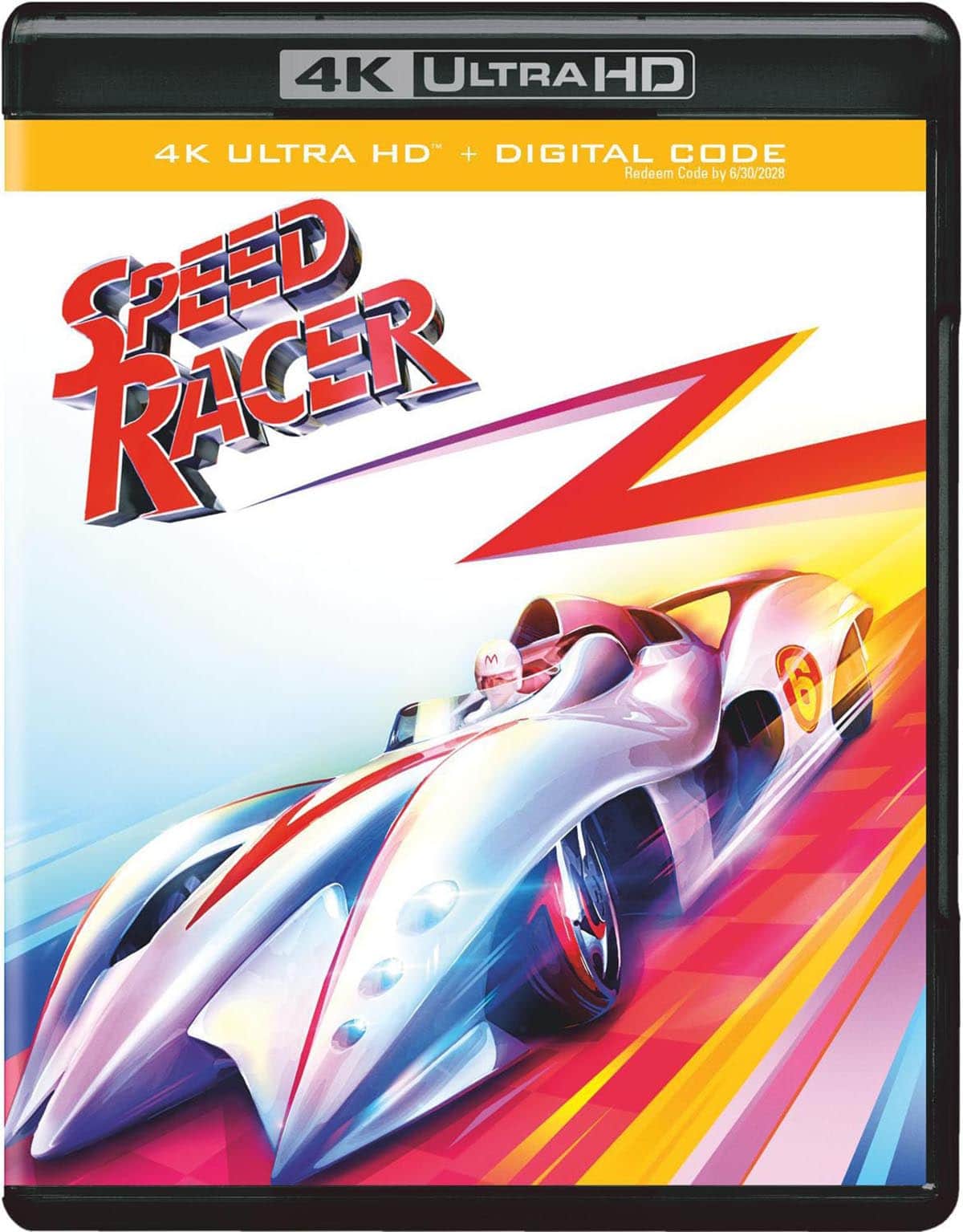
 Having openly paid tribute to Japanese manga and anime like Serial Experiments Lain and Ghost in the Shell with their Matrix trilogy, Lana and Lily Wachowski raised few eyebrows when they announced plans to make a live-action adaptation of Speed Racer, the first work of Japanese animation to make a splash in the West. The siblings’ love for the material is obvious from the start: The original cartoon, like many early anime programs, cut costs by reducing the number of cels to animate for a given shot, giving the show its trademark jittery motion and awkward lip-synching that the siblings playfully approximate in bursts of curt dialogue and racing animation that careens so fast that cars blur into streaks of light.
The film presents its hero, young hotshot racer Speed (Emile Hirsch), and his family and friends as the same two-dimensionally noble, determined figures they were in the show, with some added jokes underlining that a person like Speed would in real life have a case of ADHD that no prescription dosage could tame. At a time when movie adaptations of material originally meant for kids was self-consciously attempting to look more mature, Speed Racer revels in its childishness, including a running subplot of Speed’s kid brother, Spritle (Paulie Litt), and the boy’s pet chimpanzee amusing themselves with various sugar-high antics.
Nonetheless, the film does introduce an unexpected line of commentary in its view of professional sports and the private organizations that preside over international competitions. Speed dreams of joining a major-league race team and enjoying all the perks of sponsorships and deep-pocketed mechanical support, only to learn from a C.E.O. (Roger Allam) of one of the biggest teams that the entire sport is rigged as a means of manipulating stock markets. Disillusioned, and belatedly realizing that the seemingly accidental crash that killed his older brother, Rex, may have been murder, Speed resolves to win the season honestly, all the while working with investigators to expose the rot at the heart of the sport.
As well-suited as the Wachowskis were to the material, though, few could have anticipated, however, that the siblings would use the material to craft perhaps the most experimental blockbuster since 1940’s Fantasia, a work that not only pushed the envelope of filmmaking technology but dared to imagine how cinema itself could be fundamentally changed by these advances. Part of the early vanguard of films shot on high-definition video, Speed Racer was filmed on the recently debuted CineAlta F23, which the Wachowskis used not in an attempt to mimic the look of celluloid but to foreground the smooth image as if to remind the viewer that this is still a work of animation even if the actors are flesh and blood.
Even more radical than the visuals is the editing, which takes advantage of new possibilities of digital suites to break traditional film assembly. In celluloid cinema, every film, no matter how the shots are orders, is linear in a literal sense; strips of film proceed frame by frame through a projector. Speed Racer upends this, building on techniques heretofore confined almost exclusively to the avant-garde, such as Jean-Luc Godard’s video experiments and Michael Snow’s *Corpus Callosum. Here, shots rarely transition in the classic sense, instead layering new elements into the frame until one scene simply becomes another. Every image is in constant flux, prone to sudden intrusions of faces into the foreground in split-diopter shots or sudden, Fauvist explosions of color in the background that can be either a leap into a character’s headspace or an abrupt leap to another location.

The net result of this approach is to convey a sense of nonstop motion and simultaneity of action. Upon its original release, Speed Racer was largely dismissed by critics and the general public. Today, it’s easy to recognize it as the pinnacle of the blockbuster editing techniques that it anticipated, carefully composed even at its most cluttered and assembled in a way that has never quite been replicated since. Many movies made in its wake have appropriated some of the same techniques, but none have used them so freewheelingly to foreground pandemonium as an expression of its protagonist’s reflexes and sheer joy at doing what he loves.
Image/Sound
Warner’s 2008 2K Blu-ray faithfully replicated the film’s highly chromatic images. This new UHD, sourced from a Wachowski-approved 4K restoration, leaves that old presentation in the dust. Boosted with Dolby Vision, this transfer captures allows one to easily make out the subtle nuances in the streaks of green, purple, and yellow that racecars leave as they zoom at the speed of sound. Even in the most sedate moments, articles like the red of Pops Racer’s polo shirt has a new richness. The movie deliberately places up the smoothness of its animation and images, but textures are nonetheless more defined than on the previous Blu-ray.
Even more thrilling is the updated soundtrack. Warner’s original disc didn’t even offer a lossless audio option, instead presenting a Dolby Digital 5.1 track that ably distributed the overwhelming blend of music and sound effects across channels but still suffered from moments of compression, flattening the depth of some of the most manic scenes. This UHD comes with the original 5.1 track in lossless as well as an Atmos mix that verges on “warn the neighbors before playing” volume levels in its overwhelming, reference-quality presentation of roaring combustion engines, shrieking brakes, and metal-on-metal crunches during the many collisions.
Astoundingly, the mix is never merely loud, carefully separating each element so Michael Giacchino’s brassy score always stands out from the destruction derby mayhem. Dialogue is always clear, even when the movie is overlapping frantic screaming in a Babel of languages from racers and commentators from around the world.
Extras
Warner’s disc includes a number of brief archival featurettes, some of which weren’t on the original Blu-ray. These extras focus on such things as the film’s visual effects, and one video stages a mockumentary of the actors in character as the Racer family discussing their lives and work. The most engaging of the features is the sole new addition, a retrospective discussion by the Wachowskis, who offer some additional insights into their approach to the production and their thoughts on Speed Racer’s unexpected afterlife as a cult classic and a cause célèbre among some cinephiles (a few of whom panned the film on its initial release).
Overall
Lana and Lilly Wachowski’s cult blockbuster receives a reference-quality A/V transfer on Warner’s new 4K UHD Blu-ray release.
Since 2001, we've brought you uncompromising, candid takes on the world of film, music, television, video games, theater, and more. Independently owned and operated publications like Slant have been hit hard in recent years, but we’re committed to keeping our content free and accessible—meaning no paywalls or fees.
If you like what we do, please consider subscribing to our Patreon or making a donation.