
 How unhinged does a film have to be to get a director fired? Or, more to the point, how unhinged does it have to be to get a seasoned gonzo cyclone like Suzuki Seijun fired? After more than 10 years of cranking out perverse pulp bonanzas for Nikkatsu studio, Suzuki ran afoul of producers in 1967 with Branded to Kill, a cubist fusillade that swiftly got the filmmaker sacked on charges of “incoherence.”
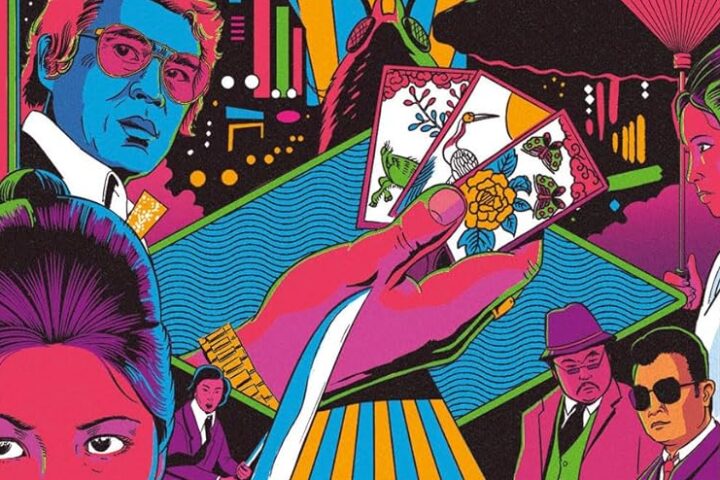
Of course, accusing the auteur behind Tattooed Life and Fighting Elegy of being incoherent is akin to accusing the Pacific Ocean of being wet, and yet it’s easy to see what about the film’s jumbled spirit so infuriated the studio heads: While most of his earlier underworld sagas subversively stretched the skin of boilerplate yakuza thrillers this way and that while still functioning as commercial genre offerings, Branded to Kill is confrontational in its disdain for stylistic conventions and box-office expectations of producer and viewer alike. What Nikkatsu wanted was a follow-up to the brassy pop-art hit Tokyo Drifter, and what Suzuki delivered was a stark, spastically existential—and, most affronting of all, defiantly unmarketable—crime-flick abstraction that unfolds like the director’s cracked self-portrait.
To recount the extended non sequitur of a plot is to feel one’s skull gradually splitting open. Hanada Goro (Shishido Jō, Suzuki’s go-to choice for bulbous parodies of leading men) is a professional assassin “ranked number three among killers,” a pair of shades frequently pinned to his rubbery visage and his libido perpetually inflamed by the scent of boiled rice. His air of Melvillian cool quickly gives way to paranoid frenzy after a hit job brings him in contact with Nakajo Misako (Mari Annu), a sleek, spectral beauty who materializes in the midst of a downpour with the words “I hate men. My dream is to die.”
Long before Mari’s femme fatale snags Hanada with the assignment that will turn him into a target for his own deadly organization, though, our hero’s macho control has already been undercut by the film’s very form, which Suzuki keeps in continuous upheaval via de-centered compositions, mile-wide jump cuts, and the sort of deranged spatial manipulation that makes the backseat of a car fluctuate in size from shot to shot. By the time the protagonist finds himself in a vacant boxing ring for a hysterical showdown with the Number One Killer (Nanbara Kōji), Japan has morphed into a vaguely extraterrestrial topography of cavernous rooms and hyper-modern furniture that barely follows the rules of time and space or cause and effect.
An extraordinary sensory experience, Branded to Kill is also Suzuki’s corkscrew vision of himself as a manic maverick ambushed by a ruthless, suffocating system. The despair concealed under the director’s surreal cartooning was never more evident: People have their identities reduced to ranking numbers, relationships are based on capricious, bestial appetites, and not even ordinary surfaces can be trusted (a sink becomes a lethal instrument as a bullet rushes up its drain pipe). His is a world of promiscuous symbols and nebulous yet rigid hierarchies, where the ability to piss in your pants mid-confrontation is hilariously offered as the ultimate proof of professionalism and the obsession with fighting for success—with literally being “Number One”—is run to absurd extremes until the characters have just about ground their fists into dust.
With Hanada’s lowly status as a killer-for-hire mirroring Suzuki’s cynicism toward the B-level projects handed him by Nikkatsu, it’s no wonder that the director can’t help but admire the puffy hitman’s dogged struggle for survival and illumination in this short-circuiting arena. Both a work of remarkable freedom and a coruscating dead end, Branded to Kill proved to be a Pyrrhic victory for Suzuki, who was left unemployable for years—even if he did have the last word with Pistol Opera, his even more bewildering 2001 quasi-remake.
Image/Sound
Pyrrhic is certainly not a word that can be used to describe the victory that is the image on this 4K UHD Blu-ray of Branded to Kill, which has been sourced from a 4K scan of the original camera negative. What immediately grabs you is the ferocious tactility of the image. Beyond the even and stable grain distribution, contrast and definition across all spectrums of the image is spectacular. There isn’t a single imperfection in sight. The Japanese LPCM 1.0 audio track, a carryover form the film’s prior Blu-ray release, is every bit as sharp of the image, explosive when it counts and nuanced in ways that draw you into the film when the bullets aren’t flying.
Extras
All the extras here have been ported over from the Criterion Collection’s prior edition. Suzuki Seijun turns up in a pair of interviews, discussing his love of dismantling cinematic grammar during a 1997 trip to a Los Angeles retrospective and recalling Branded to Kill’s origins, reception, and aftermath (including his lawsuit against Nikkatsu and ensuing years directing TV commercials) in a more recent chat. Suzuki’s eccentric methods are also described by assistant director Kuzuu Masami, who remembers how the original screenplay mutated wildly over the course of many drinking sessions (one glimpse of a script page amusingly reveals a veritable welter of scribbles, stains, and penciled-in notes). Funniest of all is an interview with star and weathered prankster Shishido Jō, whose impish remarks about aphrodisiac rice and phallic pistols often have the interviewer audibly cracking up from behind the camera. The theatrical trailer and a reverent booklet essay by Tony Rayns round out the extras.
Overall
Spectacularly born anew on 4K, Suzuki Seijun’s stark, spastically existential crime-flick abstraction unfurls like the director’s cracked self-portrait.
Since 2001, we've brought you uncompromising, candid takes on the world of film, music, television, video games, theater, and more. Independently owned and operated publications like Slant have been hit hard in recent years, but we’re committed to keeping our content free and accessible—meaning no paywalls or fees.
If you like what we do, please consider subscribing to our Patreon or making a donation.




I always wondered how he ended up writing a Lupin the 3rd anime.