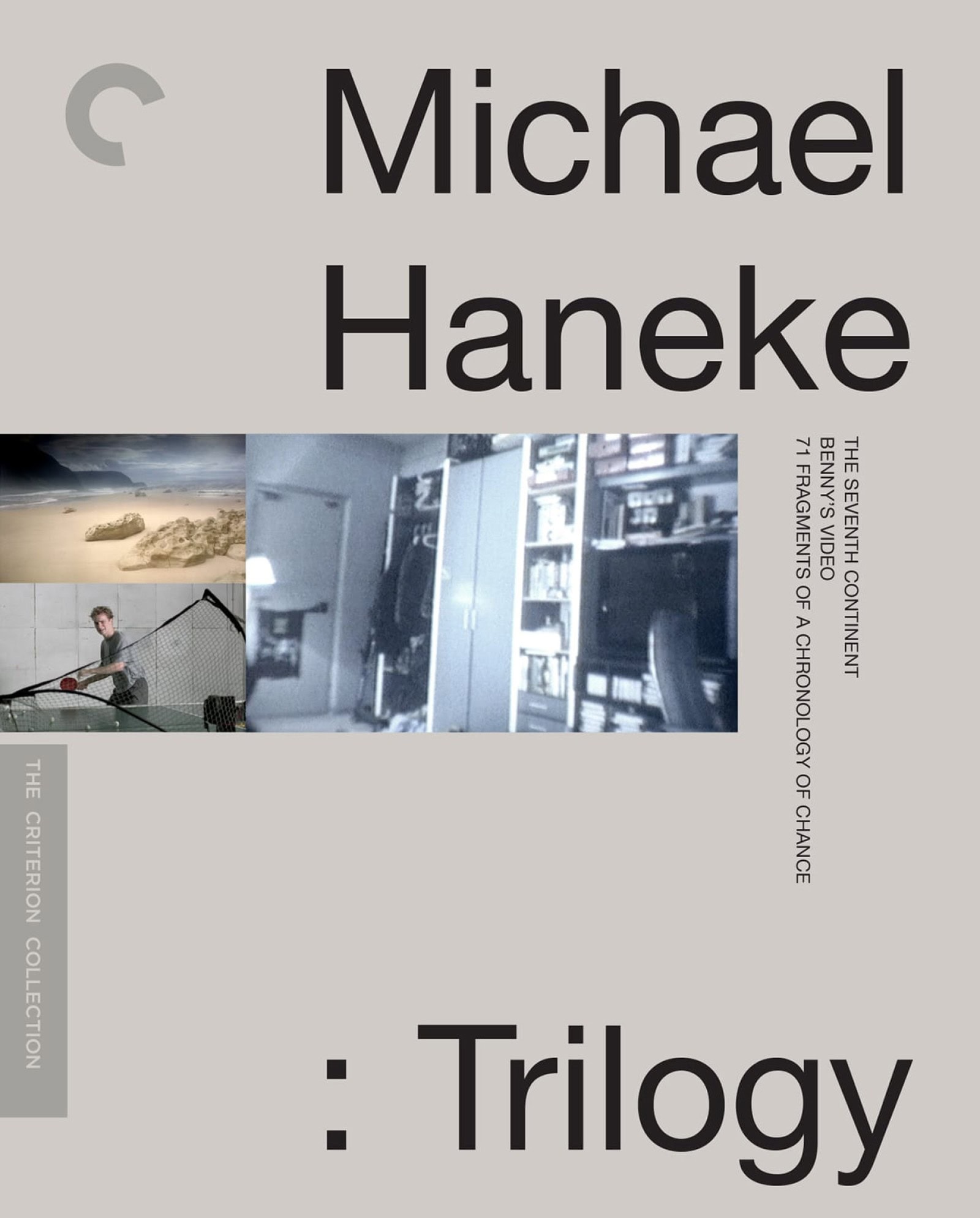
 Michael Haneke could be cinema’s Debbie Downer, if only he had any sense of humor. All the icy gloom of Code Unknown, The Piano Teacher, and Caché can be traced back to 1989’s The Seventh Continent, which may be the Austrian director’s debut film but already contains his themes and styles in place, as if emerging fully grown out of the skull of Zeus-on-depressants. Inspired by real-life events illustrating Haneke’s view of “the emotional glacification of Austria,” the film follows three years in the lives of the Schobers, a purposely unremarkable middle-class bourgeois family, financially secure yet all but imploding from unspoken alienation.
Considering that The Seventh Continent is a thesis work, the unsmiling hypothesis is stated right off the bat, with husband Georg (Dieter Berner), wife Anna (Birgit Doll), and daughter Eva (Leni Tanzer) sitting inside their auto for a carwash, the event played in real time for maximum deadening effect. The point is clear: People are gliding through life in sealed glass boxes, unable to really connect to anything besides their possessions. Accordingly, Haneke choreographs the introductory session as a dance of domestic fragmentation, disembodied hands and feet in close-up reaching for toothbrushes, shoes, cereal bowls, and assorted appliances. When a shopping cart or cash register fills the frame this ominously, you know it’s merely a matter of time for the other shoe to drop and for the audience’s abuse to commence.
If the first two thirds of the picture are dedicated to making the mundane sinister, the final third reverses the strategies to make the sinister mundane. Finally unable to cope with so much muted angst (and angst it is, for Haneke makes it feel like the family is carrying the burden of the modern world upon its shoulders), the Schobers calmly decide to kill themselves, though not before systematically demolishing all their possessions—“a statement of fact,” according to their suicide note. The session, grueling yet rigorously controlled, allows for a pungent indictment of materialistic incarceration (a literal money shot—bills ripped and flushed down the toilet—is particularly fierce), yet the fact that the characters are denied liberation or even morbid catharsis in their own communal end attests less to Haneke’s artistic integrity than to his peevish indifference to their lives as anything other than point-underlining puppets.
A sense of reality has been ruinously deformed, and to Haneke television is the main culprit; at one point, the husband wonders out loud what we would look like with monitors for heads, but Bertrand Tavernier already wondered the same thing in his 1980 sci-fi drama Deathwatch, and was smart enough to use it as a springboard for satire. How one wishes for some of Ingmar Bergman’s sardonic appreciation for absurdity to explore the satirical possibilities of a clan slowly expiring in a decimated home while Jennifer Rush emanates from the telly. By concentrating exclusively on humanity’s negativism, Haneke proves to be as damagingly reductive of life’s possibilities as the emotional malaise he sets out to expose.
From 1982, Benny’s Video is a smug, contemptuous, passive-aggressive attack on the dehumanizing effects of media, without even the common decency to offer shrill sensationalism to punch up its subsequently feckless, reactionary, pomo assertions. Benny is a young, slate-faced neo-Nazi-to-be who checks out at least one violent video from the local video store every day. The desk in his room—in his parents’ swank high-rise condo—is so completely covered with a makeshift video-editing bay that he does his homework lying in bed while blankly watching Hollywood carnage. His favorite video, though, is a nasty piece of piggy snuff that he shot himself while on holiday with his parents at their country ranch: a jumpy one-shot affair capturing the slaughter of a pig with a captive bolt pistol.
Maybe it’s the cold-blooded efficiency of the slaughter that appeals to Benny and causes him to hypnotically rewind the footage over and over again, and maybe it’s the blunt force of the murder instrument that gives him a case of sticky fingers, but eventually the time comes for him to film a sequel. Having no pigs available back in the city, he invites a girl (Ingrid Stassner), pudgy and pink for a reason, who he often sees at the video store up to his room, trains the camera on a master shot, and shows her the losing end of the tube-shaped gun’s barrel.
Haneke shoots the scene as he would most of Caché and The Time of the Wolf, both infinitely more intriguing films that tiptoe tipsily along the eschatological line between nihilism and a liberating sort of insane hope. Haneke’s early works, climaxing with the reprehensible—albeit cathartic—Funny Games, deploy both amusement and abuse in one-two fashion, usually at the precise moment where a little bit of the opposite effect would’ve gone a long way.
What are we supposed to do with a polemical screed against the numbing effects of violence-saturated media that insistently keeps its captive audience as numb as its characters? Are we expected to learn from Benny’s example? Probably not. More than likely we’re expected to empathize with Benny’s shell-shocked parents as they attempt to clean up their pathological son’s mess. Which, in the film’s final scenes, ultimately reveals Haneke’s undiluted bad faith in anyone stupid enough to take Benny’s Video seriously in the first place.
Haneke’s death-of-the-soul-of-Europe project soldiers on with 1994’s 71 Fragments of a Chronology of Chance, the final entry in his so-called “trilogy of emotional glacification.” After x-raying the intestines of the family unit in The Seventh Continent and Benny’s Video, the filmmaker was ready to go global—that is, by bringing various other sides of the planet to the miserabilist equation via the trope of the video image that defaces reality.
Though Bosnia, Somalia, and Ireland are some of the countries whose upheavals are glimpsed through the filter of TV news, Haneke grounds the action in Vienna, where, we’re told at the start, an athletic young jock (Lukas Miko) will shoot bystanders in a bank before turning the gun on himself. Lest anybody think Haneke is going only for Why Does Herr Ping-Pong Man Run Amok?, the narrative soon expands to include such strands as a homeless Romanian boy (Gabriel Cosmin Urdes) eating out of garbage cans, a couple (Anne Bennent and Udo Samel) that tries to adopt a young girl (Corina Eder) and later take in the homeless boy, and an old man (Otto Grünmandl) all but abandoned by his daughter (Patricia Hirschbichler) to the chatter of television—a mosaic (or origami puzzle, if you prefer) of modern urban alienation, denied community even in its suffering by Haneke’s isolating framing and blackout edits.
Just as Benny’s Video lays the ground for Caché, 71 Fragments of a Chronology of Chance anticipates Code Unknown in its interlocking character snippets, and, while both films’ formats owe much to Short Cuts, Haneke’s wintry vision lacks Robert Altman’s sense of life overflowing beyond the frame. The immaculate technique could rival Robert Bresson’s circa L’Argent, yet Haneke’s churlish grip over the characters’ already wretched lives is nothing short of inhuman, to say nothing of reductive; the tragedy of life, if life could be so labeled, lies in the many contradictory impulses (warmth and cruelty, humor and pain, beauty and horror) that give it a fullness that eludes the filmmaker’s relentless misanthropy. Haneke’s alarm at the injustices of the world is matched only by his own emotional sadism, as he’s already killed his characters long before he’s sent them to their senseless rendezvous.
Image/Sound
Criterion has transferred all three films from new HD digital masters, with Benny’s Video and 71 Fragments of a Chronology of Chance displaying noticeably more clarity and detail than The Seventh Continent. The blacks in the latter are slightly crushed and the image is a tad less sharp, though it’s still a huge upgrade from earlier DVD releases and its limitations are mostly apparent only in the darker, interior scenes. The color balancing stays true to Michael Haneke’s intentions, leaning toward cool and muted, while skin tones are uniformly naturalistic. On the audio front, the uncompressed mono soundtracks are surprisingly robust in handling the occasional bursts of Bach and the filmmakers heightened attention to off-screen sound.
Extras
For a three-disc set, this release is a bit lacking in extras, but the 10-minute documentary Michael H – Profession: Director from 2013 does provide a nice overview of Haneke’s early and mid-career work, with behind-the-scenes footage from several films. Many of the actors who’ve collaborated with the filmmaker over the years are interviewed, including Juliette Binoche and Isabelle Huppert, the latter of whom says that she always finds dark humor and wit in his work. Haneke shows up on each disc in clips from a 2005 interview with Serge Toubiana, in which he discusses the importance of pacing in his work, his relationship to the audience, and his desire to make films about “communication that doesn’t communicate.”
Elsewhere, we also get clips from the 2018 interview session with Arno Frisch that was included on Criterion’s Funny Games release, only here the actor is seen talking about his work on Benny’s Video, with particular focus on the casting and rehearsal process. Film Historian Alexander Horwath is also interviewed, and his discussion of Haneke’s early television work sheds some new light on the filmmaker’s approach to the medium. Finally, the package includes a bound booklet with an essay by novelist John Wray, who tackles the controversy surrounding Haneke’s first three films before teasing out their thematic similarities.
Overall
Criterion’s set isn’t bursting at the seams with extras, but the minimalist package is a tell that the distributor likely believes that these ascetic, divisive films speak for themselves.
Since 2001, we've brought you uncompromising, candid takes on the world of film, music, television, video games, theater, and more. Independently owned and operated publications like Slant have been hit hard in recent years, but we’re committed to keeping our content free and accessible—meaning no paywalls or fees.
If you like what we do, please consider subscribing to our Patreon or making a donation.