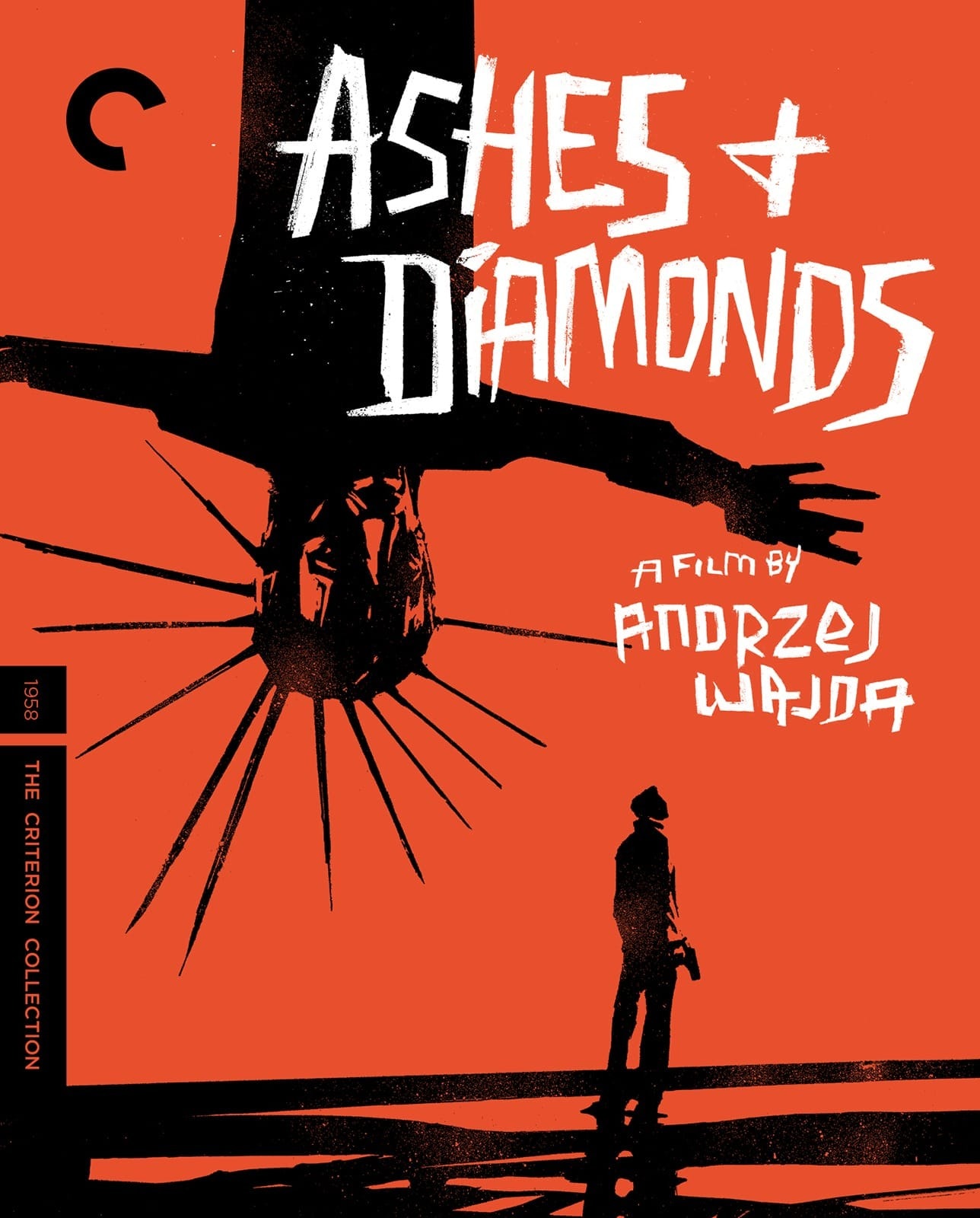
 “If we could only celebrate a Warsaw not in ruins,” says a hotel porter to Maciek (Zbigniew Cybulski) near the end of Andrzej Wajda’s Ashes and Diamonds. It’s a lament that defines the entire film and its bleak outlook on the legacy of World War II on Poland. The film takes place on May 8, 1945, the day of Germany’s formal surrender and the end of the war in the European theater, yet there’s no peace to be found here.
Ashes and Diamonds opens with Maciek, an anti-communist former Home Army officer tasked with assassinating Szczuka (Wacław Zastrzeżyński), a member of the Polish Workers’ Party. But when Maciek and two fellow soldiers, Andrzej (Adam Pawlikowski) and Drewnowski (Bogumił Kobiela), spring their trap, they accidentally kill two innocents. Their screw-up is the first of a series of bleak events that allegorize Poland’s harsh suffering during the war and its uncertain future.
The Poland seen in the film is a shadow of its former self, with buildings in such tatters that even a light rainstorm leaves interior spaces deluged with water. These settings are a startling contrast to the Hotel Monopol, where Szczuka is hosting a hollow celebration of the war’s end and death toll. The lavishly decorated rooms and conference halls of this building clearly didn’t lose their glamor during wartime, reflective of the manner in which even Poland’s encroaching communist rule will leave a chasm between the haves and have-nots.
Yet the most jarring contrast to war-torn Poland is Maciek himself. With his hair gelled into a rakish coif and sunglasses that he won’t even remove while taking off a pullover, he cuts a bizarrely cool image amid the film’s war-torn settings, suggesting what might happen if you inserted James Dean into a neorealist film. Which isn’t to say that he’s a rebel without a cause.
Maciek is just a pawn, wielded by reactionary former officers seeking to cling to their power. And if Maciek embodies some of Dean’s bad-boy good looks, he also channels some of the actor’s sensitivity. Ashes and Diamonds is consistently attuned to the would-be hitman’s malaise over his assignment, and he finds much more fulfillment aimlessly wandering around with a barmaid, Krystyna (Ewa Krzyżewska), than he does feigning nationalism passion and outrage to his superiors, as he knows that he’s been handed a suicide mission.
Maciek may feel outside of the world, but Wajda and co-screenwriter Jerzy Andrzejewski situate him socially and politically across scenes that vividly capture Poland’s ruin and uncertain tomorrow. When Maciek and Andrezj gun down the workers at the start, one man’s clothing bursts into flames as he’s gunned down, causing him to fall through a church door and reveal a statue of the Virgin Mary within. Throughout the film, shots of churches and religious iconography in various states of disrepair are consistently utilized as metaphors for Poland’s shattered postwar state and the secularism of the incoming communist bureaucracy.
The hypocritical nature of that new government is hinted at by cynical imagery, such as the glitz of the Hotel Monopol, which is shot in low angles that emphasize the power imbalance of a scarcely egalitarian socialist society. Maciek infiltrates this space with ease, but he never looks like he belongs there. In fact, it’s only when Ashes and Diamonds comes to its haunting close, after Maciek meets his foretold end and is left bleeding out in a garbage dump, does he finally feel like a part and not apart from the changing world around him.
Image/Sound
Criterion’s disc is sourced from a 4K restoration that magnifies the visual splendor of Jerzy Wójcik’s cinematography. Exterior scenes boast a sharp uptick in clarity from the previous DVD edition, beautifully capturing the refractions of light off of stagnant water and the pockmarks of bullet holes on building facades. The scenes in the hotel are especially improved, showing greater depths of detail in the glint of silverware and glass chandeliers, along with deeper black levels in prevalent use of shadows. The mono soundtrack is free of any noticeable hissing or pops, and both dialogue and music are rendered clearly in the mix.
Extras
Almost all of the extras on Criterion’s 2004 DVD release, with the exception of a gallery of production stills, have been ported over to this Blu-ray. In her audio commentary, historian Annette Insdorf details the film’s importance as a touchstone of Polish cinema, and she contributes a new video essay that further details its impact and influence. There’s also a 2005 Polish TV documentary on Andrzej Wajda and the film, as well as a newsreel feature on the film’s production while it was being made. An accompanying booklet contains an essay by scholar Paul Coates, who breaks down the film’s intricate symbolism and formalism and devotes particular attention to the complexities of Zbigniew Cybulski’s performance.
Overall
The Criterion Collection gives Ashes and Diamonds, a critical work of Eastern European cinema, a substantial upgrade that leaves the studio’s old DVD in the dust.
Since 2001, we've brought you uncompromising, candid takes on the world of film, music, television, video games, theater, and more. Independently owned and operated publications like Slant have been hit hard in recent years, but we’re committed to keeping our content free and accessible—meaning no paywalls or fees.
If you like what we do, please consider subscribing to our Patreon or making a donation.