In the 1930s, the Polish port city of Gdynia became a brief landing pad for immigrants from neighboring countries, including Jews who sought safety and prosperity before the rise of Nazi Germany. Though the Museum of Gdynia quietly explains this messy history, obvious markers of that past aren’t visible across the city. Its marina boasts a massive monument to 18th-century Polish military hero Tadeusz Kościuszko, whose actions became the stuff of legend both for the Poles and the Americans, but otherwise Gdynia stands anew, with sparkling metallic structures surrounding its stretch of the Puck Bay and the Polanka Redłowska forest.
By contrast, in the nearby town of Gdańsk, with its brightly colored and narrow buildings that hug a labyrinthine waterway, the markers of history are more immediately apparent to the naked eye. Much of the buildings have been reconstructed such that nearly every street teems with homages to the past. The Solidarity Movement was born here, in the shipyards, and in the factories, where the unassuming electrician Lech Wałęsa became something of an accidental, anti-communist revolutionary in the 1970s on his way to the presidency. Today, the massive Solidarity Center attracts tourists and scholars from all over Europe.
Many of these ghosts and whispers of the past were on display at the 48th edition of the Polish Film Festival (known as the Festiwal Polskich Filmów Fabularnych in Polish), where many of the films in and out of competition were period films wrestling with how political and social lessons of old might influence Polish identity today, which seems caught between several worlds. A few films, produced as they are by state media corporation Telewizja Polska (TVP), are clearly nationalistic propaganda, a difficult-to-ignore piece of the festival’s puzzle as the country hurtles toward a national election that threatens to put a far-right government into power.
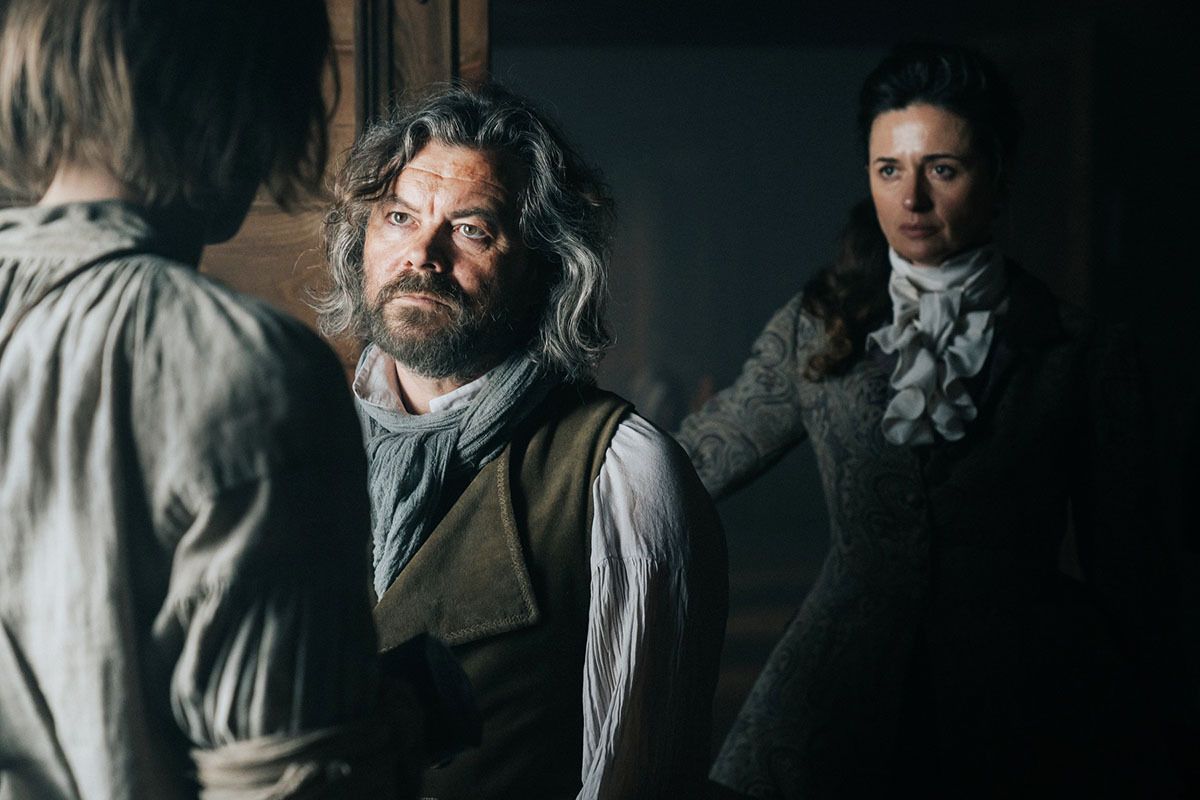
Despite the backing of TVP, though, the Golden Lion-winning Kos stood out in all its fiery, independent glory. In Paweł Maślona’s bloody, paranoiac biopic about Kościusko (Jacek Braciak), the grizzled veteran has returned to Poland from America with his friend, a former slave named Domingo (Jason Mitchell, who supplies the film with its sole spark of humor). With the intention of uniting the Polish nobility with the lower classes in a Frankenstein’s army of the oppressed, Kościusko, or Kos, works to evade Dunin (Robert Więckiewicz), a ruthless Russian cavalry leader who’s determined to stop the hugely popular leader from inciting a rebellion.
Kos (or Scarborn, as it’s been clunkily titled in English), is filled with historical anachronisms. If its cheeky treatment of very real figures recalls Quentin Tarantino’s Django Unchained and Inglourious Basterds, its minimalist scoring and convergence of characters in a gory climax channels the sleek tension of a John Carpenter horror movie. As he ascended the stage at the festival’s closing ceremony, Maślona urged the audience to see his film as an allegory about the proletarian fight against fascism and a call to arms heading into the coming elections.
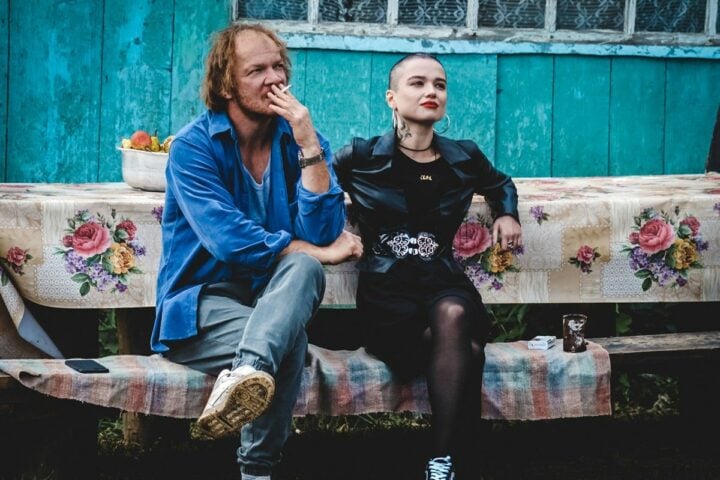
While Kos digs into the historical archives to remind the Polish public of their revolutionary roots, Next to Nothing focused on the present. Writer-director Grzegorz Dęmbrowski feature debut dramatizes how certain pockets of political power are sometimes fortified by the bodies of those that the government deems expendable. Wałęsa’s spirit could clearly be spotted in the character of Jarek (Artur Paczesny, winner of the festival’s best actor prize), a farmer who’s thrust into the role of community leader when the local MP (Artur Steranko) votes against the wishes of Jarek and his fellow farmers. Appalled by the contradictory and nakedly opportunistic actions of his representative, Jarek organizes an impromptu protest with his fellow farmers at the MP’s house, dumping an enormous pile of manure on his carefully manicured lawn.
The following morning, Jarek is called in for questioning when the rotting corpse of his best friend is found in the very same manure, which sparks an investigation into who—or what—caused the man’s death. When the answers start to trickle forth, the revelations are almost too much to bear. Next to Nothing is a taut, 90-minute political thriller, and at its best commits to a righteous indignation, suggesting the seeming powerlessness of the Polish general electorate. The film’s nihilism is relentless, impressively communicated through Jarek’s increasingly frustrated attempts at holding the local government accountable.
Perhaps the festival’s most anticipated premiere was The Peasants, DK and Hugh Welchman’s follow-up to 2017’s Loving Vincent, their animated biographical drama about Vincent Van Gogh. Based on the novel of the same name by Władysław Stanisław Reymont, The Peasants uses the same hand-painted technique as Loving Vincent, and the most impressive thing about it is all the work that went into painting its 40,000 frames. It all feels like being enveloped inside of a Van Gogh-inspired canvas, but despite the extraordinary effort that went into its making, the film is remarkably flat. Something of an improvement on Loving Vincent’s myopic understanding of what made the Dutch master so special, The Peasants still disappoints.
The film won the festival’s audience award, suggesting that its swirling and textured movement of blades of grass and folds of clothing captured in a dizzying array of oil colors was seductive to voters. But the script is too deferential toward Reymont’s popular novel. Following as it does Jagna (Kamila Urzędowska), an unwed country girl who’s violently passed between several men in the 19th-century countryside, The Peasants tries to present a verdict on the blinding misogyny and sexism of the time, yet only coldly comes across as an attempt at repurposing the unique brushstrokes of post-impressionists like Van Gogh. Jagna could potentially be seen as a stand-in for the struggle for women’s rights and independence, but the Welchmans are more content to dramatize Jagna’s repeated rapes than whatever it is that drives her ambition.
If The Peasants fails to say much about female empowerment, Olga Chajdas’s spectacular sophomore film, Imago, is at least here to carry the torch. A delirious portrait of an eccentric artist living in 1980s Poland, Imago is most exciting as a daring break from formal conventions. Lena Góra won best actress at the festival for her role as Ela, a character based on the actress’s own mother, and her forceful yet free-spirited performance communicates with clear-eyed catharsis the frustration and anger of a Polish society wrestling with both the effects of communism and the growing pains of a country on the brink of full-blown independence.
Ela is an artist exploding with a wide range of talent, but seems incapable, or else uninterested, in committing to any one outlet for her indignation. She more or less stumbles her way into the lyricist and frontman position for a rock band that dabbles in performance art histrionics, but her on-stage persona is only the latest evolution of a woman who we first meet plying her trade as a visual artist with her Basquiat-like images. Aided by an excitingly vibes-heavy soundtrack crafted by Andrzej Smolik, an artist whose influences seem to run the electronica gamut from New Order to Radiohead, Chajdas’s film is less interested in traditional narrative, relying instead on emotionally varied scenelets and formal technique to craft a singular portrait of a woman whose angst effectively stands in for a country teetering on a new age.

It’s a period of Poland’s history that was extremely well-represented at the festival. A throwback to films like The Ipcress File and The Human Factor, Jan Holoubeck’s Doppelgänger follows two brothers separated at birth and fighting on opposite sides of the Iron Curtain. Holoubeck has an admirable feel for the time period, but the film drowns in exposition, caught between trying to tell two disparate stories which, though interesting in their own right, never gel.
Elsewhere, Robert Gliński’s Strawman takes a look at one of the stranger moments in the life of Karol Wojtyla (Maciej Mikołajczyk), before he became Pope John Paul II, namely when he was spied on by Bronek Budney (Mateusz Więcławek), a lackey of the communist regime. The film shares much in common with The Lives of Others, but it has trouble communicating a similar level of emotional danger. Still, both Dopplegänger and Strawman effectively gets at how Poland is torn in two, still reeling from decades of subservience to systems of power both domestically and abroad yet desperate to carve a new identity for itself in a modern age.
Perhaps those ghosts of the past were best identified in a handful of restorations and repertory screenings. Recipient of the Platinum Lion for lifetime achievement, production designer Allan Starski (Schindler’s List, The Pianist, Danton, and many more) presented Andrzej Wajda’s The Maids of Wilko. The 1979 film, an adaptation of a popular short story by poet Jarosław Iwaszkiewicz, elegantly portrays the coming home of a prodigal son, Wiktor (Daniel Olbrychski), who cannot live up to the expectations of his lothario-like and youthful persona. His ghostlike return to his family property, Wilko, and the titular maidens who loved him at one point is elegantly contrasted with the film’s supremely bucolic photography.
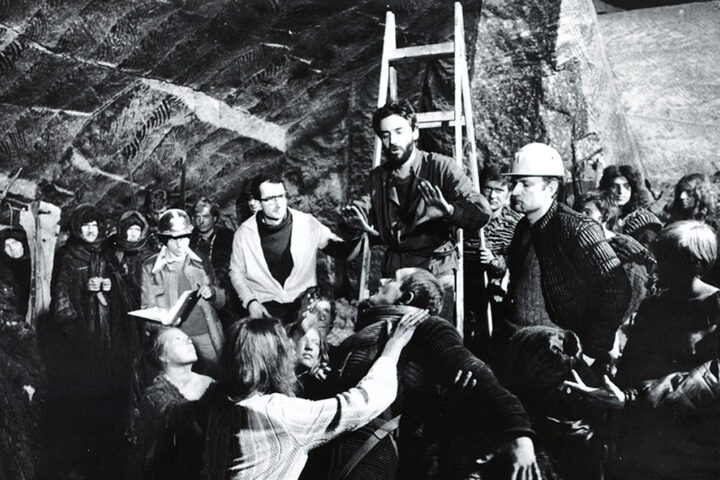
But the most ghost-like presence of the festival was felt in 1972’s rarely screened How Far, How Near, a metaphysical and meta-theatrical wonder that defies categorization. Director Tadeusz Konwicki was more prominently a novelist, and his film recalls Federico Fellini’s La Dolce Vita as much as the literature of Italo Calvino. Ostensibly a film about Andrzej (Andrzej Łapicki) on a desperate search to find out why his best friend, Maks (Gustaw Holoubek), killed himself, How Far, How Near is really a circus-like vortex of death, celebrity, politics and sex. In part due to how difficult it is to see, the film felt like a revelation—its presence fitting in squarely with a festival that’s modeled as an amplifier for Polish voices both domestically and abroad.
Ironically, the voice most amplified at the festival was that of someone who wasn’t there: the shadow-banned Agnieszka Holland, whose Green Border openly criticizes the immigration policies of the current Polish government. At the festival gala, several filmmakers and attendees wore white tee shirts with her name brandished across the front, doled out in secret by the émigré director’s daughter in cafe lobbies and theater foyers. Winning artists gave speeches urging solidarity with Holland—cries for increased acknowledgement of global diversity.
The festival’s best film, Sławomir Fabicki’s Anxiety, dramatizes a different brand of solidarity as two sisters (Magdalena Cielecka and Marta Nieradkiewicz) take a road trip to Switzerland and reconnect along the way. Over the course of the film, we learn that one of the sisters is seriously ill, and that the purpose of the trip is for her to end her life. Fabicki is well-attuned to the particularities of the sharply written characters, and Cielecka and Nieradkiewicz are vulnerably at center stage. The script’s humor accentuates an extremely specific and poignant relationship, based on a history doled out in tantalizing and fragmentary dialogue. Fabicki’s direction toes the line between intimacy and respectful distance, allowing us to feel like we’re both party to and participant in the ups and downs that have come to define the sisters’ lives.
The film thrives most on the mountain of information left outside the frame. Demonstrating an admirable restraint, the filmmakers and actors trust that small actions, such as a provocative glance, and the shorthand dialogue that develops between people who’ve known each other for a long time is enough to tell us everything about the characters. Perhaps no image will stick from this festival more than that of one of the sisters struggling to open a glass bottle of lemonade to go with her hotdog while sitting at a roadside picnic table on the banks of Lake Como, mere moments after witnessing her sibling die by controlled barbiturate overdose. Anxiety, is, ultimately, a film about the inevitability of death, about the power to decide when you get to go, and what a gift it can be to be able to determine when is the right time.
I was thinking about Fabicki’s truly backbreaking portrait of death and dying while strolling the beach path that hugs Gdynia’s narrow shore. Eighty-eight years ago, in 1935, when my great-grandmother Gittel contracted leukemia in Germany, her diagnosis rang as an almost certain death knell. She was sent to Gdynia, where she breathed in the very same salt air that I did during the festival—in hopes that the breeze off Puck Bay and the impossibly tall coniferous trees of the Polanka Redłowska forest would provide a peaceful end of life.
By 1939, most Jews were swept away on the sands of time. For the festival’s part, its main films grappled with memory, and how identity is cleaved in pieces by a simultaneous desire to acknowledge what’s come before while creating something new. Even the festival films that take place in the present day still vibrate with a sense that history is shared, inherited, and forced upon. From Kościusko to those buried in Next to Nothing from the women of Anxiety to my own great-grandmother, theirs were the ghosts I was most happy to commune with.
The Polish Film Festival ran from September 18—23.
Since 2001, we've brought you uncompromising, candid takes on the world of film, music, television, video games, theater, and more. Independently owned and operated publications like Slant have been hit hard in recent years, but we’re committed to keeping our content free and accessible—meaning no paywalls or fees.
If you like what we do, please consider subscribing to our Patreon or making a donation.