One of the most vital skills an animator can hone is a sense for how gravity will bear down on their subjects in realistic and legible ways. A character who weighs nothing appears stripped of physicality, and we regard them, consciously or otherwise, as invulnerable.
Miyazaki Hayao, over the past half-century, has conquered gravity. The Japanese artist’s drawings feel like people because they move like people; they’re believable because they’re capable of being hurt. Never is this more apparent than when two of his characters embrace, the total catharsis of human bodies colliding expressed in a tight knot of stumbling feet and clasped arms—that weight, that vulnerability, shared between them. This ability to render subjects with such convincing tactility is only one reason why Miyazaki is possibly our greatest living animator, and his latest, The Boy and the Heron—a fable about, among other things, the cost of searching for truth in the unreal—is all the more resonant for it.
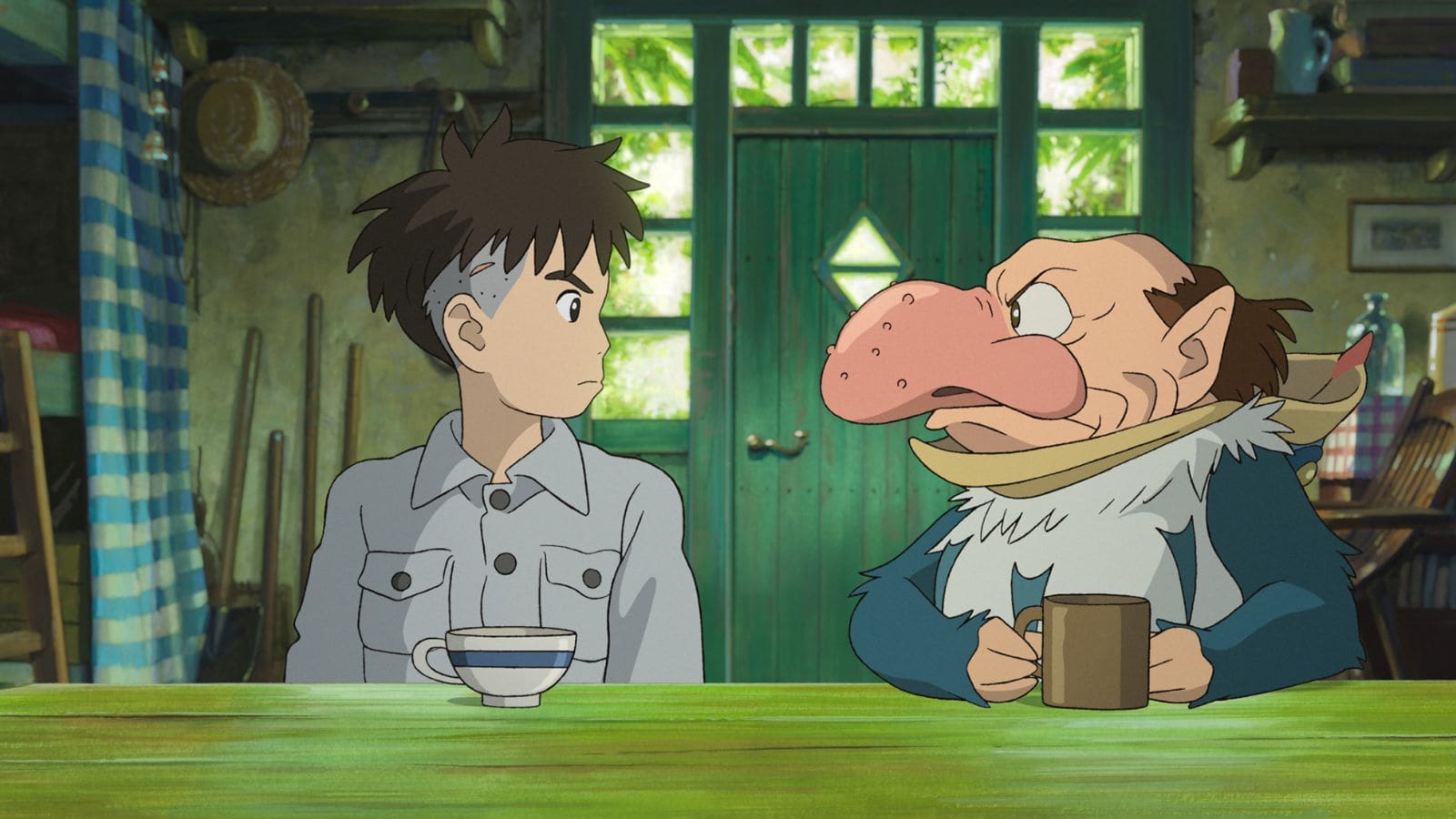
Tonally, The Boy and the Heron (retitled for Western audiences from the more evocative How Do You Live?) picks up at about where Miyazaki’s sinuous, subdued WWII drama The Wind Rises left off. Following his mother Hisako’s death in an Allied air raid, adolescent Mahito (Santoki Soma) and his father, Shoichi (Kimura Takuya), leave behind a fiery, war-torn Tokyo for the rolling greens of the countryside. As the two get settled with Natsuko (Kimura Yoshino)—Hisako’s younger sister, and Shoichi’s new wife—an otherworldly force begins beckoning Mahito to a dilapidated tower in the woods, claiming that his mother is alive inside.
Even in The Boy and the Heron’s uncharacteristically patient first act, which is, for the most part, shaped by the commingling of grief and domestic routine (a scene of Mahito silently bludgeoning his own head with a rock ranks among the rawest in Miyazaki’s canon), traces of the director’s usual preoccupations can be glimpsed at the margins. Shoichi, modeled after Miyazaki’s own father, is a munitions manufacturer, seemingly specializing in fighter plane canopies. In a film so nakedly concerned with how one, well, lives, especially when the world they’re inheriting is so impaired, this variation on an old theme—that is, violent perversion of aviation, something Miyazaki has returned to time and time again—feels especially foreboding.
Uneasier still is the revelation that the film’s tower in the woods—that dark, imposing gateway to a crumbling dreamland—was built by a man who “read too many books and went insane.” This description could be broadly applied to almost any creative consumed by their work, though it takes on acute meaning when applied to Miyazaki, a fervent humanist who, in his repeated efforts to better the world, has sequestered himself from it.
Now, nearing the end of his life, Miyazaki has taken stock of his own imagination, and seemingly deemed it insufficient. When Mahito does eventually cross the threshold, he finds a misbegotten facsimile of paradise, isolated and decaying in some walled-off corner of the universe. Here is where The Boy and the Heron loosens its reins and becomes one of the most free-associative and formally audacious films Miyazaki has ever helmed, deftly stringing together its beautiful, extravagant images with the relaxed logic of a child improvising their own bedtime story.
Flight is a unifying theme here, just as it is so much of Miyazaki’s work: This new world is populated with all manner of airborne species, many of them jostling for supremacy (a consequence, perhaps, of an overzealous creator). One of the film’s more inspired inventions is an army of fascistic parakeets, led by a king who, in more ways than one, resembles Mussolini. Everything in The Boy and the Heron’s setting has a history, everything is beholden to certain metaphysical dogmas, but the full contours of both are kept just out of reach. Instead, we bear witness only to the world’s end. Its building blocks, we learn, are plagued with impurities.
The true tragedy of The Boy and the Heron seems not to be that the blemishes of its fantasy mirror those of its reality, but that any one person should think themselves capable of sanitizing either. Miyazaki’s quest for global harmony was always going to end in failure, but only now does the full heft of that failure land, etched in the wide eyes of a boy who just wants his mother back. Nobody, not even our greatest artists, can cheat death. Watching this realization play out on screen here, seamlessly uniting an enormous sprawl of ideas both cosmic and terrestrial, is deeply moving and powerfully destabilizing. Yet the film’s tone remains hopeful to the end, suggesting that the Earth will keep spinning long after the old masters have left us.
Though The Boy and the Heron shares its Japanese title with a 1937 novel by Yoshino Genzaburo, the film is, pointedly, not an adaptation. Relatively straightforward, Yoshino’s How Do You Live? was written primarily to aid adolescent boys in developing a strong moral code. Miyazaki, though not immune to moralizing, chooses to interpret the title’s question as an open-ended one (perhaps, given his own reservations about his work, he feels ill-equipped to provide straightforward answers). His film is by no means amoral—any number of lessons can be wrung from its strange, occasionally opaque byways—but the sole directive it does explicitly verbalize is sweeping and nebulous. An aging master makes an impassioned plea to his progeny, saying, “There is work to be done.” And hurry, because in the blink of an eye, it’s all gone.
Since 2001, we've brought you uncompromising, candid takes on the world of film, music, television, video games, theater, and more. Independently owned and operated publications like Slant have been hit hard in recent years, but we’re committed to keeping our content free and accessible—meaning no paywalls or fees.
If you like what we do, please consider subscribing to our Patreon or making a donation.