
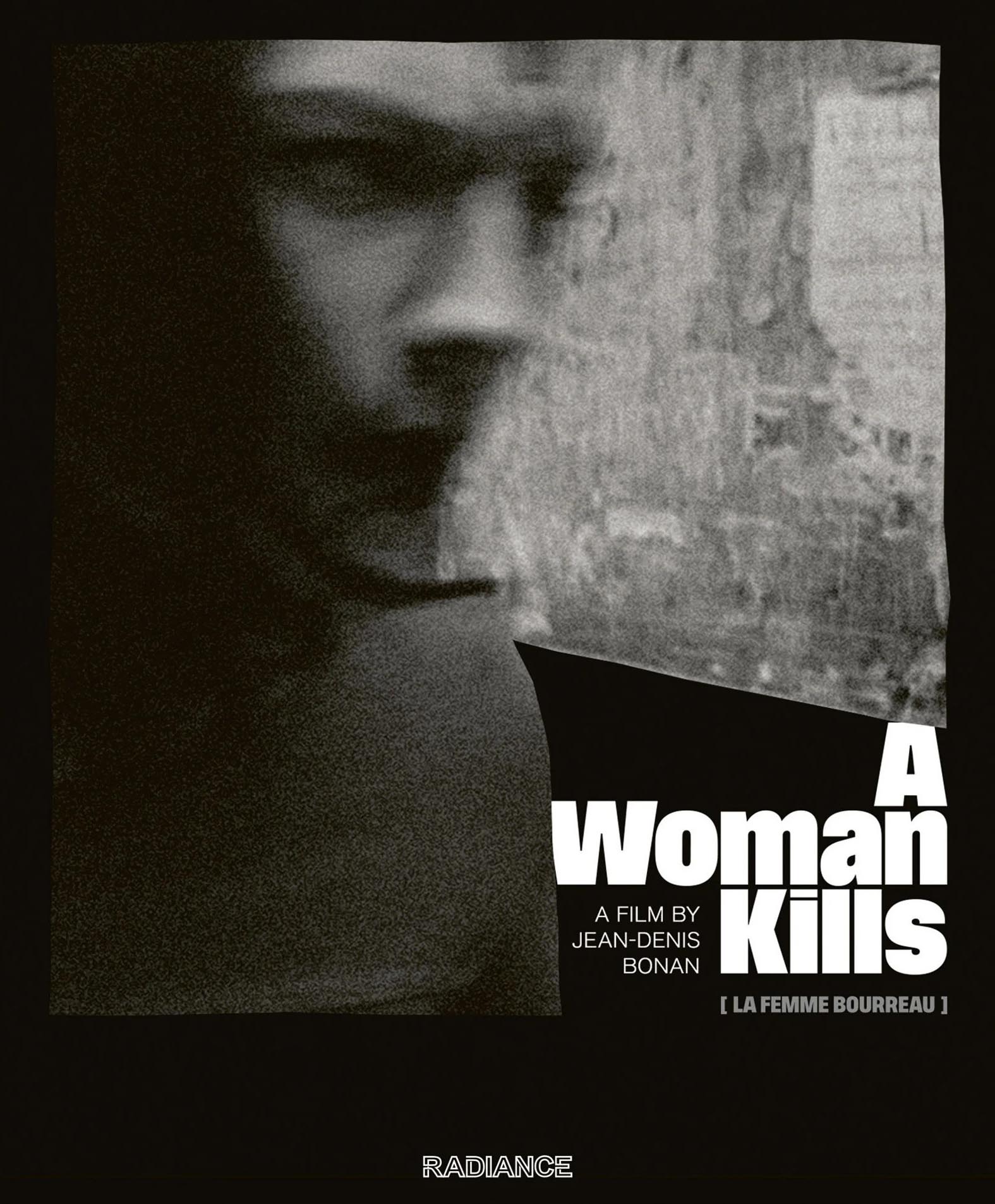
 Jean-Denis Bonan’s A Woman Kills is the recipient of some amazing cinematic grace, as it once was lost but now is found. The film was shot in 16mm on an exceedingly low budget during May 1968, amid the widespread labor strikes and student protests that roiled France at the time, a fractious backdrop that finds its way into the narrative. Because Bonan was unable to secure commercial distribution owing to the film’s radically experimental nature, it languished in a vault for 40 years, until it was finally resurrected for a 2010 screening at the Cinémathèque Française at the behest of filmmaker Jean-Pierre Bastid.
A Woman Kills ultimately proved unsellable because of its marginality. Not only was it made by a group of filmmakers who were disconnected from the dominate mode of French New Wave cinema, the film itself plays in the margins of different genres, incorporating elements of softcore, thriller, and documentary, without abiding by the rules of any of them. As if these sudden shifts in tone and generic register aren’t disorienting enough, Bonan incorporates a number of jauntily poetic songs written by Daniel Leloux that obliquely (and often ironically) comment on the unfolding action that they accompany.
The very title of the film toys with viewers. It’s not even a spoiler to reveal that the titular serial killer isn’t in fact a woman, since the culprit is clearly visible early on (and a cinch to guess anyway). What we have on our hands here is one Louis Guilbeau (Claude Merlin), a cross-dressing murderer with an abiding mother fixation. But rather than remain at the level of a psychological case history a la Alfred Hitchcock’s Psycho, A Woman Kills finds Bonan expanding his inquiry to incorporate social and even political aspects. Having been shaped into a killing machine during his military service in Algeria, Louis finds employment back home as an executioner, thus embodying the two primary perpetrators of state-sanctioned murder. Bonan takes pains to point out that PTSD and stress at work are just as responsible for Louis’s derangement as whatever childhood traumas he may have suffered.
The film takes on the characteristics of a quasi-surrealist tale of amour fou when it introduces Solange Lebas (Solange Pradel), a dedicated policewoman hot on the trail of the killer. Despite their adversarial positions (unbeknownst to Solange), the couple soon drift into a casual sexual relationship with all the guileless aplomb of the late-’60s free-love era. Bonan perversely opts to shoot their love scene in a distractingly abstract manner, but then again, he handles all of the film’s erotic encounters this way, effectively downplaying their titillation factor—none more so than a sex scene shot from below up through the metallic coils of the bedsprings.
The final act of A Woman Kills is a protracted chase through the ruined Parisian district of Bellville, the half-demolished buildings and rubbish-strewn thoroughfares serving as an objective correlative for Louis’s disintegrating psyche. The rooftop chases manage to combine generic thrills and a documentary verisimilitude in a manner not unlike Louis Feuillade’s pioneering silent crime serial Les Vampires. The documentary function is both played up, with footage shot during the May ’68 riots, but also playfully undercut by including faux “man on the street” interviews with members of Bonan’s own family (as revealed by the end credits).

The film’s tragic denouement, in which a dying Louis unburdens himself to Solange, receives a sardonic fillip: a freeze frame and title card that adumbrates her future history (likely a nod to the ironic final lines of Gustave Flaubert’s Madame Bovary). Viewers with an open mind and a taste for the avant-garde will be grateful for the rediscovery of A Woman Kills, a vital, thought-provoking, and frequently surprising time capsule from a tumultuous era.
Image/Sound
The 2K restoration of A Woman Kills by Radiance Films, sourced from original 16mm elements, looks really striking overall, especially considering the film’s low-budget, lo-fi provenance. In 1080p, Gérard de Battista’s moody monochrome cinematography looks wonderfully atmospheric. There’s some damage evident here and there, and grain can get a bit thick at times, but the recent polish reveals lots of fine details and nicely balanced contrast. The French LPCM two-channel mono track sounds terrific, gratifyingly delivering the often assaultive sound design, as well as the freewheeling free jazz score from composer Bernard Vitet.
Extras
A Woman Kills is viewable with an intro from film scholar Virginie Sélavy that does a fine job of placing the film in its historical and cinematic context. Sélavy returns to tag-team an insightful commentary track with editor and critic Kat Ellinger. Among the many topics discussed are the film’s relation to genre, Bonan’s association with horror maven Jean Rollin (who appears briefly in the film), serial killer films of the era, the film’s deployment of eroticism and sadomasochism, and the relationship between significant dates in the film and the unfolding events of May 1968.
A selection of Bonan’s early films is also included: The Short Life of Monsieur Meucieu, a surreal student film about the travails of amour fou, one of Bonan’s favorite subjects; A Crime of Love and Crazy Matthew, which portrays rural existence, jealousy, and murder plots; A Season with Mankind, which offers a disorienting counterpoint between newsreel footage and a poetic voiceover; and, easily the most outrageous of the lot, The Sadness of the Anthropophagi, a blasphemous, Buñuelian satire that was banned outright by French authorities.
Elsewhere, On the Margin: The Cursed Films of Jean-Denis Bonan—directed by Francis Lecomte, the French distributor who rescued the film—is an excellent documentary from 2015 that features Bonan and several of his collaborators talking about his early shorts, brushes with censorship, and the troubled genesis of A Woman Kills, as well as its ill-fated reception and subsequent rediscovery. Finally, the enclosed booklet features an essay from Catherine Wheatley on the film, Richard Thomas on the shorts, and an interview with Lecomte.
Overall
Radiance Films’s gritty, extras-laden Blu-ray release of Jean-Denis Bonan’s A Woman Kills brings much-needed attention to a once lost film from an often neglected filmmaker.
Since 2001, we've brought you uncompromising, candid takes on the world of film, music, television, video games, theater, and more. Independently owned and operated publications like Slant have been hit hard in recent years, but we’re committed to keeping our content free and accessible—meaning no paywalls or fees.
If you like what we do, please consider subscribing to our Patreon or making a donation.


