Orson Welles’s The Lady from Shanghai derives its tension from its almost pointed meaninglessness, which would appear to be a subterfuge for a personal expression that’s never quite achieved. Casual viewers barely familiar with Welles’s legend may see the comic noir as a charming diversion, while cinephiles will attempt to wrestle with it in the context of the auteur’s well-documented struggle to survive Hollywood on his own terms.
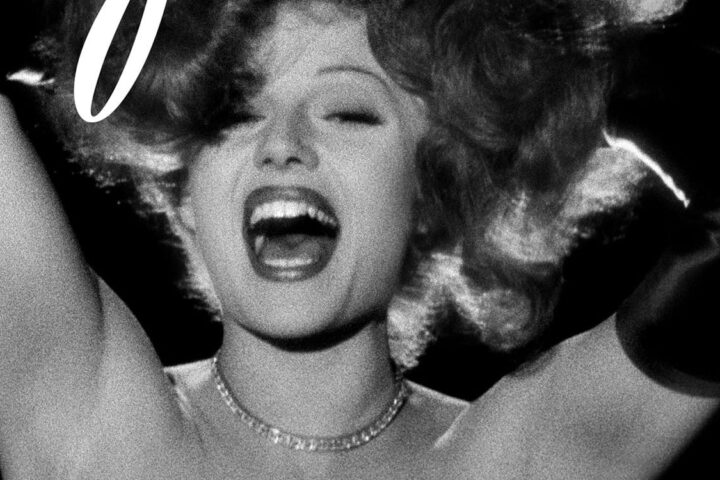
Like all of Welles’s films, The Lady from Shanghai comes with baggage, including the post-production tinkering that was unintended and uninvited, reportedly resulting in the trimming of nearly an hour of footage in an effort to move the narrative along at a more conventional clip. More personally, there’s the matter of Rita Hayworth, who cut and dyed her iconic gorgeous red locks to a short piercing blond ‘do at her estranged husband’s insistence—a move that according to rumor was intended by Welles to ruin her career. Which is to say that many ghosts haunt this initially misleadingly slim genre film, which is driven by a self-consciously frivolous wisp of a plot that could’ve been scribbled on a cocktail napkin by Welles while holding court with tales of his real-life adventures.
Welles plays Michael O’Hara, a wandering Irishman who’s suckered into the heart of the resentments brewing between the show-stoppingly beautiful Elsa (Hayworth) and her aging, handicapped husband, Arthur (Everett Sloane), who’s also—hint—a wealthy and powerful defense attorney. After meeting cute with the missus in the midst of a Central Park fistfight, Michael comes to work as a laborer on Arthur and Elsa’s boat as they make their way to San Francisco via the Panama Canal. En route, Michael encounters Arthur’s partner, George Grisby (Glenn Anders), a potentially devious man who seems to be forever on the verge of exploding The Lady from Shanghai’s steadily escalating sexual and classist tensions. Eventually, George comes out in the open with his intentions, proposing a murder plot to Michael that’s so laughably obvious in its intent on setting him up as the patsy that he can’t help but agree to participate. Because otherwise, of course, there would be no movie.
And what an overstuffed, wondrously weird movie it is. Retrospectively, The Lady from Shanghai plays as a sort of rough draft for Welles’s classic 1958 noir Touch of Evil, as it similarly operates as the audio-visual equivalent of a draftsman’s sketchbook, with the nearly incoherent plot serving as a springboard for a variety of self-contained vignettes, ostentatiously symbolic shots, motifs, and probable ideas for future Welles projects.
There’s the long commanding scene where Michael and Arthur discuss the benefits and perils of money that ends, in true Welles fashion, with the villain making the most sense. There’s the tranquil, baked-in sexual evil of the entire boat-trip sequence, which culminates in a ravishingly suggestive horizontal shot of a two-piece-clad Hayworth, and which appears to have later informed the tone of Roman Polanski’s feature debut, Knife in the Water. There’s the great absurd, phenomenally courtroom scene that climaxes with Arthur cross-examining himself, and, of course, there’s the legendary hall-of-mirrors shoot-out, which is known by people who haven’t even seen the film. And the cherry on top of this huge melting sundae is the dialogue at large, which is almost entirely composed of quotable only-in-the-movies luxury super-star bon mots: “You need more than luck in Shanghai”; “You’ve been traveling the world too much to find out anything about it”; “Everybody is somebody’s fool”; and so forth.
But if The Lady from Shanghai falls a little short of being a classic, it’s because it often coasts where Touch of Evil soars. Where the latter is charged by a bracing sense of autobiographical grandeur (in short, Welles’s desperation as an artist at the mercy of a hypocritical studio regime merged with the desperation of his socially entrapped characters), the former dissolves into a series of willfully eccentric “bits” in place of a governing personality.
Though likely a result of studio interference, too many shots in The Lady from Shanghai distractingly appear to be truncated, and so theoretically beautiful flowing compositions are broken down into inelegant montages consisting of the usual alternations of close-ups and medium and master shots. (The Stranger, a generally underrated Welles gem, is considerably more fluid.) And the film’s second half, in a manner reminiscent of Welles’s heavily re-edited The Magnificent Ambersons, collapses into a series of brief punctuations of incident that rush us through to the end of the story just as it appears to be gathering gravity and motivation. Watching this film is a peculiar experience: It’s affirming in its assertion that Welles could make art out of anything, and despairing in its palpable confirmation of that art’s compromise.
Image/Sound
Kino Lorber’s 1080p transfer of The Lady from Shanghai looks spectacular, leaps and bounds above the drab and overly dark Turner Classic Movies release from 2014. Kino’s disc is brighter, dual-layered (as opposed to TCM’s single layer), and boasts an optimal bitrate. Fine details really stand out; contrast looks well balanced; and grain never gets distractingly thick.
Audio comes in a Master Audio two-channel mono mix that sounds rich and full-bodied, cleanly delivering the often overlapping dialogue, as well as Heinz Roemheld’s score, which essentially consists of endlessly re-orchestrated versions of the song “Please Don’t Kiss Me,” which Rita Hayworth (or her voice double) performs at one point in the film, a producer-mandated nod to her showstopping “Put the Blame on Mame” number from Gilda.
Extras
Kino assembles an excellent roster of extras, some taken from earlier releases, while others are new to this disc. Carried over from the TCM Blu-ray, Eddie Muller, the “czar of noir,” offers about 20 minutes’ worth of comments on The Lady from Shanghai, which, for some reason, are broken up into three parts. In addition to relaying the often retold backstory about the film’s inception, Muller offers a personal spin on its merits and place within the film noir canon. And lifted from the 2000 Columbia DVD release, the conversation with and commentary by Peter Bogdanovich offer some delightful personal reminiscences from his time with Welles, while also delving into many aspects of The Lady from Shanghai’s production history.
New to the Kino Blu-ray are a nicely complementary pair of commentary tracks. In the first, critic Imogen Sara Smith points out the lack of director’s credit for Welles, covers The Lady from Shanghai’s troubled production and reception by the studio, indicates individual shots and sequences that were studio-mandated reshoots, and does a fine job of refuting readings of the film as a “kiss off” from Welles to Hayworth, his soon-to-be ex-wife. And in the second, novelist and critic Tim Lucas goes into The Lady from Shanghai’s distinctive deployment of sound and image, lauds Welles as a visual stylist, amusingly notes the absence of one of the false noses Welles typically favored, and outlines producer William Castle’s involvement (including a blink-and-you’ll-miss-it cameo). Lucas also delivers a fascinating excursus on author Sherwood King, the publication history of the source novel If I Die Before I Wake, earlier plans to adapt it to stage and screen, and significant differences between the book and the finished film.
Overall
Orson Welles’s funhouse mirror of a film noir gets a sterling new transfer as well as a fine roster of extras both old and new from KL Studio Classics.
Since 2001, we've brought you uncompromising, candid takes on the world of film, music, television, video games, theater, and more. Independently owned and operated publications like Slant have been hit hard in recent years, but we’re committed to keeping our content free and accessible—meaning no paywalls or fees.
If you like what we do, please consider subscribing to our Patreon or making a donation.