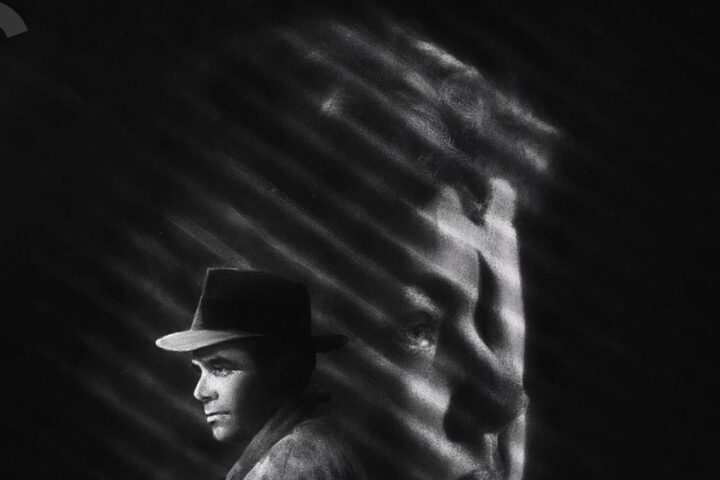
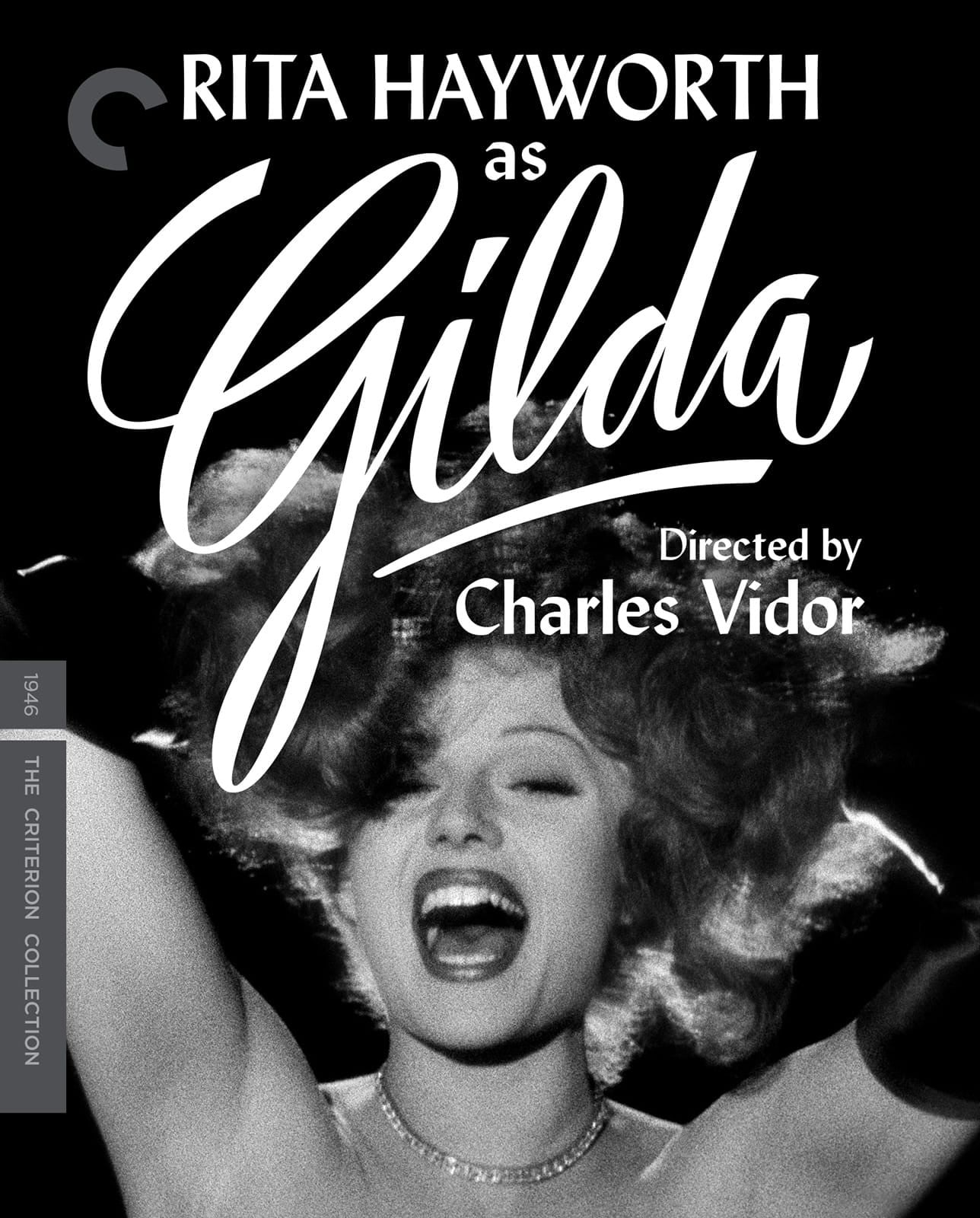
 In Jennifer Fay and Justus Nieland’s Film Noir: Hard-Boiled Modernity and the Cultures of Globalization, the authors make a case that the noir sensibility often “articulate[s] forms of emotional attachment beyond one’s country of origin” and that noir, though spawned by the machinations of the Hollywood studio system, belongs to the “aesthetic cultures of early-twentieth-century modernity.” Charles Vidor’s Gilda, with its Argentine setting and impulsive trio of friends-or-lovers, occupies the stated terrain by placing its eponymous bombshell between two men—both sexually frustrated, both concealing their impotence through deviant business practice—and having them not actually care too much about her beyond her commodity value as a trophy to shield their perpetually fractured egos.
Like Otto Preminger’s Laura, whose eponymous character is caught between three men (and a woman), Gilda questions the honesty of each character’s intentions by consistently revealing each person’s interests to be wholly self-serving. Furthermore, the film problematizes the face value of its narrative by doubling down on one double entendre after another, which reach vertiginous status once Johnny Farrell (Glenn Ford) is told, while being held in embrace by ex-flame Gilda (Rita Hayworth), that he’s out of practice…dancing, she means.
That Johnny flings Gilda to the side and jets away following the suggestion speaks to how Vidor understands the electric, sexual power that Gilda wields with such a line, where the humiliation is so great, so felt within the viscera, that extrication from the scene of the trauma is Johnny’s only possible response. In the moment, he’s psychologically defeated and made vulnerable to Gilda’s duplicities, that he literally cannot bear to be near her. That inclination—to flee the space—undergirds the entire film, not merely as a recurrent plot point, but almost as a philosophy, where borders, both national and spatial, govern one’s entire being. Johnny has plopped down in Buenos Aires to rig dice and card games, but he might as well have been spawned from thin air or—as we’re introduced to him—birthed from the floorboards.
When he’s saved by Ballin (George Macready) from a back-alley stick-up, Johnny hardly bothers to inquire how Ballin happened to find himself in such a place, given his fine dress and “little friend”—a cane concealing a switchblade. The encounter seems positively rigged, much like Johnny’s games, but the irony fails to dawn on the two-bit hustler, who’s more intrigued by Ballin’s monetary offers than his own endangerment at the hands of an actual criminal, one with the infrastructure to do far more than hustle on the floorboards of local dives.
Johnny is “no past and all future,” but it’s Gilda who shakes his convictions, appearing out of the past (and from under the screen) as an unmovable divide between himself and Ballin, with whom he’s far more in love. “Never mix women and gambling,” Ballin says early on, and the line persists throughout the film less as a misogynistic invective than an announcement of gendered, social preference for both men, who ensconce themselves in all-male environments.
Gilda’s “Put the Blame on Mame” number also speaks to Johnny’s anxieties that he could never have or handle that much woman, as he watches, anguished, from just off stage, but it’s also a primary source of the film’s simultaneous embrace and remove from Hayworth’s screen presence. Since the film invites viewer identification with Johnny, Gilda’s beauty comes to dominate every underlying motivation and action because of its pleasure-or-pain reminder.
The characters are certainly sadomasochistic (“Hate is a very exciting emotion,” says Ballin at one point), but the film suggests that audiences, too, must share in similar sources of conflicting desires given that no audience member can actually possess Gilda either. Much like Dana Andrews’s detective in Laura, who initially covets the eponymous woman through stories told and a painting, Johnny is forced into the role of impotent spectator. Gilda is best appreciated as an intelligent back and forth on the fantasy of possessing another.
Perhaps the film’s perspective on the battle of the sexes can be best summarized by Detective Maurice Obregon (Joseph Calleia), who introduces himself by saying that “women can be extremely annoying.” Later, when offering advice to Johnny following an arrest, he ponders, “How dumb can a man be?” It’s the contingency of these statements that fascinates, because the film rightly recognizes that every character is capable of actions that would qualify as “annoying” or “dumb,” but also that annoyance, on Gilda’s part, lies in the eye of the beholder. In the world of Gilda, and the greater spectrum of noir, it’s always about who’s watching.
Image/Sound
Gilda already looked great on the Criterion Collection’s 2016 Blu-ray, but this new 4K restoration further deepens the pools of black in the shadows, while intensifying the shimmer of Rita Hayworth’s lusciously wavy hair. The price of the upgrade is worth it alone for the iconic “Put the Blame on Mame” number, where Gilda’s silky black dress and gloves and sparkling diamond necklace have such texture and depth that Hayworth looks more gorgeous than ever. The audio is still the same uncompressed mono track as before, which was already more than robust enough in its presentation of the many musical numbers.
Extras
This new upgrade doesn’t include any new extras, but the excellent existing supplements already fulfill four of the five major areas any proper home-video release needs. The first is a commentary, recorded in 2010 by Richard Schickel, which provides scene-by-scene insight into the film’s production and some of its thematic through lines, though Schickel’s style is a little too laidback. Far less so is Eddie Muller, who provides a sparkling 20-minute interview that cuts right into the film’s potentially queer subtext, though for him this is a film where “the subtext is the plot.” Muller also wishes he had a time machine so that he could go back to 1946 and see audience reactions during the film’s initial run, primarily because he’s uncertain if audiences were clued into the now-obvious stand-ins for fellatio and other, disguised sexual banter.
Thirdly, we get an appealing appreciation by Martin Scorsese and Baz Luhrmann, who discuss the film’s influence on their careers in unsurprising ways; Scorsese manages to mention two dozen other films in the process, while Luhrmann says “love” and “melodrama” repeatedly. Fourthly, there’s an informative episode about Rita Hayworth from a 1964 television show called Hollywood and the Stars, narrated by Joseph Cotton. The only missing piece is an archival interview or two with any member of the cast and crew. A trailer and an essay by critic Sheila O’Malley titled “The Long Shadow of Gilda” round out this stellar disc.
Overall
Charles Vidor’s classic noir gets a sparkling 4k upgrade from the Criterion Collection that really showcases Rudolph Maté’s stunning cinematography.
Since 2001, we've brought you uncompromising, candid takes on the world of film, music, television, video games, theater, and more. Independently owned and operated publications like Slant have been hit hard in recent years, but we’re committed to keeping our content free and accessible—meaning no paywalls or fees.
If you like what we do, please consider subscribing to our Patreon or making a donation.